
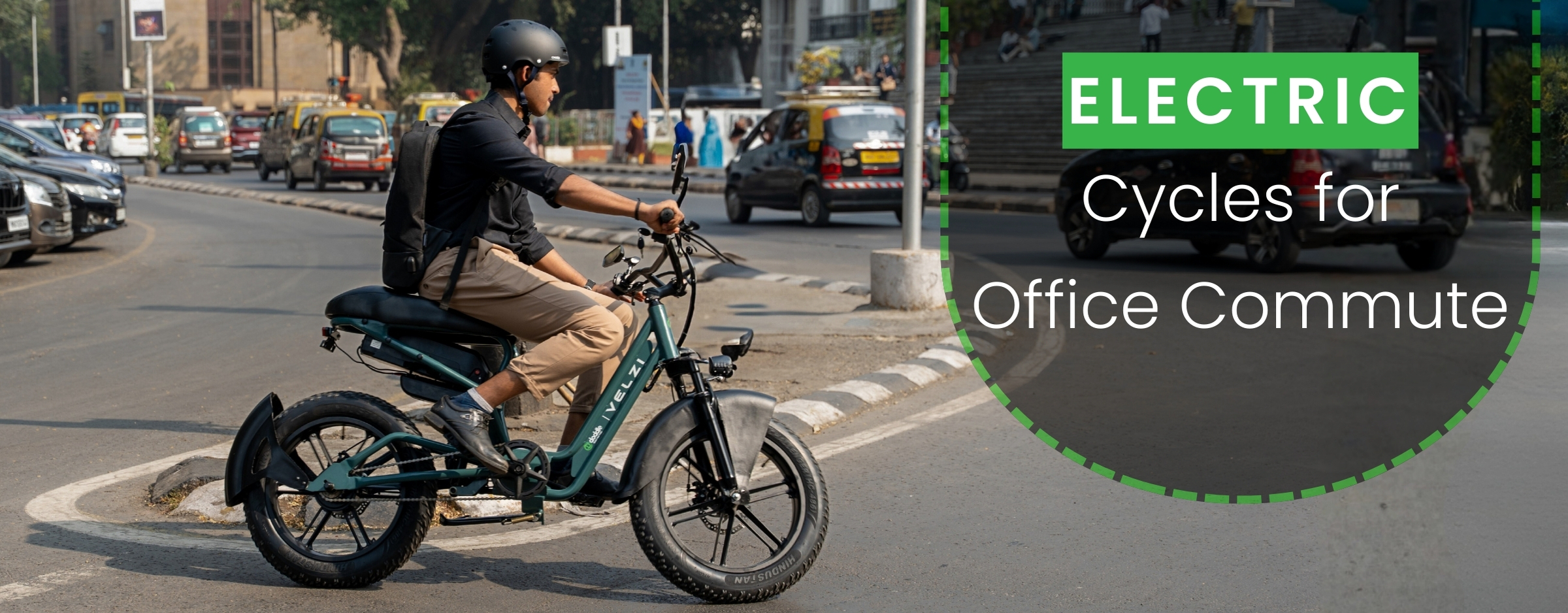
Electric cycles for office commutes are transforming how India’s workforce travels to work, offering a compelling alternative to cars, motorcycles, and public transportation. In 2026, with petrol prices hovering around ₹100-110 per liter and traffic congestion worsening across metro cities, the financial case for electric cycles has never been stronger. At Doddle, we’ve helped thousands of professionals calculate their potential savings, and the numbers consistently reveal substantial returns on investment within 12-24 months. Electric cycles such as Velzi by Doddle are designed specifically for these daily office commute scenarios, where comfort, reliability, and predictable costs matter more than speed or gimmicky features. This comprehensive analysis breaks down the true costs of various commuting options, provides detailed ROI calculations, and demonstrates why electric cycles represent not just an environmentally conscious choice, but a financially savvy one. Whether you’re spending hours in traffic or watching your fuel expenses climb month after month, this guide will help you understand the real economics of electric cycle commuting.
Why Are Electric Cycles for Office Commutes Gaining Popularity in 2026?
Electric cycles for office use have surged in popularity across Indian cities as professionals recognize the convergence of economic, health, and lifestyle benefits. The fundamental appeal lies in solving multiple pain points simultaneously-reducing commute costs, avoiding traffic congestion, incorporating exercise into busy schedules, and minimizing environmental impact.
Rising fuel costs make traditional commuting increasingly expensive. Petrol and diesel prices in 2026 remain volatile, with petrol averaging ₹105 per liter in major cities. For someone commuting 20 km daily in a two-wheeler delivering 40 km/l, monthly fuel costs alone exceed ₹1,500-₹1,800. Add maintenance, insurance, and parking fees, and the total reaches ₹3,000-₹4,000 monthly. Electric cycles dramatically reduce these expenses.
Traffic congestion robs professionals of productive time and mental energy. The average Bangalore commuter spends 45-60 minutes covering 10-15 km during peak hours. Mumbai, Delhi, Pune, and Hyderabad face similar challenges. Electric cycles navigate through traffic more efficiently, often cutting commute times by 20-30% while providing physical activity that improves health and reduces stress.
Government incentives make electric cycles more affordable. Several states offer subsidies of ₹5,000-₹15,000 under FAME II schemes for electric vehicle purchases. Combined with falling prices due to increased competition and manufacturing scale, the entry barrier has dropped significantly compared to just two years ago.
Corporate sustainability initiatives encourage employees to choose eco-friendly transportation. Many companies now provide secure bicycle parking, charging facilities, shower rooms, and even financial incentives for employees who bike to work. At Doddle, we partner with forward-thinking corporations to facilitate employee adoption programs that benefit both organizations and individuals.
How Much Does a Typical Car or Two-Wheeler Commute Actually Cost?
Electric cycles for office commutes deliver savings only when compared against current transportation costs. Let’s establish realistic baseline expenses for common commuting options in 2026, assuming a typical 10 km one-way commute (20 km daily, approximately 440 km monthly based on 22 working days).
Two-Wheeler (Petrol Scooter/Motorcycle) Monthly Costs:
Fuel Expenses: At 40 km/l efficiency and ₹105/liter petrol price, monthly fuel cost = 440 km ÷ 40 km/l × ₹105 = ₹1,155
Maintenance: Regular servicing, oil changes, brake pads, tire replacement averaged over the year = ₹400-₹600/month
Insurance: Comprehensive insurance typically ₹3,000-₹5,000 annually = ₹250-₹420/month
Parking Fees: Office parking (if charged) and public parking = ₹200-₹500/month
Depreciation: Often overlooked but real cost. A ₹80,000 scooter losing 15-20% value annually = ₹1,000-₹1,350/month
Total Monthly Cost: ₹3,000-₹4,000 (without depreciation: ₹2,000-₹2,700)
Four-Wheeler (Car) Monthly Costs:
Fuel Expenses: At 15 km/l efficiency and ₹105/liter petrol price, monthly fuel cost = 440 km ÷ 15 km/l × ₹105 = ₹3,080
Maintenance: Regular servicing, oil changes, tire rotation, brake service = ₹1,000-₹1,500/month
Insurance: Comprehensive insurance typically ₹15,000-₹25,000 annually = ₹1,250-₹2,100/month
Parking Fees: Office parking ₹1,000-₹3,000/month plus public parking
Depreciation: A ₹8,00,000 car losing 15% annually = ₹10,000/month
EMI (if applicable): Loan payment averaging ₹15,000-₹20,000/month
Total Monthly Cost: ₹16,000-₹27,000 (without EMI or depreciation: ₹5,500-₹8,000)
Public Transportation (Metro/Bus) Monthly Costs:
Daily Fare: Metro pass or daily bus tickets = ₹1,500-₹3,000/month
Auto/Cab for First/Last Mile: Additional ₹1,000-₹2,000/month
Total Monthly Cost: ₹2,500-₹5,000
These baseline costs reveal substantial monthly expenses most professionals accept as unavoidable. Electric cycles for office commutes challenge this assumption by offering dramatically lower operational costs.
What Are the True Costs of Owning and Operating an Electric Cycle?
Electric cycles for office use involve initial purchase costs and minimal ongoing expenses .At Doddle, commuter-focused models like Velzi fall within this practical price range, prioritizing durability, riding comfort, and low operating costs for everyday office travel. Understanding the complete financial picture enables accurate ROI calculation and comparison with traditional commuting options.
Initial Investment:
Purchase Price: Quality electric cycles suitable for daily office commutes range from ₹35,000-₹70,000 depending on features, battery capacity, and brand reputation. At Doddle, our most popular commuter models fall in the ₹40,000-₹55,000 range, balancing quality, performance, and value.
Accessories: Essential additions include helmet (₹800-₹2,000), lock (₹500-₹1,500), lights if not included (₹500-₹1,000), pannier or bag for laptop/belongings (₹1,000-₹3,000), and rain gear (₹1,000-₹2,000). Total accessories: ₹3,000-₹8,000.
Government Subsidy: Check your state’s FAME II implementation. Subsidies of ₹5,000-₹15,000 directly reduce purchase costs in eligible states.
Net Initial Investment: Typically ₹35,000-₹65,000 after subsidies and accessories.
Monthly Operating Costs:
Electricity for Charging: Assuming 40 km daily range, 500Wh battery capacity, and 85% charging efficiency. Daily consumption = 0.588 kWh. At ₹8/kWh residential electricity rate, daily cost = ₹4.70, monthly = ₹104. Even doubling this for conservative estimates yields only ₹200-₹250/month.
Maintenance: Electric cycles require minimal maintenance compared to petrol vehicles. Typical expenses include brake pad replacement (₹400-₹600 annually), tire replacement (₹800-₹1,200 annually), chain and drivetrain service (₹300-₹500 annually), and periodic tune-ups (₹500-₹1,000 annually). Averaged monthly: ₹150-₹250.
Insurance (Optional): While not legally required for electric cycles classified as bicycles, some owners choose voluntary coverage against theft and damage. Cost: ₹0-₹300/month depending on coverage.
Parking: Usually free at offices with bicycle parking. Even paid parking rarely exceeds ₹100/month.
Battery Replacement (Amortized): Batteries typically last 3-5 years or 800-1,000 charge cycles. Replacement cost ₹12,000-₹20,000. Amortized over 4 years = ₹250-₹420/month. However, this cost doesn’t occur monthly-just plan for it.
Total Monthly Operating Cost: ₹250-₹600 (or ₹500-₹850 if amortizing battery replacement)
The contrast between electric cycle operating costs (₹250-₹600) and traditional commuting expenses (₹2,000-₹8,000) reveals the source of substantial long-term savings.
How Do You Calculate ROI for Electric Cycles for Office Commutes?
Electric cycles for office use deliver return on investment through monthly savings compared to your current commuting method. Let’s calculate ROI using realistic scenarios based on 2026 costs and typical usage patterns.
Calculation Formula:
Monthly Savings = Current Commute Cost – Electric Cycle Operating Cost
Payback Period = Net Initial Investment ÷ Monthly Savings
Annual ROI = (Annual Savings – Annual Operating Cost) ÷ Initial Investment × 100%
Scenario 1: Replacing Two-Wheeler Commute
Current Cost: ₹3,000/month (excluding depreciation and EMI)
Electric Cycle Cost: ₹400/month (including amortized battery)
Monthly Savings: ₹2,600
Initial Investment: ₹50,000 (mid-range electric cycle with accessories)
Payback Period: 50,000 ÷ 2,600 = 19.2 months (approximately 1.6 years)
First Year Savings: ₹31,200 – ₹50,000 investment = Net cost ₹18,800
Second Year Savings: ₹31,200 (pure savings)
Third Year Savings: ₹31,200 (pure savings)
Three-Year Total Savings: ₹93,600 – ₹50,000 = ₹43,600 net benefit
Three-Year ROI: (93,600 – 50,000) ÷ 50,000 × 100% = 87.2%
Scenario 2: Replacing Car Commute (Short Distance)
Current Cost: ₹6,000/month (fuel, maintenance, parking-excluding EMI and depreciation)
Electric Cycle Cost: ₹400/month
Monthly Savings: ₹5,600
Initial Investment: ₹50,000
Payback Period: 50,000 ÷ 5,600 = 8.9 months (less than 9 months!)
First Year Savings: ₹67,200 – ₹50,000 = ₹17,200 net gain
Second Year Savings: ₹67,200 (pure savings)
Third Year Savings: ₹67,200 (pure savings)
Three-Year Total Savings: ₹201,600 – ₹50,000 = ₹151,600 net benefit
Three-Year ROI: (201,600 – 50,000) ÷ 50,000 × 100% = 303.2%
Scenario 3: Supplementing Public Transportation
Current Cost: ₹3,500/month (metro plus auto/cab for connectivity)
Electric Cycle Cost: ₹1,500/month metro + ₹400 electric cycle = ₹1,900 (using electric cycle for last-mile)
Monthly Savings: ₹1,600
Initial Investment: ₹45,000
Payback Period: 45,000 ÷ 1,600 = 28.1 months (approximately 2.3 years)
Three-Year Total Savings: ₹57,600 – ₹45,000 = ₹12,600 net benefit
These calculations demonstrate that electric cycles for office commutes typically pay for themselves within 9-28 months depending on what you’re replacing. The longer you use them, the greater your cumulative savings.
What Additional Benefits Beyond Direct Cost Savings Do Electric Cycles Provide?
Electric cycles for office travel deliver value extending beyond simple financial calculations. Quantifying these benefits provides a more complete ROI picture, even though they don’t appear as line items in budgets.
Time Savings:
Traffic congestion makes electric cycles faster than cars for commutes under 10-15 km in congested cities. Saving 15-30 minutes daily equals 5.5-11 hours monthly-time you can use for family, hobbies, or productivity. Valuing your time at even ₹500/hour translates to ₹2,750-₹5,500 monthly benefit not reflected in direct cost savings.
Health Benefits:
Regular cycling improves cardiovascular fitness, reduces stress, aids weight management, and boosts mental health. The monetary value is difficult to quantify precisely, but consider gym membership costs (₹2,000-₹5,000/month) you might save by incorporating exercise into commuting. Additionally, improved health potentially reduces medical expenses and sick days over time.
Parking Convenience:
Electric cycles park anywhere bicycles do-usually right at building entrances rather than distant parking lots. This convenience saves walking time and eliminates parking search frustration that wastes 5-15 minutes per trip.
Environmental Impact:
While not directly financial, environmental benefits hold real value. An electric cycle replacing car commutes prevents approximately 1-1.5 tons of CO₂ emissions annually. Many professionals find satisfaction in reducing their carbon footprint, a benefit that carries psychological value even without monetary translation.
Stress Reduction:
Avoiding traffic jams, crowded public transportation, and parking challenges significantly reduces commuting stress. The mental health benefits of pleasant, active travel versus frustrating car commutes contribute meaningfully to quality of life, even if they don’t show up in cost-benefit analysis.
According to Doddle’s user surveys, 78% of electric cycle commuters report improved overall wellbeing, with 65% specifically noting reduced stress levels. These qualitative benefits complement the quantitative financial advantages.
How Does Weather and Seasonal Variation Affect Electric Cycle Commuting Economics?
Electric cycles for office use face practical challenges during monsoons and extreme weather that impact ROI calculations. Honest assessment requires considering these seasonal limitations and their financial implications.
Most Indian cities experience 3-4 months of significant monsoon rainfall. During heavy rain, electric cycle commuting becomes impractical or uncomfortable despite rain gear. Similarly, extreme summer heat (above 40°C) can make cycling challenging during midday hours.
Realistic Usage Assumption: Most electric cycle commuters use their bikes 8-10 months fully and 6-8 months partially, averaging about 60-70% annual utilization. During challenging weather, they fall back to alternative transportation.
Financial Impact: If you budget ₹1,500/month for backup transportation during 3-4 monsoon months, annual backup cost = ₹4,500-₹6,000. This reduces annual savings from ₹31,200 (replacing two-wheeler) to ₹25,200-₹26,700, extending payback period from 19 months to approximately 22-24 months.
Mitigation Strategies:
- Quality rain gear enables riding in moderate rain, extending usable days
- Adjusting work schedule to avoid peak heat or rain improves comfort
- Combining electric cycles with public transportation creates hybrid approaches
- Some employers offer flexible timing for bicycle commuters
Even accounting for seasonal limitations, electric cycles for office travel deliver substantial ROI. The key is realistic planning rather than assuming 100% replacement of current transportation.
What Are Common Mistakes People Make When Calculating Electric Cycle ROI?
Electric cycles for office commuting can disappoint if expectations don’t match reality. Avoiding these common calculation mistakes ensures accurate ROI projections and informed purchasing decisions.
Mistake 1: Comparing Against Variable Costs Only
Many calculations compare electric cycle costs only against fuel expenses, ignoring insurance, maintenance, and depreciation. This underestimates savings and inflates payback periods. Always compare total operating costs, not just fuel.
Mistake 2: Underestimating Electric Cycle Expenses
Some calculations assume zero maintenance or ignore eventual battery replacement. While electric cycle operating costs are low, they’re not zero. Budget ₹400-₹600 monthly including amortized battery replacement for realistic projections.
Mistake 3: Overestimating Usage
Assuming 100% replacement of current transportation rarely happens. Weather, occasional long trips, carrying heavy loads, or transporting multiple people require backup options. Plan for 60-80% usage rates for realistic expectations.
Mistake 4: Ignoring Accessories and Setup Costs
First-time cyclists need helmets, locks, bags, rain gear, and possibly safety equipment. These add ₹3,000-₹8,000 to initial investment. Forgetting these costs creates budget surprises.
Mistake 5: Not Accounting for Battery Degradation
Batteries gradually lose capacity over years. A battery providing 50 km range when new might deliver only 40 km after 2-3 years. This doesn’t necessarily require immediate replacement but affects usability and should factor into long-term planning.
Mistake 6: Failing to Value Time Appropriately
Some focus solely on rupee costs while ignoring time savings. If electric cycles save 30 minutes daily, that’s 11 hours monthly-significant value even if unpaid time.
At Doddle, we provide realistic ROI calculators that help prospective buyers avoid these pitfalls by incorporating conservative assumptions and real-world usage patterns. Accurate projections lead to satisfied customers who achieve expected returns.
How Can Corporate Partnerships and Incentives Improve Electric Cycle ROI?
Electric cycles for office commutes become even more attractive when employers support adoption through incentive programs and infrastructure. Progressive companies recognize that employee bicycle programs deliver organizational benefits including reduced parking demand, improved employee health, enhanced sustainability credentials, and positive corporate culture.
Common Corporate Support Programs:
Purchase Subsidies: Some companies subsidize electric cycle purchases by ₹5,000-₹20,000, dramatically reducing employee initial investment and shortening payback periods.
Interest-Free Loans: Employers offer payroll-deducted loans for electric cycle purchases, eliminating upfront cost barriers while allowing employees to benefit from monthly savings immediately.
Reimbursement Programs: Companies pay per-kilometer reimbursement (₹2-₹5/km) for bicycle commuting, similar to car travel allowances. This converts electric cycle commuting into income source rather than just cost savings.
Infrastructure Investment: Providing secure parking, charging stations, shower facilities, and changing rooms removes practical barriers and makes cycling more appealing.
Health Insurance Discounts: Some insurers offer premium reductions for employees who maintain active lifestyles, including regular cycling.
Wellness Incentives: Participation in corporate wellness programs with monetary rewards for cycling frequency and distance covered.
If your employer doesn’t currently offer bicycle support, consider proposing a program. Many companies are receptive to low-cost initiatives that align with sustainability goals and employee wellness. According to Doddle’s corporate partnerships, every ₹1 invested in bicycle infrastructure yields ₹3-₹5 in benefits through reduced parking costs, lower health insurance claims, and improved productivity.
What’s the Environmental ROI of Choosing Electric Cycles for Office Commutes?
Electric cycles for office use deliver environmental returns that complement financial benefits. While personal motivation varies, understanding environmental impact helps frame the complete value proposition.
Carbon Emissions Reduction:
Two-Wheeler Replacement: A petrol scooter emitting approximately 60-70g CO₂/km. Daily 20 km commute = 1.2-1.4 kg CO₂. Monthly = 26-31 kg. Annually = 312-372 kg CO₂ prevented.
Car Replacement: Cars emit 120-150g CO₂/km. Daily 20 km commute = 2.4-3.0 kg CO₂. Monthly = 53-66 kg. Annually = 636-792 kg CO₂ prevented.
Electric cycles charged from India’s electricity grid (with its coal component) produce approximately 15-20g CO₂/km equivalent-85-90% reduction compared to petrol vehicles.
Resource Conservation:
Beyond emissions, electric cycles reduce petroleum consumption, decrease demand for fossil fuel infrastructure, minimize particulate and noise pollution, and require fewer raw materials for manufacturing and maintenance compared to cars or motorcycles.
Monetary Value of Environmental Impact:
Carbon credits trade at ₹1,500-₹2,500 per ton in various markets. Using conservative ₹2,000/ton, an electric cycle preventing 0.6 tons CO₂ annually represents ₹1,200 environmental value. While you don’t directly receive this money, it represents real global cost savings from reduced climate impact.
Many professionals find that environmental benefits strengthen their commitment during challenging weather or when tempted to revert to motor vehicles. The knowledge that each ride prevents pollution and conserves resources provides motivation beyond pure economics.
Making the Switch: Your Action Plan for Electric Cycle Commuting
Electric cycles for office travel offer compelling financial returns backed by health, environmental, and lifestyle benefits. If the ROI calculations resonate with your situation, here’s how to proceed with confidence:
Step 1: Audit Your Current Commute Costs – Track actual spending for one month including fuel, parking, maintenance, and hidden costs. This baseline enables accurate savings calculation.
Step 2: Test Ride Multiple Electric Cycles – Visit Doddle or other reputable dealers to test various models. Ensure comfort, adequate range, and features matching your needs before committing.
Step 3: Calculate Your Specific ROI – Use your actual costs, realistic usage assumptions (60-80% replacement), and complete investment figures including accessories.
Step 4: Plan for Weather Challenges – Identify backup transportation for monsoon months. Budget for this realistically rather than being surprised.
Step 5: Check Employer and Government Incentives – Research available subsidies, corporate programs, and tax benefits that reduce initial investment.
Step 6: Invest in Quality Accessories – Don’t compromise on safety. Quality helmet, lights, lock, and rain gear protect your investment and ensure enjoyable riding.
Step 7: Start Gradually – Begin with 2-3 days weekly if hesitant about full commitment. Build confidence and habits before increasing frequency.
Step 8: Track Your Savings – Monitor actual expenses and savings monthly. Seeing concrete results reinforces the decision and motivates continued use.
The transition to electric cycle commuting represents more than financial optimization-it’s a lifestyle choice that delivers monetary, health, and environmental dividends. The numbers prove the economic case; the experience proves the quality-of-life improvements.
Frequently Asked Questions About Electric Cycle Commuting ROI
Q: What’s the typical payback period for an electric cycle used for office commuting?
A: Payback periods typically range from 9-28 months depending on what transportation you’re replacing and your commute distance. Replacing car commutes yields the fastest payback (9-15 months) due to substantial fuel and parking savings. Replacing two-wheelers requires 15-24 months. Supplementing public transportation takes longest at 24-36 months. Most electric cycle commuters achieve positive ROI within two years, with cumulative savings growing significantly in years three through five.
Q: Do electric cycles really save money if I need backup transportation during monsoons?
A: Yes, even accounting for backup transportation during 3-4 monsoon months, electric cycles deliver strong ROI. If you budget ₹1,500/month for monsoon backup (auto/cab or temporary public transportation), annual cost is ₹4,500-₹6,000. This reduces annual savings from ₹31,200 (replacing two-wheeler) to ₹25,200-₹26,700-still substantial. The key is budgeting for backup transportation in your calculations rather than assuming 100% replacement year-round.
Q: How much should I budget annually for electric cycle maintenance?
A: Budget ₹2,000-₹3,500 annually for typical maintenance including brake pad replacement, tire replacement every 18-24 months, chain and drivetrain service, periodic tune-ups, and minor adjustments. This averages ₹165-₹290 monthly. Additionally, plan for battery replacement every 3-5 years at ₹12,000-₹20,000, which amortizes to ₹250-₹420 monthly. Total realistic monthly budget including amortized battery: ₹400-₹700. This remains dramatically lower than petrol vehicle maintenance of ₹1,500-₹3,000+ monthly.
Q: Are there tax benefits or deductions for purchasing electric cycles for commuting?
A: As of 2026, electric cycles classified as bicycles (motor up to 250W, speed up to 25 km/h) don’t qualify for most motor vehicle tax deductions. However, check these opportunities: State-level FAME II subsidies of ₹5,000-₹15,000 directly reduce purchase cost. Some employers offer pre-tax salary sacrifice schemes for bicycle purchases. Self-employed professionals might deduct electric cycles as business expenses if used for work travel-consult a tax professional. Corporate wellness programs sometimes offer tax-advantaged reimbursements. While not as generous as electric vehicle tax benefits, available incentives meaningfully reduce net investment.
Q: What’s a realistic commute distance range for daily electric cycle use?
A: Most electric cycle commuters find 5-15 km one-way (10-30 km round trip) ideal for daily use. This distance allows completing the commute in 25-60 minutes depending on traffic, terrain, and fitness level while staying within comfortable battery range. Shorter commutes (under 5 km) still benefit from electric cycles but deliver less dramatic time savings. Longer commutes (15-20+ km) remain feasible but require higher-capacity batteries, more time commitment, and greater physical fitness. At Doddle, our customer data shows 10 km one-way as the median office commute distance for electric cycle users.
Q: How does electric cycle commuting ROI compare to buying an electric scooter or motorcycle?
A: Electric scooters cost ₹70,000-₹150,000 initially-2-3× more than quality electric cycles. While operating costs are similarly low (electricity only), the higher initial investment extends payback periods by 12-24 months. Electric cycles offer advantages in parking convenience, health benefits through physical activity, no licensing/registration requirements, and lower insurance costs (often zero). Electric scooters excel for longer commutes (15-30 km), higher speeds, and weather protection. For typical urban commutes under 15 km where traffic congestion limits speeds anyway, electric cycles deliver better overall ROI and value proposition.
Ready to calculate your personal savings and make the switch to smarter commuting? Visit Doddle to explore our range of office-commute-ready electric cycles. Our team will help you calculate your specific ROI, choose the perfect model for your needs, and show you how much you’ll save each month. Start your journey toward financial savings, better health, and sustainable transportation today!