
Foldable vs Non-Foldable E-Bikes: Ultimate Guide for Indian Metro Cities
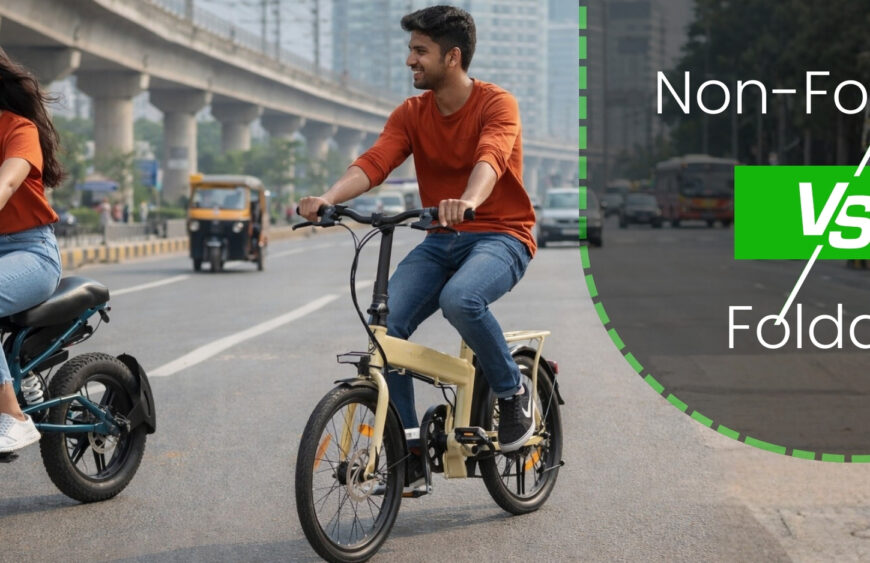
As Indian metro cities continue to struggle with traffic congestion, rising fuel costs, and limited parking space, electric bicycles have emerged as a practical solution for daily commuting. However, one common confusion among urban commuters is choosing between foldable and non-foldable electric cycles.
While foldable e-bikes are often marketed as the ultimate urban solution, real-world Indian commuting conditions tell a more nuanced story. In cities like Mumbai, Bangalore, Delhi, Pune, and Hyderabad, factors such as road quality, commute distance, storage reality, and daily convenience play a much bigger role than just portability.
This detailed guide compares foldable vs non-foldable e-bikes across comfort, practicality, cost, durability, and Indian metro-city realities-helping you choose the format that actually fits your daily life.
What Are Foldable E-Bikes?
Foldable e-bikes are electric bicycles designed with a collapsible frame that allows the bike to be folded into a more compact form for storage or transportation. The core idea behind a foldable e-bike is portability-making it easier to manage space constraints in dense urban environments.
When folded, these bikes can theoretically be:
- Carried indoors and stored in apartments or offices
- Placed in a car boot for short trips
- Transported alongside public transport in certain situations
From an engineering standpoint, foldable e-bikes rely on hinges, clamps, and locking mechanisms integrated into the frame. These components allow the frame to fold at one or more points, typically near the main tube and handlebar stem. To keep weight manageable, foldable e-bikes usually use compact geometry and smaller components.
Typical characteristics of foldable e-bikes include:
- Smaller wheel sizes, generally between 14 and 20 inches, to reduce overall folded dimensions
- Folding hinges and safety locks that secure the frame in riding position
- Compact riding geometry, often with a shorter wheelbase
- Moderate battery capacities, chosen to balance range with weight and portability
While foldable e-bikes are commonly marketed as “city-friendly,” their real-world usefulness depends heavily on how often the rider actually needs to fold the bike. If folding is required only occasionally, the benefits can feel limited compared to the compromises in ride comfort and long-term durability that compact designs sometimes bring.
What Is a Non-Foldable E-Bike?
Non-foldable e-bikes use a fixed-frame design, similar to traditional bicycles, with electric assistance integrated into the drivetrain. Instead of optimizing for portability, these bikes prioritize ride quality, structural strength, and everyday usability, making them better suited for frequent and longer rides.
Because the frame does not need to fold, non-foldable e-bikes can be engineered with:
- Stronger frame geometry
- Better weight distribution between the rider, motor, and battery
- Fewer mechanical joints that experience stress over time
Non-foldable commuter e-bikes typically feature:
- Robust fixed frames designed to handle daily riding on uneven roads
- Wheel sizes ranging from 20 to 29 inches, offering better stability and smoother rolling over potholes and speed breakers
- Comfort-oriented seating geometry, with wider saddles, better handlebar reach, and upright posture
- Improved weight balance, especially important when carrying bags or riding in traffic
- Fewer mechanical stress points, which reduces long-term maintenance needs
From a usage perspective, non-foldable e-bikes are designed for riders who:
- Commute regularly, often five or more days a week
- Ride on real-world urban roads rather than ideal surfaces
- Value comfort and stability over compact storage
Because they eliminate folding mechanisms, non-foldable e-bikes generally offer greater ride confidence, better durability, and a more natural cycling experience-especially important for Indian metro cities where road conditions can be unpredictable.
Why Foldable E-Bikes Are Often Considered for Indian Metro Cities in 2026?
Foldable e-bikes are frequently promoted as an ideal solution for Indian metro cities because they attempt to address some genuine urban challenges-especially space constraints, short-distance travel, and mixed-mode commuting. In theory, they offer flexibility that traditional bicycles and motor vehicles struggle to match.
First-Mile and Last-Mile Connectivity
One of the strongest arguments in favor of foldable e-bikes is their potential role in first-mile and last-mile commuting. In cities like Pune, Hyderabad, Chennai, and parts of Bangalore, metro stations and bus stops are often located several kilometres away from residential or office areas.
Foldable e-bikes are positioned as a bridge for these short distances, allowing riders to:
- Cover the gap between home and public transport
- Avoid dependence on autos or cabs
- Reduce waiting time and surge pricing
When used this way, foldable e-bikes can theoretically improve commute efficiency-provided public transport policies allow their use.
Space Constraints in Urban Living
Space is a real constraint in Indian cities. Many apartment complexes and offices:
- Lack dedicated bicycle parking
- Restrict bicycles in common areas
- Have limited storage inside homes
Foldable e-bikes attempt to solve this by collapsing into a smaller footprint that can:
- Fit inside apartments
- Be placed under office desks
- Be stored in corners without occupying permanent space
This indoor storage also reduces theft risk, as the cycle doesn’t need to be left unattended outdoors. For riders who truly lack parking options, this portability can be valuable.
Daily Usage Reality: Folding Sounds Easy, Until You Do It Every Day
While foldable e-bikes sound highly convenient on paper, daily usage often tells a different story-especially for people commuting five days a week.
Foldable E-Bikes in Everyday Practice
- Folding and unfolding may take 20–30 seconds, but this happens twice daily, every workday
- Hinges must be aligned correctly and locked securely each time
- Dust, rain, and road grime common in Indian cities can make folding mechanisms stiffer over time
- Regular inspection is required to ensure safety and frame integrity
In practice, many riders gradually stop folding their bikes unless absolutely necessary. The folding feature becomes an occasional-use benefit, not a daily convenience.
Non-Foldable E-Bikes in Everyday Practice
Non-foldable e-bikes eliminate this extra layer of effort entirely:
- Park the bike and walk away
- No hinges, locks, or alignment steps
- Fewer moving structural parts to maintain
For daily office commuters, this simplicity translates into:
- Faster departures
- Less mental load
- A more predictable, hassle-free routine
What This Means for Daily Commuters
For riders commuting five days a week, especially on fixed routes with known parking or storage options, simplicity often outweighs theoretical portability. What initially feels like a clever feature can become an inconvenience when repeated daily.
Foldable e-bikes make sense when folding is truly required. When it isn’t, the additional steps can feel unnecessary.
Car Boot Reality: Foldable Bikes Still Occupy Most of the Space
Foldable e-bikes are often marketed as “easy to carry in your car,” creating the impression that they integrate seamlessly with car travel. While this can be true in limited situations, the real-world experience for most Indian users is far more constrained.
Foldable E-Bikes in a Car Trunk: The Practical Reality
Even when folded, most electric foldable bikes:
- Weigh 18–25 kg, making them bulky and difficult to lift repeatedly
- Occupy a large portion of a hatchback’s boot, especially in popular Indian cars like i10, Swift, Baleno, Nexon, or Punch
- Leave very little usable space for:
- Luggage
- Grocery bags
- Strollers or suitcases
- Office or travel essentials
In many cases, placing a folded e-bike in the boot means the boot is effectively dedicated to the bike alone. This limits practicality for:
- Airport runs
- Weekend travel
- Family use
Additionally, lifting a heavy folded e-bike in and out of the boot-often at awkward angles-can become inconvenient, especially for daily or frequent use.
How Often Do People Actually Transport Bikes in Cars?
In reality, most daily commuters:
- Do not load their cycle into a car regularly
- Use their e-bike primarily for point-to-point commuting
- Rely on the cycle itself as the transport, not as an accessory to car travel
For these users, the ability to fit a bike into a car boot becomes a rare-use feature, not a daily advantage. When weighed against ride comfort, stability, and ease of use, this benefit often ranks low in long-term importance.
Non-Foldable E-Bikes in Comparison
Non-foldable e-bikes are not designed for frequent car transport, but this aligns well with how most commuters actually behave. Instead of planning around car integration, they:
- Are parked at offices, residential complexes, or bicycle stands
- Serve as the primary commuting vehicle, not a secondary one
For most urban users, this reflects a more realistic usage pattern.
Public Transport Reality in Indian Metro Cities
Another common assumption is that foldable e-bikes integrate smoothly with metro and public transport systems. In theory, foldability should make this easy. In practice, India’s public transport policies are not yet aligned with this expectation.
Current Metro System Policies (2026)
Across major Indian metro cities:
- Most metro systems do not allow bicycles, whether folded or unfolded
- Some permit foldable cycles only during limited off-peak hours
- Rules vary significantly between cities-and even between stations
- Final permission often depends on on-ground security staff discretion, not written policy
This inconsistency creates uncertainty for daily commuters.
What This Means in Real Life
Because permissions are unpredictable:
- Riders cannot reliably plan daily commutes around metro integration
- Carrying a foldable bike to a station only to be denied entry is frustrating
- Commute stress increases instead of decreasing
As a result, many riders stop attempting metro integration altogether, even if they own a foldable bike.
The Current Limitation of Multi-Modal Commuting
Until Indian metro systems adopt:
- Clear, uniform policies
- Dedicated bicycle access rules
- Infrastructure designed for cycles
Foldability alone does not guarantee seamless multi-modal commuting. The theoretical advantage exists, but practical execution remains limited.
Ride Comfort and Stability on Indian Roads
Indian metro roads present a unique combination of challenges-potholes, uneven surfaces, speed breakers, mixed traffic, and frequent stop-and-go riding. In this environment, ride comfort and stability directly affect daily usability, not just riding pleasure.
Foldable E-Bikes
Foldable e-bikes typically rely on smaller wheels and compact geometry to achieve portability. While this helps reduce folded size, it introduces compromises in ride quality.
In real-world Indian conditions:
- Smaller wheels struggle more with potholes, broken patches, and rough tarmac
- A shorter wheelbase can feel less stable at higher speeds or during sudden braking
- Compact geometry may feel twitchy or nervous in dense traffic, especially for new riders
- Riders experience more road feedback, leading to quicker fatigue on longer rides
Because of these characteristics, foldable e-bikes are generally better suited for:
- Short distances
- Relatively smooth roads
- Occasional or low-frequency riding
Non-Foldable E-Bikes
Non-foldable e-bikes prioritize ride stability and comfort over compact storage. Designs with 20-inch wheels, especially wider or fat-tire setups, strike a practical balance for metro cities.
Advantages in Indian road conditions include:
- Greater stability compared to very small wheels
- Improved shock absorption, reducing impact from potholes and speed breakers
- Better balance in traffic, especially during frequent stops and turns
- More predictable handling, which builds rider confidence over time
These factors make non-foldable e-bikes more suitable for:
- Daily office commutes
- Longer riding distances
- Congested urban traffic
- Riders who value comfort and control
For Indian roads, ride stability consistently proves more important than compactness.
Durability and Long-Term Ownership
When evaluating an electric cycle, long-term durability matters as much as initial comfort-especially for commuters riding five days a week over several years.
Foldable E-Bikes
Foldable e-bikes introduce additional mechanical complexity through:
- Hinges
- Locking clamps
- Folding joints
Over time:
- These joints become natural wear points
- Regular inspection and tightening are essential
- Exposure to dust, rain, and rough roads accelerates wear
- Structural integrity depends heavily on maintenance discipline
For riders who skip regular checks, long-term durability can be affected sooner than expected.
Non-Foldable E-Bikes
Non-foldable e-bikes benefit from simpler, fixed-frame construction:
- Fewer moving structural parts
- Lower mechanical stress over time
- Better resistance to vibrations from rough roads
- More forgiving in real-world Indian usage
This simplicity translates into:
- Fewer unexpected issues
- Lower maintenance effort
- Greater peace of mind for daily commuters
For 3–5 years of regular commuting, simpler construction typically results in more reliable ownership.
Legal and Regulatory Considerations in India
From a legal standpoint, foldable and non-foldable e-bikes are treated exactly the same under current Indian regulations.
Both formats are classified as bicycles if they meet the following conditions:
- Motor power ≤ 250W
- Maximum assisted speed ≤ 25 km/h
Under this classification:
- No driving license is required
- No vehicle registration is required
- No mandatory insurance is required
- Both are legally permitted wherever bicycles are allowed
As of 2026, there is no regulatory advantage to choosing a foldable e-bike over a non-foldable one.
Which One Should You Choose? (Honest Decision Guide)
Choosing between a foldable and a non-foldable e-bike ultimately comes down to how you will use the cycle in your daily life, not how it is marketed. Both formats can work well-but only in the right context.
Choose a Foldable E-Bike if:
A foldable e-bike makes sense when portability is a necessity, not a convenience.
You should consider a foldable e-bike if:
- You must carry the cycle indoors every day, with no alternative parking or storage
- Storage space at home or office is extremely limited
- You ride occasionally, rather than every working day
- Your commute is short, predictable, and relatively smooth
- You are comfortable folding and unfolding the bike daily and carefully
- You expect to combine cycling with other transport modes when permitted
In these scenarios, the compromises in ride comfort and durability may be acceptable in exchange for compact storage.
Choose a Non-Foldable E-Bike if:
A non-foldable e-bike is the better choice when daily comfort, reliability, and simplicity matter more than compactness.
You should choose a non-foldable e-bike if:
- You commute almost every working day
- Comfort and ride stability are important to you
- You ride on real-world Indian city roads, including uneven surfaces and traffic
- You prefer a park-and-go routine without extra steps
- You want lower long-term maintenance effort
- You value durability and peace of mind over occasional portability
For most regular office commuters, this combination aligns better with daily habits and long-term ownership.
Where Non-Foldable E-Bikes Like Velzi Fit Best
For Indian metro commuters who ride frequently, non-foldable electric cycles like Velzi by Doddle are designed around actual commuting behaviour, not theoretical use cases.
Velzi focuses on:
- 20-inch wheels that balance stability with city-friendly size
- Comfortable, upright geometry suited for longer daily rides
- Reliable performance on Indian road conditions
- Simple, hassle-free ownership without folding routines
Velzi is priced around ₹50,000–₹55,000, positioning it as a practical daily commuter rather than a niche portability product.
Instead of optimizing for occasional storage or transport scenarios, Velzi prioritizes what matters most to regular riders:
- Consistent comfort
- Predictable handling
- Stress-free daily use
Frequently Asked Questions About Foldable E-Bikes
Q1: How long does it take to charge an electric e-bike battery, and does foldability affect charging time?
A:
Charging time depends primarily on battery capacity (Wh) and charger output, not whether the bike is foldable or non-foldable. Most electric cycles used for urban commuting in India take 3–6 hours for a full charge from empty using standard chargers.
Smaller foldable e-bikes often come with smaller batteries (250–350Wh) to keep weight low, which can charge slightly faster. Non-foldable commuter e-bikes typically have larger batteries (400–500Wh), offering more range but requiring a bit more charging time.
In real-world usage, most commuters charge overnight or during work hours, so charging time rarely becomes a deciding factor between foldable and non-foldable formats.
Q2: Are foldable e-bikes practical to use daily, or are they better for occasional riding?
A:
Foldable e-bikes are best suited for occasional or mixed-use commuting, not necessarily daily riding for everyone. While folding mechanisms are designed to be quick, the daily effort of folding and unfolding-twice a day, five days a week-can become inconvenient over time.
Many users initially value foldability but gradually stop folding the bike unless absolutely required. For riders commuting daily on fixed routes with known parking or storage, non-foldable e-bikes tend to be more convenient and stress-free in the long run.
Q3: Can foldable e-bikes realistically be used with Indian metro or public transport systems?
A:
As of 2026, most Indian metro systems do not consistently allow bicycles, even when folded. Some metros permit foldable bikes during limited off-peak hours, but rules vary widely by city and are often subject to on-ground security staff discretion.
Because of this inconsistency, relying on foldable e-bikes for daily metro integration is not yet dependable in most Indian cities. Until clearer and more cycle-friendly policies are implemented nationwide, foldability does not guarantee smooth public transport integration.
Q4: Are foldable e-bikes safe and stable on Indian road conditions?
A:
Foldable e-bikes can be safe when used responsibly, but road conditions play a major role. Many foldable models use smaller wheels and compact geometry, which can feel less stable on potholes, speed breakers, and uneven roads commonly found in Indian cities.
Non-foldable e-bikes, especially those with 20-inch or larger wheels, generally offer better balance, smoother rides, and greater confidence in traffic. For riders commuting daily on imperfect urban roads, stability often becomes more important than portability.
Q5: Does a foldable e-bike actually save space in a car boot or apartment?
A:
Foldable e-bikes do save space compared to full-size bicycles, but expectations should be realistic. Even when folded, most electric foldable bikes weigh 18–25 kg and occupy a significant portion of a hatchback’s boot, often leaving limited space for luggage or groceries.
In apartments, foldable bikes are easier to store indoors, but only if folding is done regularly. If the bike is rarely folded, the space-saving advantage becomes less relevant. For many urban households, dedicated bicycle parking or common-area storage reduces the need for foldability altogether.
Q6: What is the typical lifespan and maintenance difference between foldable and non-foldable e-bikes?
A:
Both foldable and non-foldable e-bikes can last 5–10 years with proper care. However, foldable bikes have additional mechanical joints and hinges, which require more frequent inspection and maintenance.
Non-foldable e-bikes have:
- Fewer moving structural parts
- Lower long-term mechanical stress
- Better tolerance for rough roads
Batteries for both formats usually last 3–5 years or 800–1,000 charge cycles, regardless of frame type.
For daily riders, simpler construction often translates to lower long-term maintenance effort.
Q7: Can foldable or non-foldable e-bikes carry cargo or additional weight?
A:
Most electric cycles-foldable or not-are designed for single riders with total weight limits of 100–120 kg, including cargo. Foldable e-bikes typically have lower cargo capacity due to compact frames and balance considerations.
Non-foldable commuter e-bikes generally support:
- Rear racks
- Panniers or laptop bags
- Better weight distribution
Carrying passengers is not recommended on either type unless explicitly designed for it.
Q8: Do foldable or non-foldable e-bikes require insurance, registration, or a license in India?
A:
No. As long as the e-bike meets these conditions:
- Motor power ≤ 250W
- Assisted speed ≤ 25 km/h
It is legally classified as a bicycle in India. This applies to both foldable and non-foldable e-bikes. No license, registration, or mandatory insurance is required.
Some owners choose voluntary insurance for theft or damage protection, especially in metro cities.
Q9: Which option offers better value for money for Indian office commuters?
A:
Value depends on usage pattern. Foldable e-bikes often cost more due to specialized frames and hinges, even if ride comfort is lower. Non-foldable e-bikes in the ₹50–55k range, like Velzi by Doddle, typically invest more in ride quality, comfort, and durability instead of compactness.
For commuters riding almost every working day, non-foldable e-bikes generally deliver better long-term value, lower fatigue, and fewer compromises.
Q10: Should I choose foldable or non-foldable if this is my first electric cycle?
A:
If this is your first electric cycle, choose based on how you’ll actually use it, not marketing claims.
- Choose foldable if you must carry the bike indoors or combine it with public transport frequently.
- Choose non-foldable if you want a comfortable, reliable, and low-effort daily commute.
Most first-time users who commute daily find non-foldable electric cycles easier to live with over time.
Ready to transform your daily commute? Visit Doddle to explore our range of e-bikes designed specifically for Indian metro cities. Join thousands of satisfied riders who’ve discovered smarter, greener urban mobility.