
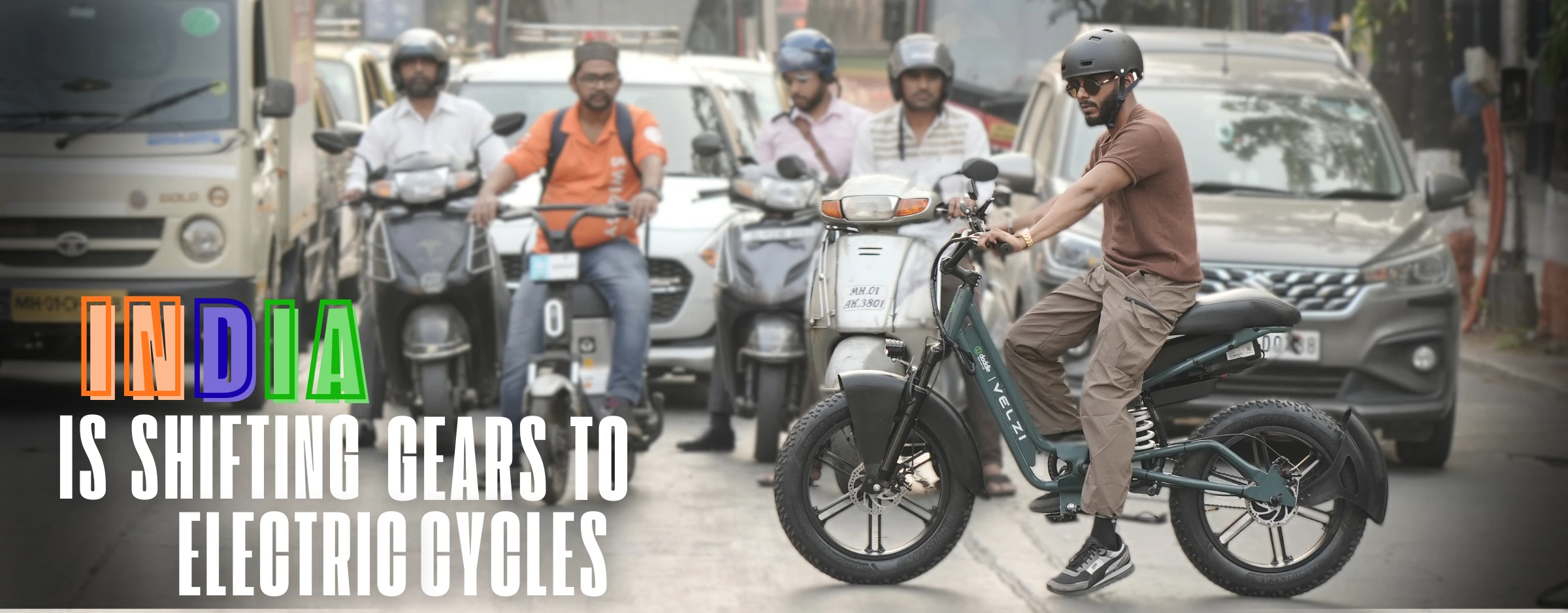
The Quiet Revolution on India’s Roads
Electric cycles are no longer a niche curiosity on Indian roads – they are rapidly becoming the preferred choice for millions of daily commuters, students, delivery workers, and eco-conscious riders. From the congested by lanes of Old Delhi to the wide roads of Tier 2 cities like Nashik, Indore, and Coimbatore, a silent two-wheeled revolution is well underway.
So what’s driving this shift? Why are so many Indians – who once swore by their petrol bikes – making the move to electric cycles in 2026?
The answer lies in a powerful combination of skyrocketing fuel costs, growing environmental awareness, improved e-cycle technology, and the sheer economic logic of switching. Doddle’s range of premium electric cycles sits at the heart of this movement, offering Indian riders a smarter, cleaner, and far more affordable way to get from A to B.
Let’s explore exactly why India is falling in love with electric cycles – and why this trend is only going to accelerate.
Why Are Electric Cycles Gaining Popularity in India in 2026?
Electric cycles have become one of the fastest-growing segments in India’s mobility market, and the numbers tell a compelling story. According to the Society of Manufacturers of Electric Vehicles (SMEV) and recent industry data, India sold over 1.5 million electric two-wheelers in the 2025–26 financial year, with e-cycles accounting for a rapidly increasing share of that total.
Several forces are converging to make this the breakthrough year for electric cycles:
- Petrol prices have crossed ₹110 per litre in most major cities
- Urban traffic congestion continues to worsen in metros and mid-sized cities
- Public awareness around air pollution and carbon emissions is at an all-time high
- The quality and range of affordable e-cycles available in India has improved dramatically
According to Doddle’s 2026 India EV Insights, first-time e-cycle buyers are now equally split between metro residents and those in Tier 2 and Tier 3 towns – a sign that the revolution is truly national, not just urban.
How Much Does It Cost to Run an Electric Cycle vs a Petrol Bike?
Electric cycles deliver savings that are frankly hard to argue with. To understand why so many Indians are switching, you simply need to compare the monthly running costs side by side.
Monthly Running Cost Comparison (for 30 km/day commute)
| Cost Factor | Petrol Bike | Electric Cycle |
| Fuel / Charging | ₹2,100–₹2,400 | ₹90–₹130 |
| Engine oil & filters | ₹300–₹500 | ₹0 |
| Servicing (monthly avg.) | ₹400–₹600 | ₹100–₹150 |
| Total Monthly Cost | ₹2,800–₹3,500 | ₹190–₹280 |
The difference is staggering. A typical petrol bike rider spends roughly ₹33,000–₹42,000 per year just keeping their vehicle running. An electric cycle rider spends under ₹3,500 for the same distance covered.
That’s a saving of nearly ₹30,000 every year – money that goes back into your pocket, your family, or your business.
Are Electric Cycles Suitable for Indian Roads and Commuting Distances?
Electric cycles are purpose-built for exactly the kind of commuting that most Indians do every day. Studies on urban mobility in India consistently show that over 60% of daily trips in Indian cities are under 15 km – well within the range of even the most basic e-cycle model.
Modern e-cycles available in India in 2026 offer:
- Range: 60–100 km on a single charge for mid-range models
- Speed: Up to 25 km/h for standard models (no licence required)
- Charging time: 3–5 hours on a standard 5-amp home socket
- Terrain handling: Front suspension and wider tyres suited to Indian road conditions
At Doddle, we design our electric cycles with Indian roads in mind – from potholed city streets to smoother suburban roads – ensuring that every ride is comfortable, stable, and reliable regardless of terrain.
Why Are Students and Young Professionals Switching to Electric Cycles?
Electric cycles have become especially popular among India’s young, cost-conscious, and digitally savvy population. For college students managing tight budgets and young professionals navigating city traffic, an e-cycle ticks every practical box.
Consider a college student in Pune or Hyderabad:
- No need for a driving licence or vehicle registration
- Daily charging cost of ₹8–₹12 – cheaper than a single auto ride
- Can carry the bike into a hostel or apartment, avoiding parking hassles
- Zero guilt about carbon footprint, which matters deeply to Gen Z
Electric cycles also align with the aspirational, tech-forward identity that younger Indian consumers want to project. Sleek design, app connectivity, digital displays, and smooth silent rides – these are features that resonate far more with a 20-year-old than a noisy, oil-leaking commuter bike.
According to a 2026 mobility survey by RedSeer Consulting, over 45% of e-cycle buyers in India in the last financial year were under 30 years of age – a demographic shift that is reshaping the entire two-wheeler market.
How Are Electric Cycles Transforming Gig Economy Work in India?
Electric cycles are rapidly becoming the vehicle of choice for India’s booming gig economy. With over 7 million active delivery workers across platforms like Zomato, Swiggy, Blinkit, and Zepto, the financial pressure of running a petrol bike is one of the biggest pain points in the sector.
A delivery rider covering 70–90 km per day on a petrol bike spends approximately ₹5,000–₹6,500 per month on fuel alone. On an electric cycle covering similar distances, that cost drops to under ₹400.
The monthly fuel saving of ₹4,500–₹6,000 effectively becomes additional take-home income – a life-changing difference for workers earning ₹15,000–₹25,000 per month.
Doddle’s cargo-capable electric cycles are designed specifically for this use case, with reinforced frames, extended battery packs delivering up to 100 km per charge, and front and rear carrier compatibility to handle the demands of high-frequency delivery work.
What Is the Battery Life of an Electric Cycle and How Much Does Replacement Cost?
Electric cycles run on lithium-ion or lithium iron phosphate (LFP) battery packs, and battery longevity is one of the most common questions from prospective buyers. Here’s a clear breakdown for 2026:
Typical battery lifespan: 800–1,000 full charge cycles, translating to approximately 3–5 years for a rider charging once daily.
Battery replacement costs in 2026:
- 10Ah Lithium-Ion pack: ₹6,500–₹9,000
- 15Ah Lithium-Ion pack: ₹10,000–₹14,500
- 20Ah LFP pack: ₹16,000–₹22,000
Doddle’s advanced battery technology uses Grade-A lithium cells paired with an intelligent Battery Management System (BMS) that protects against overcharging, overheating, and deep discharge – all of which are the primary causes of premature battery degradation in Indian conditions.
With proper charging habits (avoiding full depletion, charging in shade during summer months), most Doddle users report their batteries performing well beyond the 1,000-cycle mark.
How Do Electric Cycles Compare to Petrol Bikes on Maintenance Costs?
Electric cycles have a fundamental mechanical advantage over petrol bikes: they have far fewer moving parts. There’s no internal combustion engine, no gearbox, no clutch, no exhaust system, and no carburetor. The result is dramatically lower maintenance requirements and costs.
Annual Maintenance Cost Comparison
| Maintenance Item | Petrol Bike | Electric Cycle |
| Engine oil changes (3x/year) | ₹1,200–₹1,800 | ₹0 |
| Air filter replacement | ₹300–₹600 | ₹0 |
| Spark plug replacement | ₹200–₹400 | ₹0 |
| Brake service | ₹500–₹800 | ₹300–₹500 |
| Tyre replacement | ₹1,500–₹2,500 | ₹1,000–₹1,800 |
| General servicing | ₹2,000–₹4,000 | ₹500–₹1,000 |
| Annual Total | ₹5,700–₹10,100 | ₹1,800–₹3,300 |
The maintenance saving alone – between ₹4,000 and ₹7,000 per year – is significant. Combined with fuel savings, the total annual advantage of riding an electric cycle over a petrol bike in India can easily exceed ₹35,000.
Are Electric Cycles Good for the Environment in Indian Cities?
Electric cycles are zero-emission vehicles at the point of use – meaning they produce no exhaust fumes, no particulate matter, and no noise pollution while riding. In a country where 14 of the world’s 20 most polluted cities are Indian, this matters enormously.
India’s urban air quality crisis costs the economy an estimated ₹2.5 lakh crore annually in healthcare and productivity losses, according to a 2025 report by the Council on Energy, Environment and Water (CEEW). Switching from petrol bikes to electric cycles at scale could remove millions of tonnes of CO₂ and particulate emissions from Indian city air every year.
Even accounting for India’s current electricity grid mix (which still includes significant coal-based generation), an electric cycle produces roughly 8–12 times fewer lifecycle emissions than a petrol bike per kilometre travelled – and that ratio will only improve as India’s renewable energy capacity expands toward its 500 GW target by 2030.
People Also Ask
Q: Do I need a driving licence to ride an electric cycle in India? A: No. Electric cycles with motors up to 250W and a top speed of 25 km/h are classified as non-motorised vehicles under India’s Motor Vehicles Act. No licence, registration, or insurance is required.
Q: What is the mileage of an electric cycle on one charge? A: Most quality e-cycles available in India in 2026 offer 60–100 km of range per full charge, depending on battery capacity, rider weight, terrain, and speed. Entry-level models typically offer 40–50 km.
Q: How long does it take to charge an electric cycle battery? A: On a standard 5-amp home socket, a full charge takes 3–5 hours. Fast-charging adapters (where available) can reduce this to 2–3 hours. Most riders simply charge overnight and start each day with a full battery.
Q: Is an electric cycle worth buying in India in 2026? A: Yes – especially for commuters travelling 20–60 km daily. The combination of near-zero running costs (under ₹0.15/km), minimal maintenance, no fuel price volatility, and no licence requirement makes an electric cycle one of the most financially sound transport investments an Indian rider can make today.
Conclusion: The Future of Indian Mobility Is Electric – and It’s Already Here
Electric cycles represent the most practical, affordable, and forward-thinking mobility solution for India in 2026. The case for switching has never been stronger: fuel savings of ₹25,000–₹35,000 per year, maintenance costs under ₹3,000 annually, zero emissions, and the freedom of licence-free riding combine to create an overwhelmingly compelling argument.
Whether you’re a student in Bhopal, a delivery rider in Bengaluru, a daily commuter in Gurugram, or an eco-conscious professional in Kochi – an electric cycle is not just a smarter choice, it’s the obvious one.
At Doddle, we believe every Indian deserves access to clean, affordable, and reliable mobility. Our electric cycles are engineered for the realities of Indian roads, Indian weather, and Indian budgets – because sustainable transport should work for everyone, not just the privileged few.
Ready to make the switch? Explore the full range of Doddle electric cycles and find the perfect model for your daily ride.
FAQ: Electric Cycles in India (2026)
Q1. What is the price range of electric cycles in India in 2026?
A: Electric cycles in India are available across a wide price range. Entry-level models start at ₹14,000–₹20,000, mid-range models with better batteries and features are priced between ₹22,000–₹40,000, and premium performance models go up to ₹70,000–₹80,000.
Q2. Which electric cycle is best for daily commuting in India?
A: For daily commuting, look for models offering a minimum of 60 km range per charge, a removable lithium-ion battery, decent suspension for Indian roads, and a reliable after-sales service network. Doddle’s mid-range lineup is engineered precisely for this use case.
Q3. How much does it cost to charge an electric cycle at home in India?
A: A full charge typically consumes 1.5–2.5 units of electricity, costing ₹10–₹18 based on India’s average residential electricity tariff of approximately ₹6–₹8 per unit. This works out to less than ₹0.15 per kilometre.
Q4. Can electric cycles handle hilly terrain and Indian road conditions?
A: Yes. Modern e-cycles with 250W–500W motors and front suspension handle moderate inclines and uneven road surfaces effectively. For consistently hilly routes, models with torque sensors and higher-capacity motors are recommended.
Q5. What is the resale value of electric cycles in India?
A: The resale market for e-cycles is still maturing in India. However, well-maintained models from established brands retain 50–65% of their value after two years – comparable to entry-level petrol scooters. Battery condition is the key determinant of resale value.
Q6. Are spare parts and service centers easily available for electric cycles in India?
A: Availability is improving rapidly. Established e-cycle brands now have service networks in most metro cities and many Tier 2 towns. Doddle operates an authorized service network across India, with doorstep service available in select cities for added convenience.