
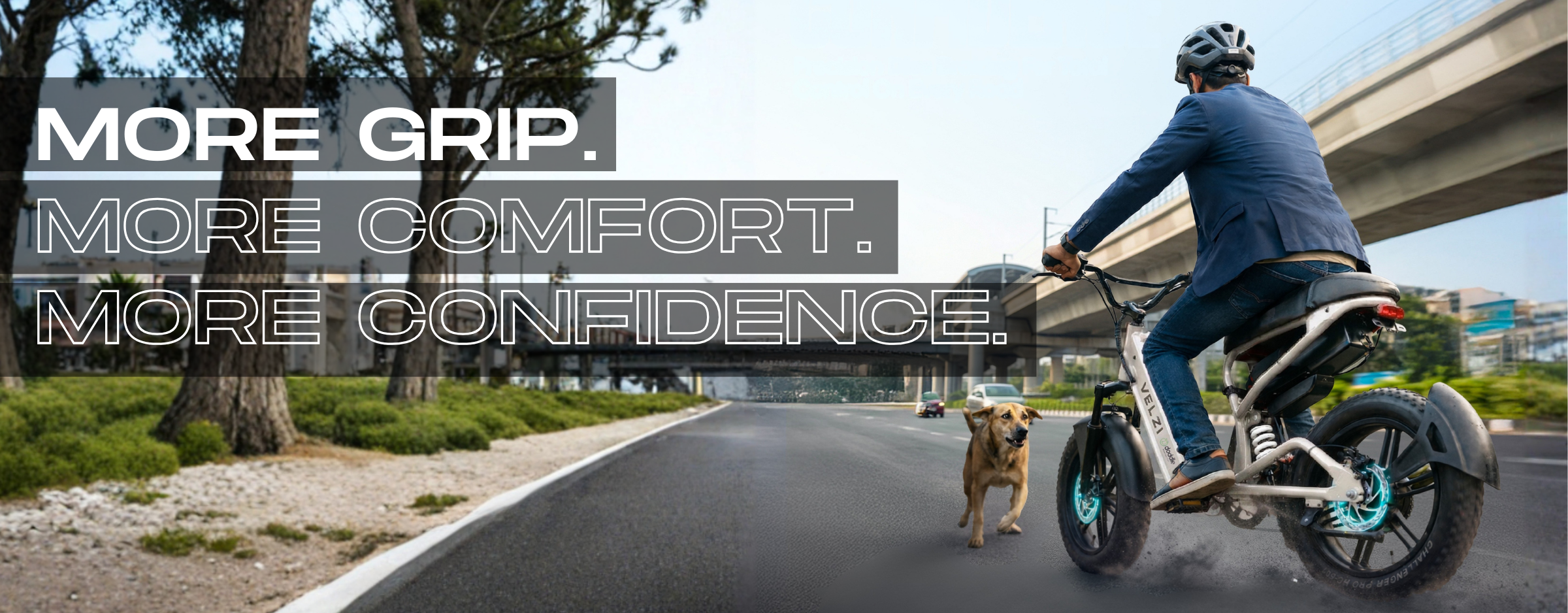
Fat tyre electric cycle India riders are discovering something that regular commuters have missed for years – the road beneath your wheels changes everything. India’s roads are famously unpredictable: a smooth highway in Bengaluru gives way to a pothole-riddled lane; a clean flyover in Pune drops you onto a waterlogged street after a monsoon shower. Standard bicycle tyres handle this poorly. Fat tyres, paired with electric power, handle it brilliantly.
At Doddle, we design fat tyre EV cycles specifically with Indian road conditions in mind – from the congested by lanes of Delhi and Mumbai to the uneven stretches of Tier 2 towns like Nagpur, Coimbatore, and Indore. This guide explains exactly why a fat tyre electric cycle is the smartest mobility upgrade you can make in 2026.
Why Are EV Cycles Gaining Popularity in India in 2026?
Fat tyre electric cycle India adoption is accelerating at a pace few predicted just three years ago. India’s e-bike market, valued at approximately USD 1.42 billion in 2025, is projected to grow at a CAGR of 13.4% through 2033, according to Grand View Research. In the first four months of 2026 alone, electric two-wheeler sales surged 29.7% year-on-year – a clear signal that Indian consumers are pivoting hard toward electric mobility.
The reasons are straightforward:
- Petrol prices hovering above ₹105–₹115 per litre in most metros
- Worsening urban traffic and parking scarcity
- A growing generation of eco-conscious riders
- Improved battery technology delivering longer ranges at lower costs
Fat tyre models, in particular, are gaining a dedicated following because they solve problems that regular e-cycles simply cannot address on Indian terrain.
What Exactly Is a Fat Tyre Electric Cycle?
Fat tyre electric cycle India models are distinguished by their wide tyres – typically 3.8 to 4.5 inches across, compared to a standard cycle’s 1.75–2.1 inch tyre. This extra width means a larger contact patch with the ground, distributing weight more evenly and absorbing surface irregularities with ease.
Combined with an electric motor (usually 250W–500W), pedal-assist technology, and a lithium-ion battery, the result is a ride that feels stable, confident, and effortless – whether you’re crossing a rocky village track or navigating a monsoon-flooded street in Chennai.
How Does a Fat Tyre EV Cycle Perform on Indian Roads?
Fat tyre electric cycle India performance on real-world roads is where the advantage truly shines. Consider the three most common Indian road challenges:
1. Potholes and broken surfaces The wide, low-pressure tyre acts as a natural shock absorber, compressing around potholes rather than slamming into them. Riders report significantly less fatigue on rough routes compared to standard narrow-tyre cycles.
2. Sand, gravel, and mud India’s Tier 2 and Tier 3 towns often have unpaved or semi-paved lanes. Fat tyres distribute load across a wider surface, preventing the sinking or slipping that derails narrow tyres on loose ground.
3. Monsoon-wet roads Wider tyres in the 4-inch range offer better grip on wet, slippery surfaces – a critical safety advantage during India’s four-month monsoon season.
According to Doddle’s 2026 India EV insights, over 68% of our riders cite “road confidence” as the top reason they chose a fat tyre model over a standard electric cycle.
How Much Does a Fat Tyre Electric Cycle Cost in India in 2026?
Fat tyre electric cycle India pricing in 2026 ranges broadly depending on battery capacity, motor power, and brand positioning:
| Category | Price Range (₹) |
| Entry-level fat tyre e-cycle | ₹28,000 – ₹40,000 |
| Mid-range fat tyre e-cycle | ₹40,000 – ₹65,000 |
| Premium fat tyre e-cycle | ₹65,000 – ₹1,00,000+ |
Doddle’s fat tyre electric cycles are positioned in the mid-range segment, offering premium-grade components – lithium-ion batteries, brushless hub motors, and anti-puncture tyres – at accessible price points for Indian urban and semi-urban buyers.
How Far Can a Fat Tyre Electric Cycle Travel on a Single Charge?
Fat tyre electric cycle India range per charge is one of the most commonly asked questions – and for good reason. Nobody wants range anxiety on their morning commute.
On average, a well-designed fat tyre e-cycle with a 36V/10Ah or 48V/10Ah lithium-ion battery delivers:
- Pedal-assist mode: 50–80 km per charge
- Throttle-only mode: 30–50 km per charge
- Mixed usage (typical Indian commuter): 45–65 km per charge
Doddle’s advanced battery technology ensures consistent range delivery even in high-heat Indian conditions – a challenge that affects battery output more than most manufacturers openly acknowledge. Our thermal management design keeps cells operating optimally even at 40°C+ temperatures common across North and Central India in summer.
For the average Indian commuter travelling 15–25 km daily, a single charge comfortably covers two to three days of riding before needing a top-up.
What Does It Cost to Run a Fat Tyre EV Cycle Daily in India?
Fat tyre electric cycle India running costs are dramatically lower than petrol-based alternatives – and this is where the financial case becomes undeniable.
Running cost comparison (per km):
| Vehicle | Fuel/Energy Cost per km |
| Petrol scooter (at ₹110/litre) | ₹3.50 – ₹4.50 |
| Fat tyre e-cycle (grid electricity) | ₹0.15 – ₹0.25 |
| Fat tyre e-cycle (home solar) | Nearly ₹0 |
A typical Indian commuter travelling 25 km/day on a petrol scooter spends approximately ₹2,500–₹3,200 per month on fuel alone. On a Doddle fat tyre EV cycle, that same distance costs roughly ₹100–₹150 per month in electricity – a saving of ₹2,300–₹3,000 every single month.
Over one year, that’s a saving of ₹27,000–₹36,000 – enough to recover a significant portion of the cycle’s purchase cost.
How Long Does the Battery Last and What Does Replacement Cost?
Fat tyre electric cycle India battery life is typically 500–800 full charge cycles for standard lithium-ion packs, which translates to approximately 3–5 years of regular daily use.
Battery replacement costs in India in 2026:
- 36V/10Ah lithium-ion pack: ₹6,000 – ₹10,000
- 48V/10Ah lithium-ion pack: ₹9,000 – ₹14,000
- 48V/13Ah premium pack: ₹12,000 – ₹18,000
These costs have dropped nearly 70% over the past decade as lithium-ion manufacturing scales up domestically – a trend confirmed by market research from Mordor Intelligence. Indian battery manufacturers like Exide Industries are now building gigafactories to supply the EV ecosystem, which will push replacement costs even lower through 2028.
What Is the Maintenance Cost of a Fat Tyre Electric Cycle in India?
Fat tyre electric cycle India maintenance is one of its most compelling advantages. Unlike petrol vehicles, there’s no engine oil, no spark plugs, no complex transmission – the mechanical simplicity is profound.
Typical annual maintenance costs:
- Tyre check and inflation: ₹0 (DIY)
- Brake pad replacement: ₹300 – ₹600
- Chain lubrication and cleaning: ₹100 – ₹200
- Annual service at a Doddle-authorised centre: ₹500 – ₹1,000
- Minor electrical check: ₹200 – ₹400
Total estimated annual maintenance: ₹1,100 – ₹2,200
Compare this to a petrol two-wheeler’s annual maintenance bill of ₹5,000–₹12,000, and the lifetime savings compound further in the EV cycle’s favour.
Are Fat Tyre Electric Cycles Good for Delivery Professionals in India?
Fat tyre electric cycle India use cases for delivery professionals – Swiggy, Zomato, Dunzo, and local courier riders – are growing rapidly in 2026. Delivery riders typically cover 60–100 km per day across mixed urban terrain, and the demands on their vehicle are intense.
Fat tyre e-cycles address their needs directly:
- Stability under load: Wide tyres handle the added weight of delivery bags without compromising balance
- Comfort over long hours: Reduced vibration means less physical fatigue over 8–10 hour shifts
- Low running cost: At ₹0.15–₹0.25 per km, fat tyre e-cycles dramatically reduce operating costs for gig economy workers
- Ease of parking: Cycles park anywhere petrol scooters cannot, saving time between deliveries
Several last-mile logistics firms in Mumbai, Hyderabad, and Ahmedabad have begun fleet trials of fat tyre e-cycles in 2026, citing lower total cost of ownership as the primary driver.
Are Fat Tyre EV Cycles Suitable for Students and Women Riders?
Fat tyre electric cycle India suitability extends confidently to students and women riders – two demographics that are increasingly central to the EV cycle market’s growth in India.
For students in Tier 2 cities like Jaipur, Lucknow, Bhopal, and Nashik, the financial arithmetic is clear. Monthly fuel costs of ₹2,000–₹3,000 for a scooter compare to under ₹200 in electricity for an e-cycle covering the same college commute distance.
For women riders, fat tyre e-cycles offer:
- A lower, more stable riding position due to wider tyres and often step-through frame designs
- The confidence of electric assist on hills and long stretches without physical strain
- Quiet, clean operation suitable for daily urban commuting
According to market data from Market Research Future, young adults are the fastest-growing demographic in India’s e-bike market as of early 2026 – and the gender mix is shifting meaningfully toward women as design improves.
How Does a Doddle EV Cycle Reduce Commuting Costs?
At Doddle, we design our fat tyre electric cycles to deliver maximum value across the total ownership period – not just at the point of purchase. The saving begins on day one.
Here’s how a Doddle fat tyre e-cycle reduces commuting costs:
- Zero fuel cost: Every kilometre runs on electricity at a fraction of petrol’s per-km rate
- Minimal servicing: Our brushless hub motors have no wearing internal parts, reducing service intervals and costs
- Smart battery management: Doddle’s BMS (Battery Management System) extends cell life by preventing overcharge, deep discharge, and thermal stress
- Long tyre life: Anti-puncture fat tyres last significantly longer than standard cycle tyres, reducing replacement frequency
A Doddle rider commuting 20 km daily can expect to recover the cycle’s purchase cost in fuel and maintenance savings within 18–30 months – depending on their previous vehicle’s running costs.
What Makes India’s Roads Particularly Suited to Fat Tyre EV Cycles?
Fat tyre electric cycle India compatibility with local road conditions isn’t a coincidence – it’s a design match. India presents a unique mobility challenge that no single conventional vehicle type solves perfectly:
- Metro cities: Dense traffic, frequent stops, parking scarcity → e-cycles win on agility and parking ease
- Tier 2 and Tier 3 towns: Uneven roads, mixed surfaces, modest infrastructure → fat tyres win on stability and grip
- Hilly regions: Shimla, Dehradun, Shillong → electric assist makes gradients manageable
- Coastal cities: Mumbai, Kochi, Visakhapatnam → monsoon-ready fat tyres offer superior wet-weather safety
India’s traffic congestion index remains among the highest in Asia. In this environment, the e-cycle is not a leisure vehicle – it is practical, efficient, and increasingly essential urban infrastructure.
People Also Ask
Q: What is the price of a fat tyre electric cycle in India in 2026?
Fat tyre electric cycles in India are priced between ₹28,000 and ₹1,00,000+, depending on battery capacity and features. Mid-range models from brands like Doddle typically fall in the ₹40,000–₹65,000 range and offer the best balance of quality and value.
Q: How many kilometers can a fat tyre e-cycle travel per charge?
Most fat tyre electric cycles in India deliver 45–80 km per charge in pedal-assist mode, depending on rider weight, terrain, and battery capacity. A 48V/10Ah battery typically provides around 50–65 km of real-world range.
Q: What is the monthly running cost of a fat tyre electric cycle in India?
The average monthly electricity cost to run a fat tyre EV cycle covering 25 km per day is approximately ₹100–₹200 – compared to ₹2,500–₹3,200 for a petrol scooter covering the same distance.
Q: How long does the battery of a fat tyre electric cycle last in India?
A quality lithium-ion battery in a fat tyre e-cycle lasts 500–800 charge cycles, typically 3–5 years of regular use. Replacement battery packs cost approximately ₹6,000–₹18,000 depending on capacity.
Q: Is a fat tyre electric cycle good for Indian roads?
Yes. Fat tyres (3.8–4.5 inches wide) are specifically well-suited to Indian road conditions – potholes, gravel, mud, monsoon-wet surfaces – because they absorb shock, distribute weight evenly, and provide superior grip on unpredictable terrain.
Q: Can a fat tyre e-cycle be used for food delivery in India?
Absolutely. Fat tyre electric cycles are increasingly used by delivery professionals in India because they offer stability under load, very low running costs (₹0.15–₹0.25 per km), ease of parking, and reduced physical fatigue compared to petrol scooters during long delivery shifts.
Conclusion: Is a Fat Tyre Electric Cycle the Right Choice for You in 2026?
Fat tyre electric cycle India riders aren’t just early adopters anymore – they’re part of a mainstream mobility shift that is reshaping how India commutes. With fuel costs climbing, road conditions remaining as challenging as ever, and battery technology improving every year, the fat tyre EV cycle sits at a perfect intersection of practicality, economics, and sustainability.
Whether you’re a daily office commuter in Bengaluru, a student in Jaipur, a delivery professional in Mumbai, or an eco-conscious rider in Indore – a fat tyre electric cycle offers a compelling answer to India’s unique mobility challenges.
At Doddle, we’re proud to be building that answer – one ride at a time.
👉 Explore Doddle’s range of fat tyre electric cycles at doddle and find the model built for your road.