
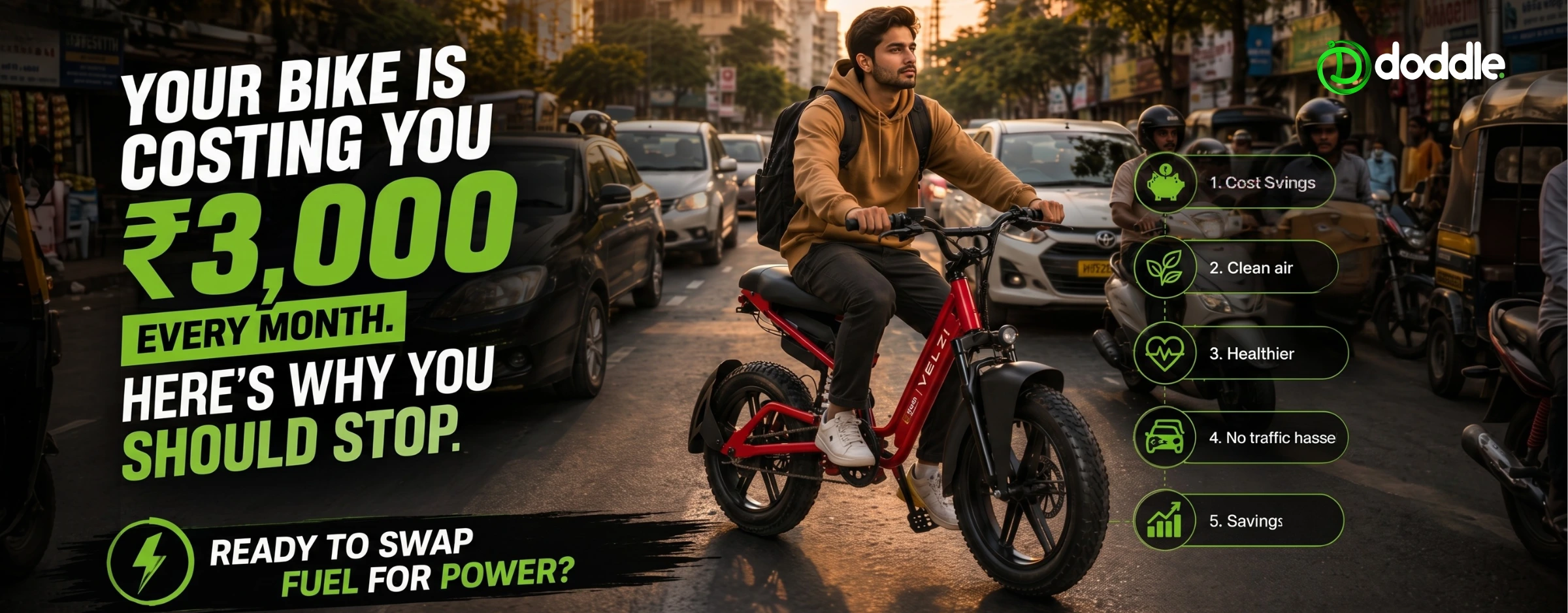
Benefits of using electric cycles are being discovered every day by a fast-growing wave of Indian city riders – commuters who switched from petrol two-wheelers, students who no longer depend on shared autos, delivery professionals who slashed their monthly operating costs in half, and eco-conscious riders who simply refuse to add to the smog choking India’s urban skies.
And yet, despite the momentum, millions of potential riders still hesitate. They’ve heard vague promises about savings and sustainability, but nobody has laid out the real picture – with actual numbers, Indian context, and honest data.
That’s exactly what this article does. Below are the five benefits of switching to an electric cycle that genuinely surprise people – not the obvious talking points you’ve already seen, but the deeper, more meaningful advantages that make city riders wonder why they didn’t make the switch sooner. If you’re considering your first e-cycle, start by exploring the Doddle Velzi – engineered specifically for Indian urban roads and the diverse demands of Indian riders.
Benefit 1: The Cost Savings Are Far More Dramatic Than Most Riders Expect
Benefits of using electric cycles begin, for most riders, with the financial shock of their first electricity bill after switching. Charging a quality electric cycle costs approximately ₹10–₹20 per full charge at standard Indian household electricity rates in 2026. For a daily commute of 20–25 km, this equates to a monthly charging expense of just ₹150–₹350.
Compare that to a petrol two-wheeler: at current fuel prices of ₹110–₹115 per litre, a daily commute of the same distance costs ₹3,000–₹5,000 per month in fuel alone.
Annual cost comparison for a 20 km daily commuter:
| Expense Category | Petrol Two-Wheeler | Electric Cycle |
| Fuel / Charging | ₹36,000–₹60,000 | ₹1,800–₹4,200 |
| Annual servicing | ₹5,000–₹12,000 | ₹1,700–₹3,800 |
| Total annual cost | ₹41,000–₹72,000 | ₹3,500–₹8,000 |
The savings of ₹35,000–₹65,000 per year mean that a quality electric cycle in the ₹30,000–₹45,000 price range pays for itself entirely within 12–18 months – after which, every kilometre you ride is essentially free.
According to Doddle’s 2026 India EV insights, urban commuters who switch to an electric cycle typically recover their full purchase cost within one riding season when accounting for both fuel and maintenance savings.
Benefit 2: You Are Actively Helping Fix India’s Air Quality Crisis
Benefits of using electric cycles extend well beyond your own wallet – they reach the lungs of every person in your city. Research published in peer-reviewed transport studies confirms that a typical e-cycle produces approximately 22g of CO₂ per kilometre when accounting for electricity generation – compared to 200–400g per kilometre for a conventional petrol vehicle.
Road transport currently accounts for 20–30% of urban air pollution in Indian cities, according to a joint report by the IEA and NITI Aayog. Studies further show that replacing just 15% of short car and two-wheeler trips with e-bike usage can reduce urban transportation emissions by up to 12%.
For Indian cities where air quality regularly breaches safe limits, this isn’t abstract environmentalism – it’s a public health emergency that every rider has the power to address. Switching one petrol two-wheeler to an electric cycle removes the equivalent of several hundred kilograms of CO₂ from the air annually.
This matters especially for Tier 2 cities like Lucknow, Agra, Kanpur, and Patna, which consistently appear on India’s most-polluted city lists. Electric cycles offer these cities a scalable, affordable path to cleaner air – one commuter at a time.
Benefit 3: You Arrive Healthier – Without Arriving Exhausted
Benefits of using electric cycles include a health dimension that no petrol vehicle can offer: the option to exercise during your commute. Pedal-assist technology (PAS) lets riders choose their level of physical effort – from full electric assist for days when you need to arrive fresh, to a genuine cardiovascular workout when you want to engage your body.
This matters enormously for India’s urban population. Sedentary commuting – sitting in traffic on a scooter or in a car – is associated with higher rates of cardiovascular disease, obesity, and chronic stress. Research consistently links regular cycling with:
- Improved cardiovascular fitness – reduced risk of heart disease and hypertension
- Lower stress levels – cycling triggers endorphin release and reduces cortisol
- Better mental well-being – exposure to open-air movement improves mood and reduces anxiety
- Healthy weight management – even low-intensity pedal-assist riding burns 250–400 calories per hour
The critical advantage of an e-cycle over a conventional bicycle is the removal of the exhaustion barrier. You don’t arrive at your office in Andheri or your college in Koramangala drenched in sweat – the motor handles the heavy lifting when you need it. But you still move your body, breathe fresh air, and build physical resilience over time.
At Doddle, we design our pedal-assist systems to make this balance intuitive – so riders can seamlessly shift between workout mode and assisted commute mode without interrupting their ride.
Benefit 4: City Traffic Becomes Your Advantage, Not Your Enemy
Benefits of using electric cycles are most viscerally felt in the one experience every Indian urban commuter dreads: peak-hour traffic. Where a car sits immobile and a petrol scooter burns fuel idling, an electric cycle moves.
E-cycles can navigate through gaps in traffic legally, use cycle lanes where available, and access shortcuts through by-lanes and campus roads that motorised vehicles cannot. In cities like Mumbai, Bengaluru, Chennai, and Pune, where average peak-hour speeds can fall below 12 km/h, a confident e-cycle rider frequently outpaces the surrounding traffic on a 5–15 km urban commute.
The electric motor removes the physical effort typically associated with stop-and-go city cycling. You don’t arrive fatigued from repeatedly accelerating through traffic. You don’t overheat in summer because you’re not exerting yourself at every signal. And crucially – you never queue at a fuel station.
Add to this the parking advantage: an electric cycle can be secured at a regular bicycle stand, parked in your apartment’s lift lobby, or carried into your office. In cities where parking charges at commercial areas run ₹50–₹200 per day, the cumulative saving is significant.
According to industry mobility research, e-cycle riders in Indian metro cities save an average of 20–35 minutes per day on their commute compared to car users travelling the same route during peak hours.
Benefit 5: The Long-Term Financial Value Is Genuinely Exceptional
Benefits of using electric cycles include a financial angle that most buyers don’t think about at the moment of purchase: long-term asset value. With India’s e-bike market expanding at a robust CAGR of 8.69% through 2034, demand for quality electric cycles is growing every year – which means well-maintained e-cycles from reputable brands hold their resale value far better than early buyers expected.
A quality electric cycle purchased today for ₹35,000–₹45,000 can typically be resold after 2–3 years for 50–60% of its original value, provided the battery is healthy and the frame is in good condition. The e-cycle’s low mechanical complexity means fewer things go wrong: no engine seizures, no carburettor issues, no clutch plates to replace.
Total lifetime cost breakdown for a ₹40,000 e-cycle over 3 years:
| Item | Cost |
| Purchase price | ₹40,000 |
| 3-year charging cost | ₹5,400–₹12,600 |
| 3-year maintenance | ₹5,100–₹11,400 |
| Resale value (after 3 years) | –₹20,000–₹24,000 |
| Net 3-year cost of ownership | ₹30,500–₹44,000 |
For a petrol scooter, the equivalent 3-year fuel and maintenance cost alone exceeds ₹1,23,000–₹2,16,000 – before accounting for insurance, road tax, and depreciation.
Doddle’s advanced battery technology, with built-in thermal management and smart BMS protection, is specifically engineered to extend battery life in Indian climatic conditions – ensuring that your battery retains strong capacity well beyond the typical 2-year ownership cycle, protecting your resale value.
Who Benefits Most from Switching to an Electric Cycle in India?
The five benefits above apply to virtually every urban rider – but they are especially transformative for specific groups:
Urban office commuters travelling 15–30 km daily save the most in fuel and time. The financial case is overwhelming within the first year.
Students gain independence without a driving licence (for sub-25 km/h, 250W models), with minimal monthly running costs that fit tight budgets.
Delivery professionals – the backbone of India’s booming quick-commerce and food-delivery economy – can dramatically reduce their daily operating costs. At ₹10–₹20 per charge versus ₹150–₹200 per day in petrol, the arithmetic is impossible to ignore.
Eco-conscious riders across metro cities and growing Tier 2 towns like Indore, Surat, Nashik, and Vijayawada are increasingly choosing electric cycles as a deliberate lifestyle statement – a refusal to contribute to urban pollution.
The Bottom Line
Benefits of using electric cycles in India in 2026 go far beyond vague promises of “green mobility.” They translate into tens of thousands of rupees saved annually, measurable improvements in personal health, real reductions in commute time, and a genuine contribution to the air quality of the cities we all share.
The five benefits covered here – financial savings, environmental impact, health and fitness, traffic advantage, and long-term asset value – represent a compelling, evidence-backed case for making the switch today.
If you’re ready to experience these benefits firsthand, the Doddle Velzi is where to start – built for Indian roads, priced for Indian budgets, and backed by a service network that extends to Tier 2 and Tier 3 cities across the country.
Frequently Asked Questions (FAQ)
What are the main benefits of using an electric cycle in India?
The main benefits of using an electric cycle in India are dramatically lower running costs (₹150–₹350 per month vs ₹3,000–₹5,000 for petrol), zero tailpipe emissions, improved personal health through pedal-assist exercise, faster urban commuting through traffic, and strong long-term financial value with low maintenance costs and good resale value.
How much money can I save by switching to an electric cycle from a petrol bike?
Most urban commuters travelling 20 km daily save between ₹35,000–₹65,000 per year by switching from a petrol two-wheeler to an electric cycle. This accounts for both fuel savings and lower annual maintenance costs. At this savings rate, a ₹40,000 electric cycle pays for itself completely within 12–18 months.
Is riding an electric cycle good for health?
Yes. Electric cycles with pedal-assist technology allow riders to exercise at their own pace during their commute. Regular e-cycle riding improves cardiovascular fitness, reduces stress hormones, supports healthy weight management, and improves mental well-being – without the exhaustion of arriving at work after intense pedalling in Indian heat.
How many kilometres does an electric cycle cover on one charge?
Most quality electric cycles available in India in 2026 deliver a real-world range of 40–65 km per charge on city roads. For average daily urban commutes of 18–25 km, a single charge comfortably covers 2–3 days of riding. Premium models with larger battery packs can achieve 70–100 km per charge.
Is an electric cycle better for the environment than a petrol scooter?
Yes, significantly. A petrol scooter emits 200–400g of CO₂ per kilometre. An electric cycle produces approximately 22g of CO₂ per kilometre when accounting for electricity generation. Over a year of regular commuting, switching to an electric cycle removes several hundred kilograms of CO₂ from the atmosphere.
What is the annual maintenance cost of an electric cycle in India?
Annual maintenance for a quality electric cycle in India costs approximately ₹1,700–₹3,800, covering tyres, brake servicing, and a general checkup. This compares to ₹5,000–₹12,000 for a petrol two-wheeler’s annual maintenance – making the electric cycle significantly more affordable to own and operate over time.