
Electric Cycle Battery Life: How Long Does an E-Cycle Battery Last in India?
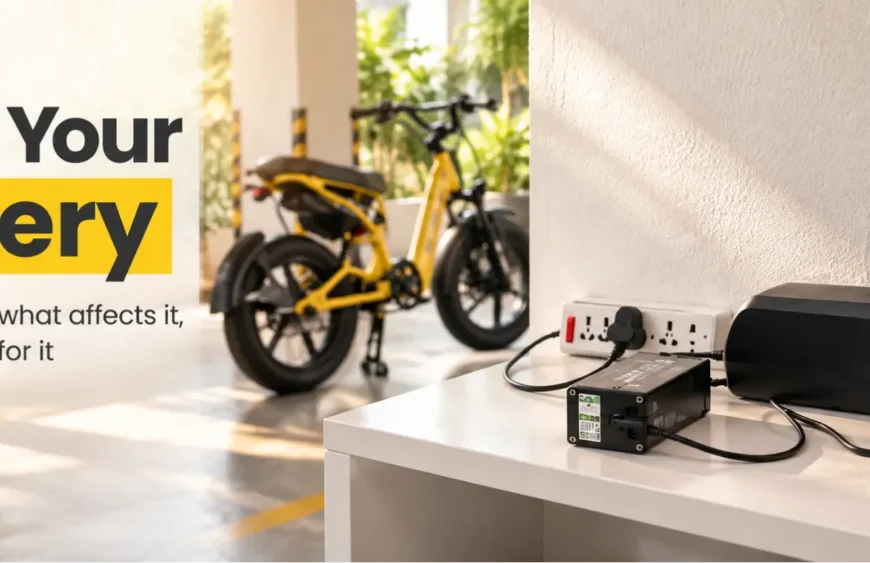
Electric cycle battery life is one of the most important ownership questions for anyone buying an e-bike in India. The motor may get most of the attention, but the battery determines how far the cycle can travel, how frequently it needs charging, how convenient daily ownership feels and what the most significant long-term replacement cost may be.
There are two different meanings of battery life that buyers often mix together. The first is range per charge: how many kilometres the cycle can cover before the battery needs electricity again. The second is service life: how many months or years the electric cycle battery can continue delivering useful capacity before ageing makes replacement worthwhile. A battery can still work after years of use while delivering less range than when it was new.
This guide explains both meanings of e cycle battery life, the factors that speed up ageing in Indian weather, charging habits that help, realistic signs of battery deterioration, and what to consider when thinking about electric cycle battery price and replacement.
How Long Does an Electric Cycle Battery Last?
There is no single fixed number because lithium-ion battery ageing depends on cell quality, charge cycles, heat, depth of discharge, storage, charger quality and riding load. In normal use, a well-managed lithium-ion e-cycle battery is designed to deliver hundreds of charge cycles before capacity reduction becomes significant. For many riders, that translates into several years of practical use rather than a battery that suddenly ‘expires’ on a specific date.
The useful question is not simply how long does an electric cycle battery last, but how quickly its usable capacity declines for your riding pattern. A rider who travels 8 km per day and charges twice a week will accumulate cycles far more slowly than a rider covering 50 km daily.
What Is a Battery Charge Cycle?
A charge cycle is roughly the equivalent of using 100% of the battery’s capacity, but it does not need to happen in one ride. Using 50% today and 50% tomorrow is approximately one full equivalent cycle. Partial charging does not automatically damage a modern lithium-ion battery; in fact, avoiding frequent deep discharge can be gentler than repeatedly running the pack to empty.
| Example | Battery use | Approx. cycle equivalent |
| Ride 1 | 100% to near 0% | About 1 full cycle |
| Ride 2 + Ride 3 | 100% to 50%, then 100% to 50% | Together about 1 cycle |
| Four short rides | Each uses ~25% | Together about 1 cycle |
| Top-up after a short commute | Small partial use | Only the used portion counts toward cycle ageing |
Range per Charge vs Battery Lifespan
Range per charge depends on stored energy and riding conditions. Battery lifespan describes how long the pack remains healthy over months and years. A battery might begin at 100% of its original capacity and gradually move downward. The rider notices this as reduced kilometres per charge rather than a dramatic failure.
Doddle Velzi uses a 48V 13Ah removable battery rated at 624Wh. Doddle lists up to 85 km range on pedal assist and up to 45 km on throttle. Those figures are mode-dependent because pedal assist shares the workload with the rider, while throttle mode asks the motor to do much more of the propulsion work.
What Affects Electric Bicycle Battery Life in India?
| Factor | How it affects the battery | Better habit |
| High heat | Speeds chemical ageing when battery stays hot for long periods | Park in shade; avoid leaving battery in a hot enclosed vehicle |
| Frequent deep discharge | Adds stress when repeatedly taken to very low charge | Recharge before routinely reaching near-empty |
| High load / aggressive throttle | Increases current draw and heat | Use pedal assist when practical |
| Incorrect charger | Can create unsafe or poor charging behaviour | Use the manufacturer-approved charger |
| Long-term storage at empty/full | Can accelerate degradation | Store partially charged and check periodically |
| Water at charging connectors | Creates electrical risk | Keep ports dry; charge indoors |
| Low tyre pressure | Makes motor work harder | Maintain recommended tyre pressure |
Heat Is the Biggest Indian-Climate Concern
Indian summers are demanding for any lithium-ion battery. The battery generates some heat during charging and discharging, and external heat adds to that. The worst routine is to finish a hard ride in peak afternoon heat, leave the cycle in direct sun and immediately begin charging while the pack is still very warm.
A better habit is simple: park in shade, allow a hot battery to return closer to normal indoor temperature, then charge in a dry, ventilated area. Do not place the charger or battery under blankets, inside sealed boxes or next to heat sources while charging.
Should You Charge an E-Cycle Battery After Every Ride?
You do not need to force a full 0–100% cycle every time. For a short commute, a top-up can be perfectly practical. What matters more is avoiding extreme habits: repeatedly running the battery to complete shutdown, storing it empty for weeks, or leaving it connected to an unsuitable charger indefinitely.
- Charge in a dry indoor location whenever possible.
- Use the charger supplied or approved by the manufacturer.
- Let a very hot battery cool before charging.
- Avoid making 0% discharge a daily habit.
- If storing the cycle for a long period, do not leave the battery completely empty.
- Inspect the connector periodically for dirt, moisture or damage.
How Riding Style Changes Battery Range and Ageing
Battery life is influenced by how hard the electrical system works. Full-throttle starts, heavy loads, steep climbs, low tyre pressure and constant stop-start acceleration all increase energy demand. Pedal assist reduces that demand because the rider contributes part of the work.
This is why the same electric cycle can deliver different range for two riders on the same route. Rider weight, wind, road gradient, tyre pressure and selected assistance level all matter. A battery that gives less range on a difficult day is not necessarily unhealthy; the route may simply have demanded more energy.
Signs Your Electric Cycle Battery Is Ageing
Normal battery ageing is gradual. The clearest sign is a consistent reduction in usable range under similar conditions. If a route that once used 30% of the battery now uses 45–50% with the same rider, tyre pressure, riding mode and weather, battery capacity may have declined.
- Noticeably lower range across repeated rides, not just one unusually difficult day.
- Battery percentage dropping more rapidly under normal load.
- Charging ending much earlier than expected because usable capacity has reduced.
- Unexpected shutdown at a displayed charge level that previously worked normally.
- Physical swelling, unusual heat, smell or damage—stop using the battery and contact support immediately.
Battery Problems That Are Not Normal Ageing
A gradual capacity drop is normal. Swelling, leaking, burnt smell, damaged casing, sparks, excessive heat or repeated charger faults are not. Do not open a lithium-ion battery pack yourself. High-energy cells and battery-management electronics require trained handling.
If an electrical issue appears, isolate the cycle from charging, keep it away from heat and flammable materials, and contact the manufacturer or qualified service provider. Doddle’s support guidance recommends professional assistance for battery, motor and complex electrical repairs.
What Determines Replacement Cost?
Electric cycle battery price depends on voltage, amp-hour capacity, cell quality, BMS, housing, connector design and brand support. A 48V 13Ah pack is not interchangeable with every other 48V battery because physical fit, connector pinout, controller compatibility and BMS communication can differ.
For that reason, buying an e-cycle only because the initial price is low can be risky if replacement batteries are unavailable two or three years later. Before purchase, ask the brand whether original replacement packs, chargers and connectors will remain available and what the current replacement policy is. Replacement pricing can change over time, so current quotations are more useful than a fixed figure in a blog.
How to Extend E Cycle Battery Life
| Habit | Why it helps |
| Keep the battery out of prolonged direct sun | Reduces heat exposure and long-term chemical stress |
| Use pedal assist for routine commuting | Reduces high-current demand compared with constant throttle |
| Maintain tyre pressure | Prevents unnecessary motor load |
| Use the correct charger | Protects charging voltage/current behaviour |
| Keep charging connectors dry | Reduces corrosion and electrical faults |
| Avoid storing fully empty | Prevents deep-discharge stress during storage |
| Service the cycle regularly | Brakes, bearings and drivetrain drag can increase electrical load |
See How Velzi Powers, Charges and Rides
Daily-Use Perspective
Velzi’s 48V 13Ah removable battery gives apartment and office users a practical advantage: the battery can be carried to a suitable indoor charging point instead of requiring the complete cycle to sit beside a wall socket. The listed 4–5 hour charge time works well for overnight charging or a workday top-up.
The range difference between PAS and throttle also gives riders control over energy use. If maximum distance matters, pedal assist is the efficient choice. If convenience matters for a short segment, throttle can reduce rider effort but consumes more battery per kilometre.
Battery Care Checklist for Indian Riders
- Before riding: check battery lock/fit and connector condition.
- Weekly: inspect the charging port for dust or moisture.
- Monthly: compare your normal-route range for major changes.
- Summer: avoid hours of direct-sun parking when possible.
- Monsoon: charge indoors and never connect a wet charger or battery port.
- Long storage: keep the battery partially charged and check it periodically.
- Electrical fault: stop DIY experimentation and contact qualified support.
Battery Life Is Mostly About Good Habits
Electric cycle battery life is not a countdown timer. It is a gradual relationship between chemistry, temperature, charging habits and usage. Riders who keep batteries cool and dry, use the correct charger, avoid frequent deep discharge and maintain the rest of the cycle reduce unnecessary stress on the pack.
When comparing an electric bicycle, look beyond the claimed kilometres per charge. Check battery voltage and capacity, whether it is removable, warranty terms, charger availability and whether a replacement pack will be supported later. Those details tell you much more about long-term ownership than a large range number alone.
Ready to see how Velzi’s removable battery fits your routine?
Book A Free Demo Ride | Check EMI Options | Know Your Velzi Electric Cycle
Frequently Asked Questions About Electric Cycle Battery Life
How long does an electric cycle battery last?
A quality lithium-ion e-cycle battery is designed for hundreds of charge cycles and can provide several years of useful service, but actual lifespan depends on heat, charging habits, depth of discharge, cell quality and usage. Capacity usually declines gradually rather than failing on a fixed date.
How many kilometres can the Doddle Velzi battery provide?
Doddle lists up to 85 km in Pedal Assist mode and up to 45 km on throttle for Velzi. Actual range changes with rider weight, road gradient, speed, tyre pressure, weather and assistance level.
Is it bad to charge an electric cycle every day?
Not automatically. Partial charging is normal for lithium-ion batteries. More important habits are using the correct charger, avoiding repeated deep discharge, keeping the battery cool and not storing it completely empty for long periods.
Does hot weather reduce electric bicycle battery life?
High temperature accelerates lithium-ion ageing, especially when a battery remains hot for long periods. Park in shade, avoid enclosed hot vehicles and allow an overheated battery to cool before charging.
What is the electric cycle battery price in India?
Replacement prices vary significantly by voltage, capacity, cell quality, BMS, enclosure and brand. Because prices change, ask the manufacturer for the current genuine replacement battery price and warranty terms instead of buying an incompatible generic pack.
Can I repair an electric cycle battery myself?
Battery packs should not be opened or rebuilt casually. Lithium-ion cells store significant energy and require specialised knowledge. For internal battery, BMS or connector faults, use qualified service support.
How do I know if my e-cycle battery needs replacement?
Consider replacement when usable range has dropped enough to interfere with your normal commute, after ruling out tyre pressure, brake drag, temperature and riding-mode changes. Sudden faults, swelling or unusual heat require immediate professional inspection.
Should I remove the battery when charging?
If the battery is designed to be removable, charging it indoors can be convenient and protects it from rain or insecure parking. Follow the manufacturer’s instructions for removal, connection and charging.