
Electric Cycle vs Electric Scooter: Which Is Better for Daily Travel in India?
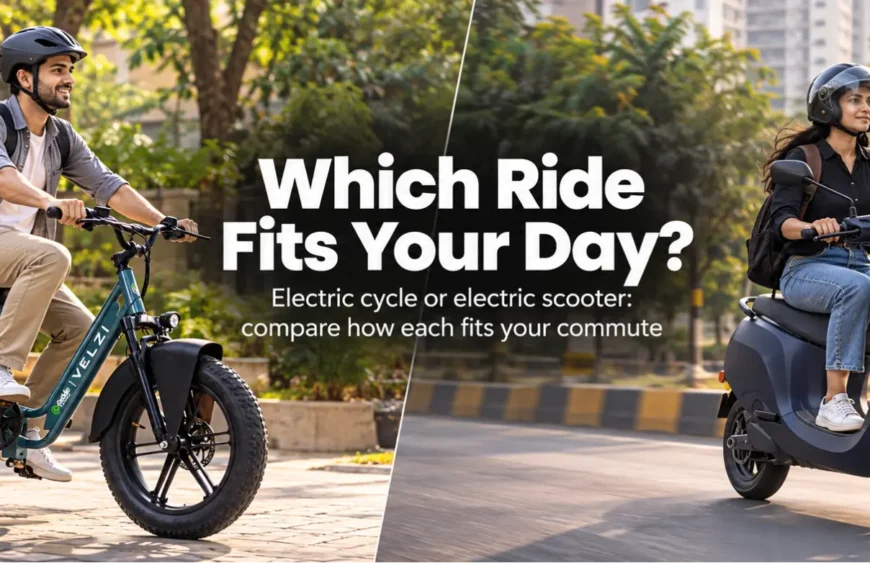
Choosing between an electric cycle vs electric scooter has become a practical question for Indian commuters in 2026. Both reduce dependence on petrol, both can handle everyday city trips, and both are far cheaper to energise than a conventional petrol two-wheeler. But they serve different kinds of riders. An electric scooter behaves like a compact motor vehicle. An electric cycle keeps the bicycle format and adds motor assistance, giving the rider the option to pedal, use pedal assist and, on some models, use a throttle.
That difference changes almost everything: purchase price, weight, parking, charging, exercise, registration requirements, range expectations and maintenance. A commuter travelling 8–15 km through congested neighbourhood roads may value the light footprint and low running cost of an e-cycle. Someone travelling farther at higher road speeds with a passenger or heavier luggage may prefer the capacity of an electric scooter.
This guide compares electric bicycle vs electric scooter ownership in an Indian context so you can decide based on actual use rather than assumptions.
The Basic Difference Between Electric Cycle vs Electric Scooter
An electric cycle is fundamentally a bicycle with an electric drive system. The rider can pedal normally and use electrical assistance when needed. A low-speed electric cycle such as the Doddle Velzi uses a 250W motor with a maximum assisted speed of 25 km/h. An electric scooter is designed as a motorised two-wheeler with a floorboard, scooter body, larger battery, higher vehicle weight and usually a higher-capacity electrical system.
| Factor | Electric cycle | Electric scooter |
| Basic format | Bicycle with motor assistance | Motor scooter powered by battery |
| Typical riding input | Pedal, pedal assist; some models include throttle | Throttle-operated |
| Vehicle weight | Generally lighter | Generally heavier |
| Exercise option | Yes | No meaningful pedalling |
| Parking footprint | Small | Larger |
| Battery size | Smaller | Much larger |
| Energy use | Very low | Higher than e-cycle, still lower than petrol |
| Passenger suitability | Usually designed primarily for one rider | Many models support rider + pillion |
Which Costs Less Upfront?
In most cases, an electric cycle costs less to buy than a full electric scooter. The difference is logical: an e-scooter requires a larger battery, heavier chassis, body panels, tyres, suspension, lighting, controls and vehicle-grade systems. E-cycles can therefore offer electric mobility at a lower entry price, especially for riders who do not need scooter-level speed or carrying capacity.
The Doddle Velzi is currently listed at ₹54,999 including shipping and taxes. Electric scooter prices vary widely by brand, battery size, speed and features, so buyers should compare current on-road prices rather than relying on old headline figures. Insurance, registration and financing can also affect the true upfront cost of a scooter.
Running Cost: E-Cycle vs Electric Scooter
Both are economical to charge, but an e-cycle usually consumes less electricity because its battery is much smaller. Velzi’s battery is 624Wh. A scooter battery may be several kilowatt-hours, meaning one full charge uses multiple times the electricity of an e-cycle. That does not make scooters expensive to run—they are still efficient—but for short daily distances an e-cycle has a clear energy-consumption advantage.
| Cost area | Electric cycle | Electric scooter |
| Electricity per charge | Very low due to small battery | Higher due to larger battery |
| Tyres/brakes | Bicycle-scale components; generally lower cost | Scooter-scale components; generally higher cost |
| Insurance | Depends on vehicle classification; low-speed e-cycles may not require it | Usually part of normal road ownership requirements for registered scooters |
| Routine service | Bicycle drivetrain + electrical checks | Vehicle-grade brakes, tyres, suspension, electrical system |
| Battery replacement | Smaller pack, generally lower absolute cost | Much larger pack, higher replacement value |
Speed and Commute Distance
This is where the electric cycle or scooter decision becomes personal. If your route is short, congested and filled with frequent stops, a 25 km/h e-cycle can be perfectly adequate. Urban average speeds often fall well below posted road speeds because of signals, traffic, narrow lanes and parking delays. For longer arterial-road commutes, an electric scooter’s higher cruising speed can save time when traffic conditions allow it.
Range must also be interpreted differently. E-cycle range is highly affected by how much the rider pedals and which assist mode is selected. Doddle lists Velzi at up to 85 km on pedal assist and up to 45 km on throttle. Electric scooters usually publish a certified or claimed motor-only riding range because pedalling is not part of the equation.
Charging Convenience
Charging can be more important than range. A scooter may offer a large battery, but apartment residents need either a parking-area charging point or a removable pack that is manageable to carry. An e-cycle battery is much smaller. Velzi’s 48V 13Ah battery is removable, so a rider can take it into a home, office or hostel room for charging.
- Choose an e-cycle if you frequently park where there is no power socket.
- Choose a scooter only after confirming your building or workplace charging setup.
- If either vehicle has a removable battery, check actual battery weight and carrying convenience.
- Avoid buying purely on maximum range if charging access is inconvenient.
Parking and Traffic Practicality
An e-cycle occupies less space and is easier to move manually. That matters in crowded residential buildings, office parking areas and college campuses. It can often be rolled through narrow entries or repositioned without starting the motor. Walk Assist on Velzi is designed for exactly this kind of low-speed manoeuvring.
An electric scooter offers more road presence, built-in storage on some models and easier passenger use, but it needs scooter-sized parking. In congested cities, parking convenience can be a daily quality-of-life factor—not a minor feature.
Fitness and Rider Effort
The biggest difference in electric cycle vs scooter use is that an e-cycle lets you decide how much physical effort you want. On a low-energy day, higher pedal assist can reduce effort. On a fitness-focused day, you can lower assistance or pedal normally. An electric scooter does not provide this flexibility because the motor performs the propulsion work.
For many office commuters, this makes an e-cycle a bridge between transport and light daily activity. The rider does not need to treat every trip as a workout; the point is that movement remains available instead of being removed entirely.
Comfort on Indian Roads
Scooters usually have a larger, more enclosed riding position and can feel more familiar to people moving from petrol two-wheelers. Electric cycles vary greatly. Thin-tyre, rigid-frame models can feel harsh on rough streets, while comfort-oriented models use wider tyres and suspension.
Velzi uses 20×4 fat tyres, front suspension and rear mono shocks. That combination is intended to improve stability and comfort over potholes, broken patches and uneven city roads. When comparing an e cycle vs electric scooter, test ride both on realistic road surfaces rather than only smooth showroom lanes.
Licence, Registration and Compliance
Low-speed electric cycles with a 250W motor and maximum speed of 25 km/h are generally positioned in India as the category that does not require the same registration and driving-licence process as conventional motor vehicles. Velzi is built to these 250W / 25 km/h specifications. Electric scooters can fall into different regulatory categories depending on their speed and power, so buyers should confirm the exact legal requirements of the model they are considering.
Regulations can change, and manufacturer documentation should always be checked at the time of purchase. Avoid assuming that every product called ‘electric’ follows the same rules.
Which Is Better for Different Daily Users?
| User profile | Electric cycle may suit you if… | Electric scooter may suit you if… |
| Office commuter | Trip is short to moderate and parking is tight | Trip is longer and higher cruising speed matters |
| College student | Campus/hostel charging and affordability matter | Long off-campus travel or pillion use is frequent |
| Fitness-conscious rider | You want pedalling as part of the commute | Exercise is not a transport priority |
| Apartment resident | You need a small removable battery | You have dependable parking-area charging |
| Family use | One rider, light luggage | Pillion and heavier carrying are regular needs |
| Mixed roads | You choose an e-cycle with suitable tyres/suspension | You want scooter-style stability and bodywork |
Quick Decision Checklist
- Pick an electric cycle when your commute is usually short to moderate, you want very low energy use, parking space is limited and you like the option to pedal.
- Pick an electric scooter when you regularly need higher road speed, pillion capacity, more built-in carrying space or longer motor-only travel.
- Compare charging access before comparing advertised range.
- Compare real service support, battery warranty and spare-parts availability for both options.
- Test comfort with your normal bag, clothing and route conditions.
Where the Doddle Velzi Fits
Velzi is designed for riders who want the low running cost and flexibility of an e-cycle without choosing a bare-bones bicycle setup. Its 250W motor, removable 48V 13Ah battery, up to 85 km PAS range, five riding modes, fat tyres and front/rear suspension support everyday commuting. It is particularly relevant for riders who value charging flexibility and do not need scooter-level speed.
Choose for Your Route, Not the Category Name
There is no universal winner in electric cycle vs electric scooter because the two formats solve different mobility problems. The better choice is the one that fits your distance, road speed, charging access, parking, passenger needs and preferred riding style. If most of your trips are individual urban commutes and you value low running cost, compact parking and the ability to pedal, an electric cycle can be the more efficient tool. If your daily travel requires higher speed, pillion use and heavier loads, an electric scooter may be more practical.
For many Indian city commuters, the decision becomes clear after mapping one normal week of travel. Write down your daily kilometres, where you park, whether you carry a passenger and where you can charge. Those four facts are more useful than any broad claim about which category is ‘better’.
Ready to see how Velzi’s removable battery fits your routine?
Book A Free Demo Ride | Check EMI Options | Know Your Velzi Electric Cycle
Frequently Asked Questions About Electric Cycle vs Electric Scooter
Which is cheaper to run electric cycle or electric scooter?
An electric cycle normally uses less electricity because its battery is much smaller. Routine mechanical costs can also be lower because many parts are bicycle-scale. Actual cost depends on model, usage and maintenance.
Is an electric cycle good enough for a daily office commute?
Yes, if your route and speed expectations suit the format. A commuter e-cycle with adequate range, reliable brakes, comfortable tyres and a removable battery can work well for short to moderate city commutes.
Which has better range electric bicycle vs electric scooter?
Scooters often carry much larger batteries, but range figures are not directly comparable. E-cycle range can increase significantly when the rider contributes through pedal assist, while scooter range is motor-only.
Can an electric cycle replace a scooter?
For solo commuting, errands and short-to-moderate urban trips, it can. If you regularly carry a passenger, travel on faster arterial roads or need scooter-style storage, the scooter format may remain more suitable.
Does the Doddle Velzi require a licence?
Velzi uses a 250W motor and is limited to 25 km/h, specifications generally associated with low-speed electric cycles in India that do not follow the standard registration/licensing process of higher-speed motor vehicles. Buyers should verify current rules when purchasing.
Which is easier to charge in an apartment?
An electric cycle with a removable battery is usually easier because the battery pack is smaller and can be carried indoors. Large electric-scooter batteries may require a parking-area socket unless they are removable.
Which is better for college students?
An e-cycle often works well when trips are short, parking is tight and the student wants low running cost. A scooter may make more sense for longer off-campus travel, frequent pillion use or higher-speed routes.
Which option needs less maintenance?
Both electric formats avoid petrol-engine maintenance, but an e-cycle generally has simpler, lighter mechanical components. It still needs regular chain, brake, tyre and electrical checks.