
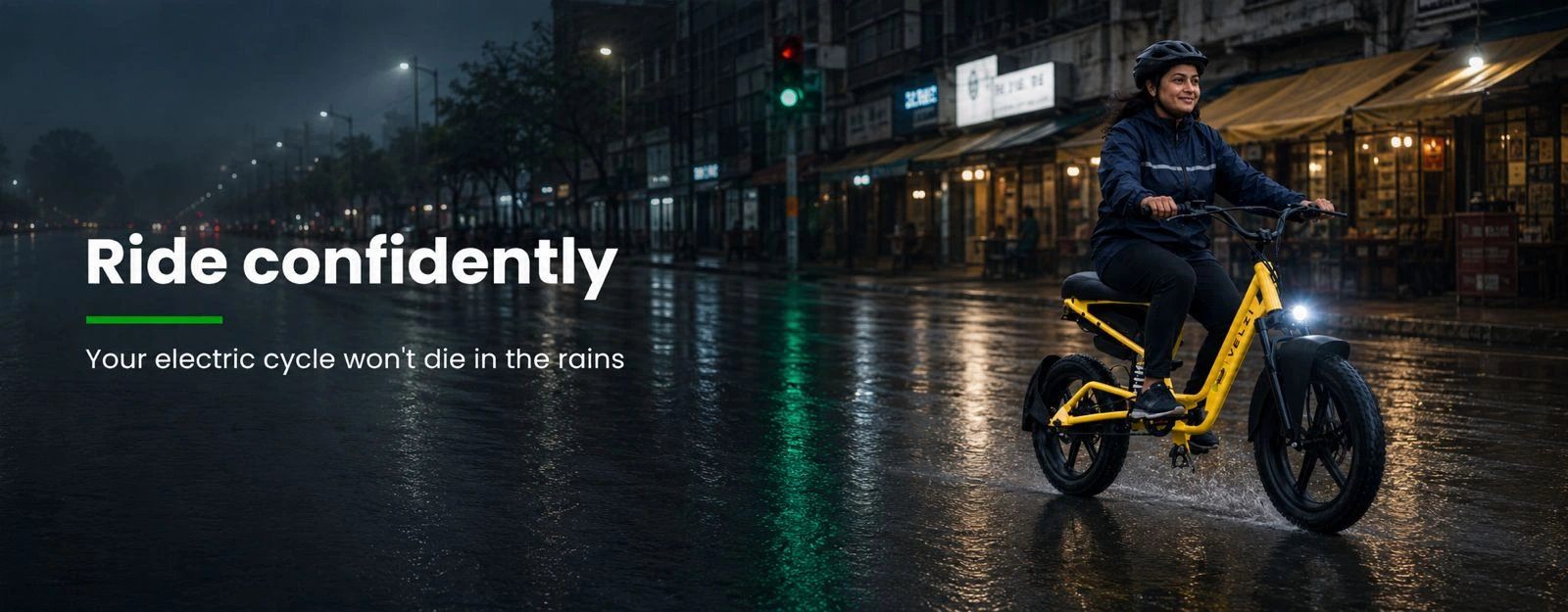
Short answer: Yes – ride confidently. The Doddle Velzi’s motor, battery and display cluster are IP65 rated – sealed against dust and low-pressure water jets – with internal wiring routing, built for Indian monsoon riding. The rule to remember: electric cycles are water-resistant, not waterproof. Rain is fine. Waterlogging deeper than about 10 cm is not – water should never reach the rear hub motor. And never charge a wet cycle. Full guide below.
India’s monsoon doesn’t do things by halves. The 2025 southwest monsoon delivered 937.2 mm of rainfall nationally – about 108% of the long-period average (IMD Monsoon Report 2025). Mumbai’s peak monsoon days can cross 100 mm of rain in 24 hours. Kochi and Mumbai spend four months a year wet; Chennai gets its drenching from October.
So for every e-cycle commuter, the question isn’t academic: do you park it for a third of the year, or keep riding? If you own a well-built electric cycle and follow a few habits, the answer is: keep riding. Here’s everything you need to know.
Monsoon question about your Velzi right now? WhatsApp our 24×7 assistance line: +91 99871 15536.
Water-Resistant vs Waterproof: The Distinction That Actually Matters
No electric cycle – at any price, from any brand – is fully waterproof. Every honest manufacturer will tell you the same thing: e-cycles are water-resistant, to a degree defined by their IP (Ingress Protection) rating.
Water-resistant means the electrical components withstand a defined level of water contact: rain, road spray, splashes. It does not mean the cycle can be submerged, ridden through flooded roads, or pressure-washed. Think of it the way you think of a water-resistant watch – brilliant in the rain, not built for the swimming pool.
The practical version of the rule, straight from how we engineer the Velzi: as long as water doesn’t reach the rear hub motor, you’re safe to ride. That’s the physical logic behind the 10 cm waterlogging limit you’ll read below.
IP Ratings Explained – And What the Velzi Carries
IP ratings have two digits: the first for dust (1–6), the second for water (1–8). For monsoon riding, the second digit is the one that matters.
| IP Rating | What It Means | Monsoon Riding? |
| IPX4 | Splash-proof from all directions | Light drizzle only |
| IP54 | Dust-resistant + splash-proof | Light to moderate rain |
| IP65 | Dust-tight + protected against low-pressure water jets | Confident riding in normal to heavy monsoon rain |
| IP67 | Dust-tight + brief immersion up to 1 m | Heavy rain + shallow standing water |
The Doddle Velzi’s motor, battery pack and display cluster are IP65 rated, and its wiring is routed internally through the frame – no exposed cable runs collecting water where you can’t see them. In plain language: dust-tight components that shrug off rain and road spray, which covers the overwhelming majority of real Indian monsoon riding.
Here’s a buying tip that will serve you regardless of brand: ask any e-cycle seller for the IP rating on the motor and battery – in writing. Many brands in the market don’t publish one. If the seller can’t answer, that tells you something. We publish ours.
Can You Ride the Doddle Velzi in Monsoon Rain? Yes – Here’s Why
- IP65-rated motor, battery and display cluster – sealed against dust and rain, verified for Indian riding conditions
- Internal wiring routing – cables run inside the frame, away from rain and road spray
- Battery cover – an added layer between the removable 48V battery and the weather
- 20×4 fat tyres – a wide contact patch that helps the ride feel planted on wet, slippery surfaces
- Front and rear disc brakes – disc brakes maintain more consistent stopping performance in the wet than drum brakes
- LED headlight and tail light with brake light – visibility both ways in grey, low-light monsoon conditions
None of this makes the Velzi invincible – no e-cycle is. What it means is that rain itself is not the enemy. The two real risks in an Indian monsoon are deep waterlogging and careless charging, and both are fully within your control.
Monsoon Riding: Do’s and Don’ts
| DO | DON’T |
| Ride confidently in light to heavy rain | Ride through waterlogging deeper than ~10 cm – water must never reach the rear hub motor |
| Check the charging port cover is closed before riding | Charge the cycle while it’s wet |
| Slow down – wet roads need noticeably more braking distance | Pressure-wash the motor or battery area |
| Use the LED headlight even in daytime rain | Ride through flooded underpasses or submerged stretches |
| Remove the battery and store it indoors if parking in the open | Park overnight in a spot that waterlogs |
| Wipe the display, connectors and port area dry after a wet ride | Ignore a cracked or missing port cover |
8 Monsoon Habits That Keep Your E-Cycle Healthy for Years
1. Know your depth limit – and the reason for it. Wet roads and shallow puddles are fine. The limit is about 10 cm of standing water – the practical rule is that water should never reach the rear hub motor. If you can’t see the road surface through the water, take the other road.
2. Slow down and brake early. Wet tarmac gives your tyres less to hold onto, and painted road markings become skating rinks. Ride at 15–18 km/h in heavy rain rather than the full 25, and start braking earlier at every junction and speed-breaker. The Velzi’s dual disc brakes do their job in the wet – give them the distance to do it.
3. Let it dry before you charge. After a properly wet ride, park the Velzi in a covered spot, wipe the charging port area with a dry cloth, and let it air-dry before plugging in. Better yet – pop the battery out and charge it indoors, dry and comfortable, the way the removable design intends. This one habit prevents the most common monsoon electrical issues on any e-cycle.
4. Check the charging port cover before every wet ride. It’s the most vulnerable water entry point on any electric cycle. Thirty seconds to confirm it’s closed and undamaged. If it’s cracked or missing, replacements are easy to source locally – or WhatsApp our support line and we’ll guide you.
5. Wipe down after wet rides. Two minutes with a dry cloth on the display, battery contacts and port area. City rainwater carries pollutants that corrode contacts slowly over seasons – this tiny ritual is what “long-term ownership” actually looks like.
6. Keep tyres in their recommended pressure range. Underinflated or overinflated tyres both behave worse in the wet. The recommended range is printed on the tyre sidewall – stay inside it.
7. Be seen. LED headlight on, even at noon, in heavy rain. A rain jacket with reflective strips if you commute daily. In monsoon visibility, being seen early is the best safety feature there is.
8. Book a post-monsoon check. After four months of humidity and spray, have your dealer inspect seals, connectors and brake pads once the season ends. Find your nearest dealer or book via WhatsApp.
City-by-City Monsoon Guide for Velzi Riders
The monsoon isn’t one thing – it behaves differently in every city Velzi riders call home. Test rides and dealer support are available in Delhi, Kolkata, Bengaluru, Ahmedabad, Surat, Coimbatore and Kochi.
| City | Monsoon Season | Character | What Velzi Riders Should Watch |
| Mumbai | Jun–Sep | Heavy, sustained | Severe waterlogging in low-lying areas (Hindmata, King’s Circle) during peak spells – reroute, don’t wade |
| Delhi NCR | Jul–Sep | Short intense bursts | Underpass flooding after cloudbursts; roads dry fast – wait out the burst |
| Kolkata | Jun–Sep | Heavy, humid | Rapid waterlogging in Behala and Salt Lake after evening showers |
| Bengaluru | Jun–Oct | Erratic, flash-prone | Flash flooding in low-lying tech corridors (Koramangala, Bellandur) |
| Ahmedabad | Jun–Sep | Moderate | Occasional flash flooding in low-lying pockets; mostly very rideable |
| Surat | Jun–Sep | Heavy spells | Tapi riverside areas and central underpasses fill quickly |
| Kochi | Jun–Sep (+Oct) | Among India’s wettest | Long wet season – the wipe-down and dry-charging habits matter most here |
| Coimbatore | Oct–Nov | Light–moderate | One of India’s most manageable monsoon riding cities |
The rule in every city is the same: rain is fine; standing water is the thing to route around. Follow your city’s civic flood alerts (BMC, KMC, BBMP) during heavy spells.
Electric Cycle vs Petrol Two-Wheeler in the Monsoon
A few underrated advantages the electric cycle holds when the sky opens up:
- No stalling. Petrol engines can stall when water gets into the air intake or exhaust. An electric motor has neither – no cold-start drama on a wet morning.
- No fuel system to contaminate. No carburettor, no fuel line, no water-in-petrol worries.
- No exhaust to flood. One less expensive failure mode in waterlogged conditions.
- Quiet. You can hear traffic approaching in low-visibility rain – a genuine safety edge.
- Nothing to queue for. While petrol two-wheelers idle at the pump in the rain, you charged at home.
Add zero licence, zero registration and zero mandatory insurance, and the monsoon commute maths tilts further towards the e-cycle.
FAQs – Electric Cycles in Rain and Monsoon (India)
Can you ride an electric cycle in the rain in India?
Yes. A well-built electric cycle is designed for rain. The Doddle Velzi’s motor, battery and display cluster are IP65 rated with internal wiring routing, which covers normal to heavy Indian monsoon rain. The limits: avoid waterlogging deeper than about 10 cm (water should never reach the rear hub motor), never submerge the cycle, and never charge it while wet.
Is the Doddle Velzi waterproof or water-resistant?
Water-resistant – like every electric cycle honestly described. The Velzi carries an IP65 rating on its motor, battery pack and display cluster: dust-tight and protected against water jets, which means rain and road spray are handled. It should not be ridden through deep waterlogging or submerged.
What IP rating should an electric cycle have for Indian monsoons?
IP65 or above on the motor and battery is the benchmark for confident monsoon riding. The Velzi meets it. When comparing e-cycles, ask every brand for the IP rating on motor and battery in writing – many don’t publish one.
What happens if my electric cycle gets wet in heavy rain?
Nothing dramatic – that’s what the sealing is for. After a heavy soak: park it covered, wipe the connectors, display and charging port dry, and let it air-dry before charging. If you’ve accidentally been through deep water that may have reached the motor, get it checked before your next ride – WhatsApp support works 24×7.
Can I charge my electric cycle after riding in the rain?
Not immediately. Dry the charging port area first and let the cycle air-dry. The smarter monsoon habit: remove the Velzi’s battery and charge it indoors – dry, safe, and exactly what the removable design is for.
Does rain reduce an electric cycle’s range?
Not meaningfully. The battery is sealed and insulated. You may see a small reduction from riding slower and running lights continuously – not enough to matter on a daily commute.
Is it safe to ride in Mumbai or Kolkata during peak monsoon?
Yes, with city sense. In Mumbai, avoid known waterlogging zones like Hindmata and King’s Circle during and just after heavy spells. In Kolkata, watch Behala and Salt Lake after evening showers. Everywhere: rain is rideable, standing water is not.
Ride Through Every Monsoon
The monsoon is four to five months of the year in most Indian cities. A commuter who parks their e-cycle every time it rains gives up a third of the year’s savings and convenience – for a problem that good engineering and five habits already solved.
IP65-sealed electricals. Internal wiring. Fat tyres and disc brakes for the wet. A removable battery that charges indoors while the weather does its worst. The Velzi was built for Indian roads – and Indian roads come with Indian weather.
Keep riding:
- Monsoon doubt, any hour: WhatsApp our 24×7 line: +91 99871 15536
- Test ride before the next downpour: Presence in Mumbai, Delhi, Kolkata, Bengaluru, Ahmedabad, Surat, Coimbatore and Kochi – WhatsApp us to book
- Ready to ride the season: order at doddle.in – ₹54,999, free doorstep delivery, EMI available