
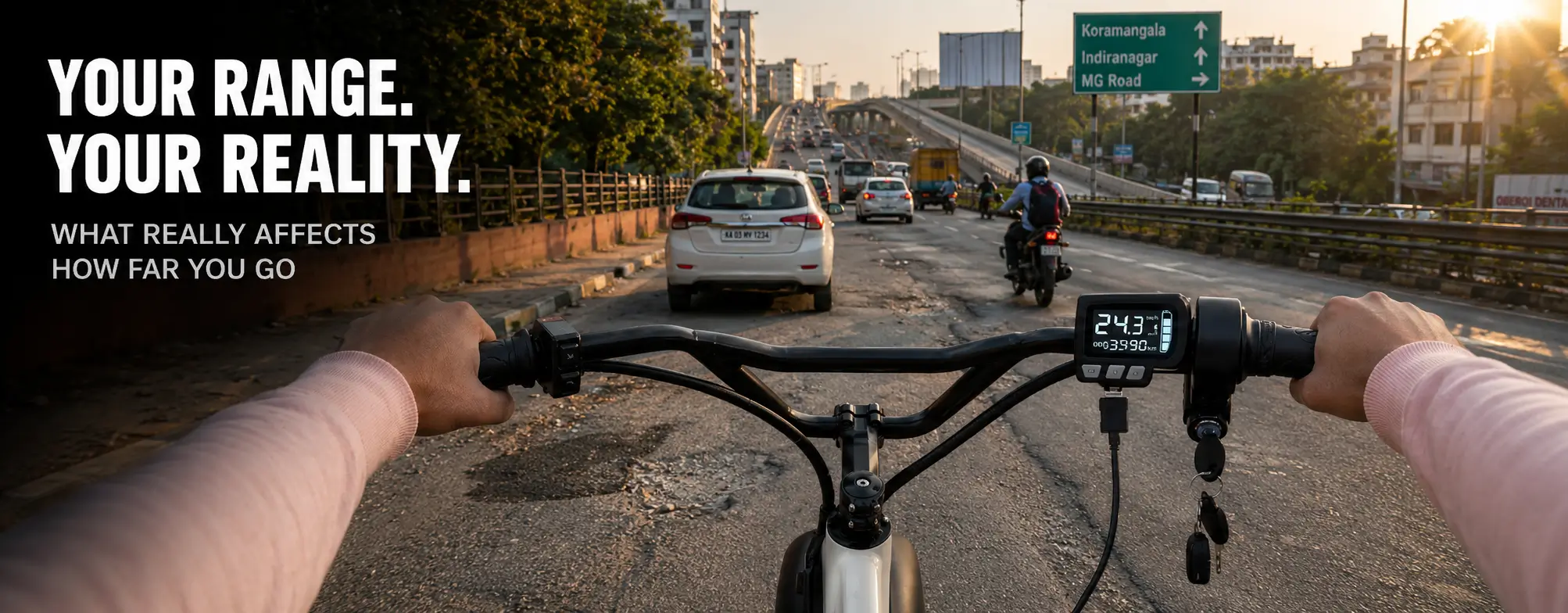
If you’ve searched for an electric cycle, you’ve probably seen “up to 80-85 km range” printed on more than one product page – including ours. It’s a real number. But it’s also a number that changes depending on who’s riding, where, and how. This guide breaks down exactly what “80 km” means, what actually eats into your range on Indian roads, and how to get the most out of every charge.
Quick answer: An electric cycle’s range depends mainly on battery capacity (Wh), motor power, rider weight, terrain, riding mode (pedal-assist vs. throttle), and tyre pressure. A cycle rated for 85 km typically delivers 65–80 km in real city riding conditions — Velzi users report even higher in favorable conditions – pedal-assist mode, moderate terrain, and a rider under 75 kg get you closest to the advertised figure.
What Does “80 km Range” Actually Mean?
Every electric cycle brand tests range under a defined set of conditions – usually a fixed rider weight (around 65–75 kg), flat road, low pedal-assist level, moderate speed, and no wind. This is standard practice across the industry, not unique to any one brand, and it’s why the number on the box is a best-case figure, not a guarantee.
That doesn’t make it dishonest – it makes it a benchmark. Two riders on the identical cycle can get very different distances: one riding uphill in Pune traffic carrying a backpack, and another cruising flat roads in the early morning with light pedalling. The battery and motor are the same; the outcome isn’t.
This is also the single biggest content gap we found when researching how other e-cycle brands talk about range – most either quote a single flat number with no context, or bury the test conditions in fine print. We think you deserve the full picture before you buy, especially for a purchase that’s supposed to replace a chunk of your daily commute cost.
How Electric Cycle Range Actually Works
Range comes down to a simple relationship: battery capacity ÷ energy consumed per km.
- Battery capacity is measured in watt-hours (Wh) – voltage × amp-hours. A 36V 15Ah battery, for example, stores 540Wh. Velzi’s 624Wh (48V 13Ah) removable lithium-ion battery sits above this typical range, which is part of why it supports a longer stated range.
- Motor power and efficiency determine how much of that stored energy goes into moving you forward versus getting lost as heat or resistance. A well-tuned 250W hub motor (like Velzi’s) is efficient enough for daily Indian commuting without draining the battery aggressively.
- Everything else – your weight, the road, the wind, the mode you ride in – determines how much energy is needed per kilometre.
In short: battery size sets the ceiling. Riding conditions decide how close you get to it.
10 Factors That Affect Your Electric Cycle’s Range
| Factor | Impact on Range | Why |
| Rider + cargo weight | High | Every extra kg means more energy to move it. A rider at 90kg vs. 65kg can see 10–15% less range. |
| Riding mode (throttle vs. pedal-assist) | High | Pure throttle mode drains the battery fastest since the motor does all the work. Pedal-assist can extend range by 30–40%. |
| Terrain and inclines | High | Climbing consumes significantly more power than flat roads; even gentle flyovers add up over a commute. |
| Speed | Medium-High | Higher speeds increase wind resistance, which the motor has to work harder to overcome. |
| Tyre pressure and type | Medium | Under-inflated tyres increase rolling resistance. Fat tyres (like Velzi’s 20×4) grip better on rough roads but need correct pressure to stay efficient. |
| Road quality | Medium | Potholes, gravel, and uneven surfaces (common on Indian roads) force the motor to compensate more often. |
| Battery age and health | Medium | Lithium-ion batteries naturally lose some capacity over hundreds of charge cycles – this is normal, not a defect. |
| Weather and temperature | Low-Medium | Extreme heat or cold slightly affects battery chemistry and efficiency. |
| Wind conditions | Low-Medium | Riding into strong headwinds increases the energy needed at any given speed. |
| Stop-start traffic | Low-Medium | Frequent braking and re-accelerating uses more energy than steady cruising – relevant for city commuters. |
Does a Fat Tyre Electric Cycle Reduce Range?
This is a common question, since electric cycles with fat tyres are increasingly popular for India’s uneven roads. Fat tyres do have slightly higher rolling resistance than slim tyres, but the difference is minor when tyres are correctly inflated. What fat tyres give up in marginal efficiency, they make up for in stability and reduced strain on the motor over potholes and broken roads – where a narrow-tyre e bike would need more power just to stay balanced and controlled. For most Indian city and semi-urban commutes, this trade-off favours fat tyres.
Range by Riding Mode: What to Expect
| Riding Mode | Typical Real-World Range* | Best For |
| Pedal-assist (low) | Closest to the rated 70-85 km | Long commutes, maximizing range |
| Pedal-assist (medium) | Moderate reduction, 60-70 km | Balanced daily use |
| Pure throttle | Lowest range, highest comfort, 45-50 km | Short trips, minimal pedalling effort |
*Actual figures vary by rider weight, terrain, and battery health – use this as a directional guide, not a fixed promise.
A Real-World Example: What 80 km Means for Your Commute
If your one-way office commute is 12 km, an 80 km-rated range (even at a real-world 60–65 km) means you could ride to work and back for 2–3 days before needing to recharge – instead of plugging in every single night. For most daily commuters in Indian cities, that’s the practical benefit of a long-range electric cycle: fewer charging cycles, less battery wear over time, and one less thing to think about on a Monday morning.
How to Maximize Your Electric Cycle’s Range
- Use pedal-assist instead of pure throttle whenever you can – even light pedalling significantly extends distance.
- Keep tyres at the recommended pressure – under-inflated tyres are one of the most common (and easiest to fix) range killers.
- Avoid unnecessary hard acceleration – smooth, steady riding uses less energy than frequent bursts of speed.
- Charge fully but avoid letting the battery sit at 0% for long periods, which can affect long-term battery health.
- Service your cycle regularly – a well-lubricated chain and properly aligned brakes reduce drag on the motor.
- Plan routes to avoid steep, repeated inclines where possible, especially on days you need maximum range.
Why Velzi Is Built for 85 km Range
Velzi’s 85 km real-world range comes from a precision-engineered combination:
- 624Wh removable lithium-ion battery (48V 13Ah) — one of the largest in its class
- Efficient 250W rear hub motor — optimized for steady-state commuting, not peak power
- 20×4 fat tyres with alloy mag wheels — stable rides on Indian roads without demanding excess power to stay balanced.
The result is a cycle engineered to get you genuinely close to its rated range in real commuting conditions – not just in a lab.
Questions about your specific commute? Chat with us on WhatsApp or
See Velzi’s full specifications → | Book a free demo ride →
Frequently Asked Questions
What affects an electric cycle’s range the most?
Rider weight, riding mode (throttle vs. pedal-assist), and terrain have the biggest impact. Riding in pedal-assist mode on flat roads with a lighter load gets you closest to the advertised range.
How far can an electric cycle really go on a single charge?
Most electric cycles rated for 80 km deliver 55–70 km in real-world city riding, depending on rider weight, terrain, and riding mode. Ratings are based on standard test conditions like flat roads and moderate pedal assist.
Does riding an electric cycle with a fat tyre reduce range?
Slightly, due to marginally higher rolling resistance, but the difference is small when tyres are properly inflated. Fat tyres improve stability on rough Indian roads, which can offset the minor efficiency trade-off.
Does battery age affect electric cycle range?
Yes. Lithium-ion batteries gradually lose some capacity after hundreds of charge cycles, which is normal wear rather than a defect. Proper charging habits help slow this decline.
Is throttle mode or pedal-assist better for range?
Pedal-assist mode extends range significantly compared to pure throttle, since the rider’s pedalling reduces how much work the motor has to do.
How many days can I go without charging an 80 km range electric cycle?
For a typical 10–15 km one-way commute, an 80 km-rated e bike can often last 2–3 days of riding before needing a recharge, depending on riding mode and terrain.
How does Velzi’s 85 km range compare to other electric cycles?
Velzi’s 85 km real-world range is verified through tested commutes under typical Indian riding conditions (pedal-assist mode, moderate terrain, rider under 75 kg). The combination of a large 624Wh battery, efficient 250W motor, and fat-tyre design engineered for Indian roads means Velzi users often achieve close to or exceed the rated range. Competitor cycles in this price range typically offer 60–75 km claimed range; Velzi delivers the range claim with real-world verification.
#VelziRange #ElectricCycleIndia #EBikeRange #UrbanCommute #ElectricVehicles #IndiaEV #FatTyreEBike #RealWorldTesting #CommuteSmart #CycleLife #IndianStartup #EcoCycling