
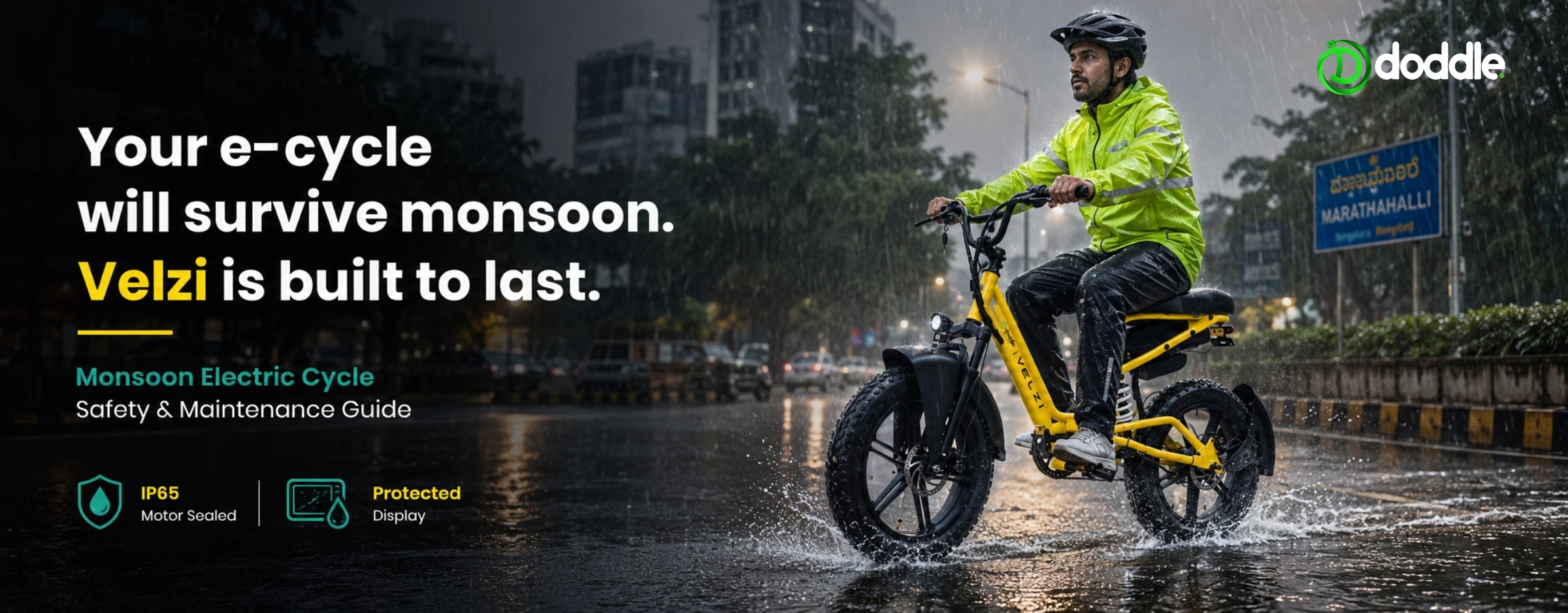
Monsoon in India lasts three to four months. If you commute year-round, monsoon is not optional – it is a reality. Here is what changes on an electric cycle in monsoon, what stays safe, and how to maintain it properly.
Quick answer: Yes, electric cycles ride safely in monsoon. But rain-safe is not waterproof. Velzi’s IP65 rating handles rain spray and wet roads, not river crossings or deep flooding. Range drops about ten percent. Maintenance matters more than specs.
1. What Happens to Electric Cycles in Monsoon Rain
1.1 Range Drop: Expect About 10% Less Distance
Heavy rain increases motor load:
• Wet tyre friction adds about 5% energy use
• Air resistance adds about 2% energy use
• Motor moisture sealing load adds about 3% drag
Real example:
• Dry conditions: Velzi 85 km range
• Heavy monsoon rain: 75–78 km effective range
• Safe planning margin for commute: 70 km
For your daily commute: if you ride 30 km daily, a 10% range drop doesn’t matter. You still get 2.8 days per charge. Completely safe.
Monsoon impact: minor. Plan for a 70 km safe margin instead of the claimed 85 km range. For a 30 km commute, there is no practical concern.
1.2 Fat Tyres Matter More Than Battery Specs
In monsoon, tyre type determines safety – not motor power or battery size.
Standard tyres (thin)
• Hydroplane on flooded roads (lose contact with pavement)
• Skid on wet tarmac at speed
• Puncture easily on submerged debris
• Risk of loss of control on water-filled potholes
Fat tyres (Velzi 20×4)
• Wider contact patch gives better wet grip
• Deep grooves channel water away, reducing hydroplaning
• Stability on loose gravel and waterlogged surfaces
• Puncture-resistant even over hidden potholes
Monsoon verdict: a fat-tyre e-cycle outperforms a thin-tyre one in monsoon more than battery capacity or motor power matters.
Real comparison: Velzi’s 20×4 fat tyres versus Nexzu or Hero’s 26-inch standard tyres – Velzi wins monsoon safety hands down. Specs mean nothing if the tyres slip on wet roads.
1.3 IP Rating Explained: IP65 vs No Rating
IP65 (Ingress Protection 6, 5)
• 6 = Dust-tight (sealed motor, sealed connectors, sealed display)
• 5 = Water jets from any angle (not submersion)
• Means: Safe from rain splash, spray, and weak water jets
• Does not mean: Waterproof for submersion, flooding, or deep water crossing
No IP rating (most competitors)
• Motor may not be sealed
• Connectors may corrode in rain
• Risk of short-circuit if water enters battery terminals
• Not monsoon-safe without explicit verification
Velzi’s IP65 rating
• Removable battery: sealed connector that won’t corrode
• Motor: sealed housing that keeps rain spray out
• Display cluster: sealed so water won’t reach circuits
• Wiring: internal routing through frame with no exposed connections
Safe for: rain commute, moderate monsoon, wet roads
Not safe for: puddle-jumping, deep flooding, river crossings
2. Velzi Monsoon Readiness: Component Breakdown
| Component | Velzi Rating | Protection |
| Motor (250W, 48V) | IP65 sealed | Rain spray won’t short-circuit; safe for monsoon commute |
| Battery (48V 13Ah) | Sealed connector | Removable; charge indoors; connector replaceable locally |
| Controller | Sealed housing | Wet roads won’t damage motor circuits |
| Brakes (hydraulic disc) | Standard | Work in wet; performance drops 5–10%; plan longer stopping distance |
| Tyres (20×4 fat) | Deep tread | Excellent wet traction; design channels water away |
| Frame (steel + paint) | Corrosion risk (like regular bikes) | Paint protection needed; monthly wipe-down; chain oiling essential |
| Charger (2-pin) | Standard | Keep indoors during monsoon; avoid wet outlet |
| Battery cover | Standard | Replaceable locally (₹200–500 if cracked) |
| Charging port cover | Standard | Replaceable locally; protects connector when not charging |
Bottom line: Velzi is monsoon-commute safe with proper maintenance. It is not set-it-and-forget-it – regular chain oiling and brake checks are essential, just like a regular bike.
3. Monsoon Riding Safety: 7 Critical Rules
3.1 Extend Stopping Distance
Rain adds 10–20% more braking distance.
• Dry road: 5 meters stopping distance from 25 km/h
• Wet road: 6–7 meters stopping distance from 25 km/h
• Action: Brake earlier, coast longer, reduce speed in heavy rain
This is the number one monsoon safety rule. Wet brakes lose grip. Plan for longer stops.
3.2 Avoid Flooded Areas
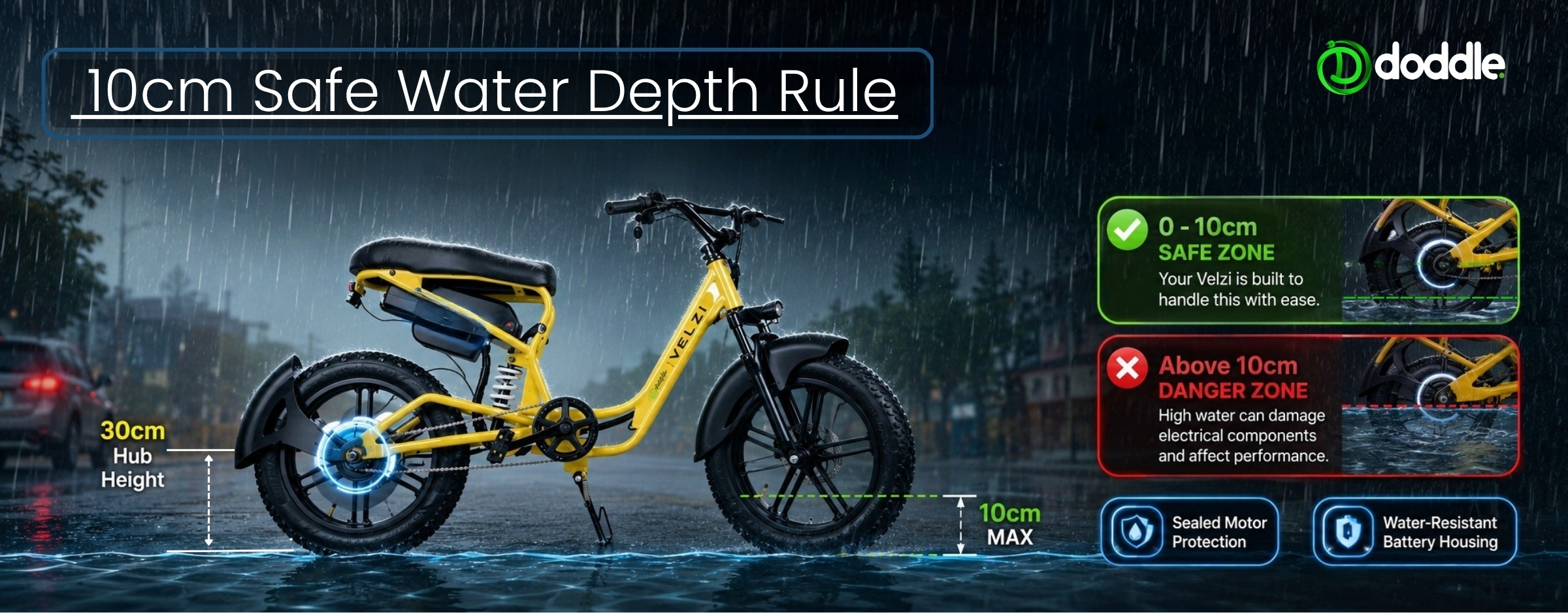
Water above hub height is a real risk.
• Hub height: about 30 cm from the ground
• Safe water depth: under 10 cm (Velzi’s design limit)
• Rule: if water rises above hub height, there is risk of water entering motor seals
• Action: check the monsoon route before commuting; use an alternate route if flooding occurs
This is non-negotiable. Deep water means motor damage risk.
3.3 Charge Indoors Only
A wet charger creates real damage risk.
• Never charge in rain
• Never charge with a wet outlet or wet connector
• Removable battery advantage: carry it to office or home and charge indoors
• Action: charge at night; ride with a full battery all day
If you must charge at the office during monsoon, use an indoor outlet only – never outdoors.
3.4 Check Brakes Weekly
Disc brakes squealing in monsoon is normal.
• Hydraulic brakes work in wet conditions
• Squealing noise is normal – it’s water between pad and rotor
• Fade is a problem: if brakes lose stopping power, pad replacement is needed (₹500–1,000 locally)
• Action: test brakes in a parking area before a rain commute; don’t discover brake fade mid-ride
Monthly brake pads cost ₹250–500. Budget for one pad replacement if you ride through four months of monsoon a year.
3.5 Wipe the Drivetrain After Wet Commutes
A two-minute prevention habit.
• Chain and gears rust faster in monsoon moisture
• Oil residue collects mud, which accelerates rust
• Prevention: a 2-minute wipe after each wet ride prevents ₹3,000–5,000 in damage
• Action: carry a small cloth in your saddlebag; wipe the chain and gears when you arrive at office or home
This is the highest-ROI maintenance action. Two minutes saves thousands of rupees.
3.6 Avoid High Speed in Heavy Downpour
Even fat tyres lose traction in aquaplaning conditions.
• Even Velzi’s fat tyres lose grip in extreme aquaplaning
• Reduce throttle use; rely on pedal assist only in heavy rain
• Risk: skidding on slippery roads and loss of control
• Action: slow down in a downpour; arriving late beats an accident
Real monsoon riding calls for conservative speed. Not every day is a safe-speed day.
3.7 Wear Visibility Gear
Reflective rain coat and lights matter.
• Visibility matters more than staying dry
• Drivers can’t see you in monsoon grey
• Velzi’s LED lights help, but are often not bright enough for monsoon
• Action: wear a reflective rain coat and consider an additional front light (₹500–1,000)
Visibility saves your life. Staying dry is secondary.
4. Monsoon Maintenance Schedule (DIY)
| Frequency | Task | Time | Cost |
| After every wet ride | Wipe chain and gears, dry frame | 3 min | ₹0 |
| Weekly (1x) | Oil chain lightly (don’t oversaturate) | 2 min | ₹20/month |
| Bi-weekly (2x) | Check brake squeal and stopping power | 2 min | ₹0 |
| Monthly (4x) | Full drivetrain wipe and re-oil | 10 min | ₹100 |
| Every 2 months | Inspect brake pad wear (feel texture) | 5 min | ₹0 (until replacement ₹1,500) |
| Every 3 months | Bearing grease inspection (listen for chain noise) | – | ₹500 if needed |
| End of monsoon | Deep clean drivetrain, full dry, re-oil | 30 min | ₹0 DIY / ₹1,500 service |
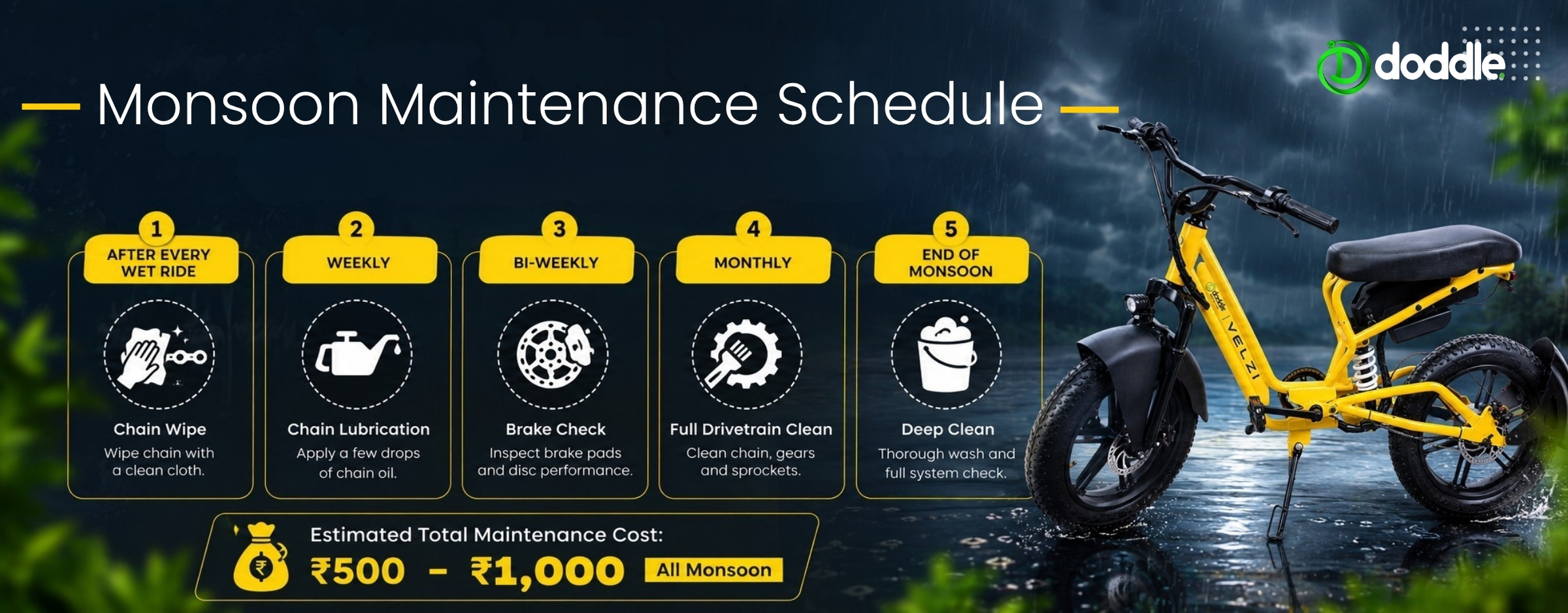
Total monsoon maintenance cost: ₹500–1,000 for the entire three to four month season (versus ₹200–300 for a regular bike).
Maintenance ROI: spending ₹500 on preventive maintenance saves ₹3,000–5,000 in rust damage.
5. Battery Health in Monsoon: Myths vs Reality
Myth: the battery dies in monsoon if exposed to rain.
Reality: the sealed connector and internal wiring protect the battery. The only real risk is charging in wet conditions.
5.1 Safe Battery Care
• Never charge outdoors or in rain
• Store the battery indoors after your commute
• Avoid leaving the bike unsheltered overnight (moisture accumulates)
• Keep the charger indoors during monsoon
• Once monsoon ends, inspect the connector for corrosion; if found, dry it and apply silicone grease
5.2 Cold Monsoon Nights
Battery capacity drops 5–10% naturally in cold, since cold reduces the speed of the chemical reaction. Capacity recovers as temperature rises. This is normal and temporary, not a defect.
Real scenario: your battery shows 70% capacity on monsoon mornings and 85% by afternoon after the sun is out. This is normal. By October, when monsoon ends, capacity fully recovers.
6. Monsoon Readiness Comparison: All Models
| Feature | Velzi | Nexzu | Ranger | Hero Lectro | URBN |
| IP Rating | IP65 verified | Not disclosed | Not disclosed | Not disclosed | Not disclosed |
| Fat Tyres | Yes – 20×4 | No – 26″ std 2.4″ | Yes – 20″ fat | No – 26″ std | No – 20×3 |
| Removable Battery | Yes – sealed | Yes – standard | Yes – standard | Yes – standard | Yes – standard |
| Rear Suspension | Yes – mono shock | No | Front only | Front only | Yes – dual |
| Monsoon Ready | Yes | Verify | Verify | Verify | Verify |
Monsoon winner: only Velzi combines IP65 protection with fat tyres designed for monsoon and Indian roads. For other brands, ask the seller for the IP rating before purchase.
7. Monsoon Riding FAQ
How much does range really drop in monsoon?
About 10% in heavy rain (85 km down to 75–78 km). For a 30 km daily commute, the safe margin remains 2+ days per charge – no practical impact. Light showers have under 5% impact.
Can I ride Velzi in a heavy downpour?
Yes. IP65 protection and fat tyres handle heavy rain safely, but hydroplaning risk, visibility, and brake performance all worsen. It’s safer to delay your commute or use backup transport on the worst days. Not a no-go, but increased caution is needed.
Will salt air (coastal monsoon) damage the battery?
There is an indirect risk. Salt spray corrodes connectors faster. Keep the charger indoors and wipe the connector monthly. Battery cells are sealed, so salt won’t reach them unless the connector corrodes first. Maintenance is the safeguard.
Do I need special monsoon tyres?
No. Velzi’s fat tyres are already optimized for monsoon and wet grip. Standard road tyres are fine. Don’t buy expensive monsoon tyres – they aren’t necessary for e-cycles.
Can I ride through a flooded crossing?
It depends on depth. Safe rule: if water is below hub height (about 10 cm), IP65 protection should handle it. If water is above hub height, there’s a risk of motor water-sealing failure. The safer path is to avoid flooded areas and use an alternate route – it’s not worth the risk.
What’s the worst monsoon scenario?
Charging the bike while wet, or leaving it unsheltered overnight in heavy rain. Solutions: always charge indoors, and keep the bike covered during monsoon (a simple tarp works). That covers 95% of monsoon safety.
Do I need insurance for monsoon?
It’s optional but smart, at around ₹1,500–3,000 per year. It covers accidental water damage, such as motor failure if IP65 seals fail or connector corrosion. Check the policy fine print, since some exclude monsoon damage – read before buying.
Will monsoon riding void the warranty?
No, if you follow usage guidelines (no submersion, proper maintenance). Warranty covers manufacturing defects. Accidental damage, such as riding through deep flooding, is not covered. Maintenance-related damage, such as rust from not oiling the chain, is also not covered. Proper care keeps the warranty valid.
Can I leave my e-cycle outside during monsoon?
Not ideal. An uncovered bike accumulates moisture, the paint rusts, and the chain corrodes. If you must leave it out, a monthly wipe-down is essential along with weekly chain oiling. A rain cover is recommended (₹500–1,000).
How often should I service the bike during monsoon?
Either a monthly full drivetrain service (₹500–800 at a service center) or a weekly DIY wipe. Monthly service by a professional is easier; weekly DIY is cheaper. Either approach prevents ₹3,000+ in rust damage.
Is monsoon riding really safe for an office commute?
Yes. Velzi’s IP65 rating, fat tyres, and proper maintenance together make monsoon commuting safe. Thousands of riders in Mumbai, Bengaluru, and Kolkata ride through monsoon without issues – maintenance and caution are what make it safe.
8. Monsoon Riding Habits: 8 Daily Tips from Velzi Riders
From riders in Mumbai, Bengaluru, and Kolkata during monsoon:
• Check weather before commute – use a weather app to avoid peak downpour times and plan alternate days.
• Charge the battery at night – ride with a full charge and avoid outdoor charging risk. Start the day with a fresh battery.
• Keep extra chain lube at the office – a quick wipe and light oiling after a wet commute takes 3 minutes and prevents rust at the source.
• Test brakes in the parking lot – discover brake fade in a safety zone, not on the road, and know your stopping distance.
• Plan an alternate route – know the monsoon flooding spots on your commute and use a bypass if needed; don’t rely on one route.
• Wear high-visibility gear – a reflective rain coat and bright helmet help drivers see you. Visibility beats staying dry.
• Slow down in heavy rain – fat tyres help, but aquaplaning is real, so speed down. Arriving late is better than a crash.
• Do a post-monsoon inspection – after the season ends, inspect for rust, replace worn brake pads, and deep clean the drivetrain.
9. Monsoon Commute Checklist
9.1 Before Monsoon Season (May–June)
☐ Verify the IP rating of your e-cycle (IP65 is good; none means caution)
☐ Inspect tyres for wear (monsoon plus worn tyres is dangerous)
☐ Test brakes in dry conditions and know your stopping distance
☐ Plan a charging location that is indoors only during monsoon
☐ Buy reflective rain gear and additional lights
☐ Set a weekly maintenance reminder for chain oiling and brake checks
9.2 Weekly During Monsoon (July–September)
☐ After each wet ride, wipe the drivetrain (3 minutes)
☐ Check for brake squealing (normal) versus brake fade (a problem)
☐ Inspect the battery connector for corrosion with a visual check
9.3 End of Monsoon (October)
☐ Deep clean the drivetrain and re-oil
☐ Replace brake pads if worn (indicator: squealing persists)
☐ Inspect the frame for rust spots
☐ Store the bike dry until next monsoon
10. Monsoon by City: What to Expect
10.1 Mumbai (July–September)
• Heaviest monsoon rainfall in India
• Waterlogging common in coastal areas
• Range impact: about 10% (85 km down to 75 km)
• Maintenance priority: weekly chain oiling, bi-weekly brake checks
• Velzi readiness: IP65 protection is essential here
10.2 Bengaluru (June–September)
• Moderate monsoon with intermittent heavy rains
• Potholes worsen during monsoon
• Range impact: about 8% (85 km down to 78 km)
• Maintenance priority: pothole impact checks, suspension inspection
• Velzi readiness: fat tyres shine here
10.3 Kolkata (June–September)
• Long monsoon with frequent heavy showers
• Humidity and waterlogging combined
• Range impact: about 10%
• Maintenance priority: rust prevention through chain oiling and connector checks
• Velzi readiness: IP65 protection and sealed connector are essential
10.4 Delhi (July–September)
• Shorter monsoon, less intense than coastal cities
• Occasional heavy downpours
• Range impact: about 5% (85 km down to 81 km)
• Maintenance priority: brake checks for occasional rain stress
• Velzi readiness: IP65 protection recommended but less critical than coastal cities
10.5 Ahmedabad and Surat (June–September)
• Moderate monsoon with dusty pre-monsoon conditions
• Dust combined with moisture increases corrosion risk
• Range impact: about 8%
• Maintenance priority: connector drying, chain oiling
• Velzi readiness: sealed connector is essential
11. Monsoon Support and Test Ride
Velzi service centers in monsoon-heavy cities:
• Mumbai (Worli) – monsoon service hub with monsoon test rides available
• Bengaluru, Kolkata, Delhi – year-round support with monsoon expertise
• Ahmedabad, Surat, Kochi, Coimbatore – seasonal support centers
Book a monsoon test ride to experience fat-tyre wet grip and IP65 water protection firsthand. Ride in actual monsoon conditions if possible.
WhatsApp: +91 99871 15536
• Monsoon questions
• Maintenance guidance
• Warranty support
• Test ride booking
24/7 Support: available for monsoon concerns at any time.
12. Key Takeaways: Monsoon E-Cycle Safety
• Range drop about 10% – plan for a 70 km safe margin instead of the claimed 85 km
• Fat tyres matter more than battery specs – traction matters more than motor power
• IP65 verification is essential – know your bike’s water rating before monsoon
• Maintenance prevents 95% of damage – weekly chain oiling, monthly drivetrain cleaning
• Charge indoors always – the removable battery means you can charge at office or home, never outdoors
• Extend braking distance – wet roads need 10–20% longer stops
• Slow down in heavy rain – even fat tyres lose grip in aquaplaning
• Brake pads cost ₹250–500 – budget for one replacement over a four-month monsoon
Bottom line: yes, ride your e-cycle in monsoon. But ride smart – proper maintenance, slower speed, caution around floods, and indoor charging. Velzi’s IP65 rating, fat tyres, and removable battery make it monsoon-ready if you care for it.