
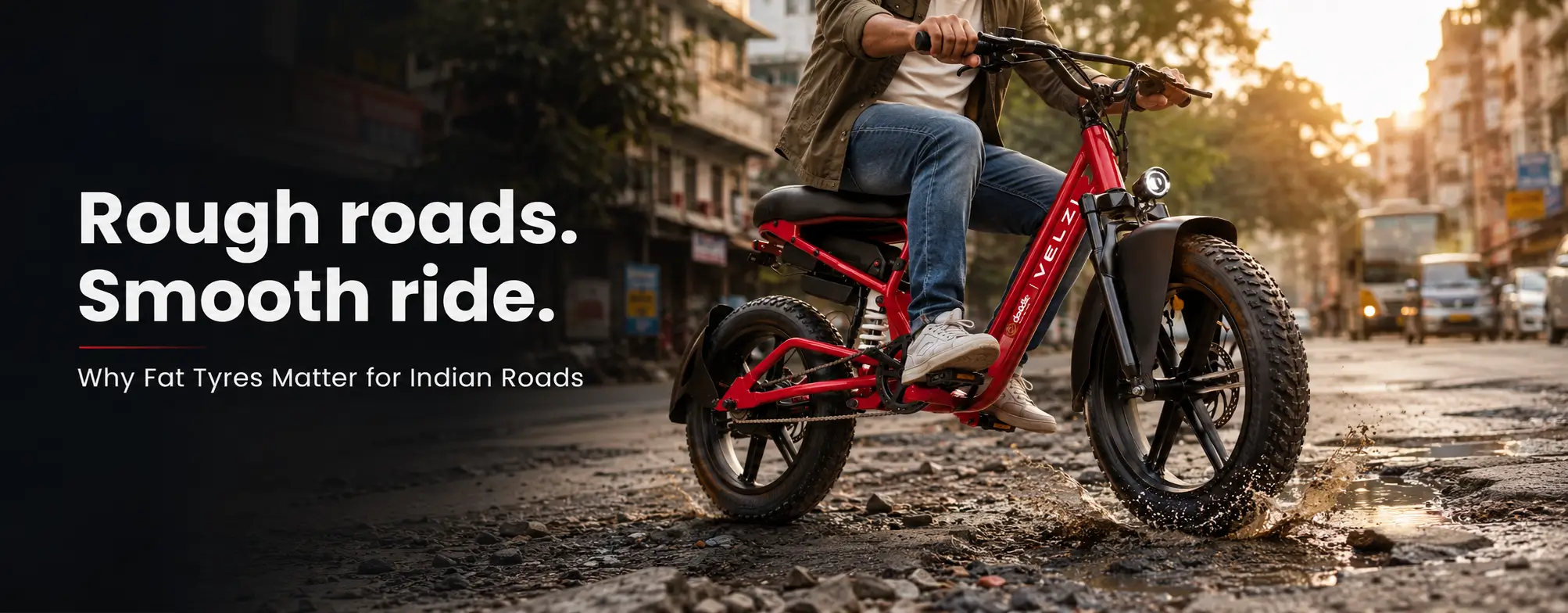
Anyone who has ridden a two-wheeler in India knows the drill: a smooth stretch of road one moment, a pothole-riddled mess the next. Between monsoon damage, patchy repairs, and uneven construction, Indian roads test every vehicle that rides on them – and standard-tyre e-cycles often struggle to keep up.
Fat tyre electric cycles are changing that experience. Built with wider, higher-volume tyres than regular bicycles or e-cycles, they’re designed to absorb shocks, grip uneven surfaces, and stay stable on exactly the kind of roads most Indian commuters deal with every day. If you’re deciding between a regular e-cycle and a fat tyre model, Doddle’s Velzi electric cycle electric cycle is a clear example of how this tyre design translates into a genuinely more comfortable daily ride.
Why do Indian roads need fat tyre electric cycles?
Fat tyre electric cycles exist because Indian road conditions demand more from a vehicle’s tyres than most standard designs can offer. Potholes, speed breakers, and uneven surfaces aren’t just an inconvenience — they’re a real safety and comfort factor. According to Ministry of Road Transport and Highways (MoRTH) data, nearly 3,625 pothole-related incidents occur annually in India, making tyre design a practical choice, not just a preference.
Fat tyre electric cycles help address this directly. Their wider contact patch and higher air volume let them absorb impact from potholes, loose gravel, and broken tarmac far more effectively than the thin tyres found on regular bicycles or basic e-cycles.
The scale of the problem is significant, too. A study by IIT Madras found that nearly 78% of urban potholes reported by citizens remain unfixed for more than two weeks, meaning riders can’t simply wait for smoother roads – they need a vehicle that handles rough conditions right now.
People also ask: Are Indian roads really that difficult for regular cycles and e-cycles? Yes. Monsoon damage, inconsistent repair work, and heavy traffic loads mean potholes and uneven surfaces are a near-daily reality in most Indian cities and towns, making tyre design a genuine safety and comfort factor, not just a preference.
What makes a fat tyre electric cycle different from a regular electric cycle?
Fat tyre electric cycles use tyres that are typically 3.5 to 4 inches wide, compared to the 1.5–2 inch tyres on standard bicycles and e-cycles. This width isn’t just cosmetic – it fundamentally changes how the vehicle handles rough terrain.
A few practical differences stand out:
- Better shock absorption: Wider tyres cushion impact from potholes and speed breakers, reducing strain on the rider’s back and wrists.
- Improved grip: A larger contact patch with the road means better traction on gravel, wet surfaces, and loose dirt – common on Tier 2 and Tier 3 town roads.
- Greater stability: Fat tyres lower the effective center of gravity, making the ride feel planted even at higher speeds or on uneven surfaces.
- Lower risk of punctures: The added tyre volume and often thicker sidewalls handle sharp debris better than slim tyres.
Fat tyre electric cycles do add a small amount of rolling resistance compared to thin-tyre designs, but for Indian riding conditions, the trade-off strongly favors comfort and safety over marginal efficiency gains.
How do fat tyres improve safety and stability on potholes?
Fat tyre electric cycles reduce the sudden jolts that cause riders to lose control when hitting a pothole at speed. Instead of the wheel dropping sharply into a gap, the wider tyre partially bridges smaller potholes and absorbs the impact of larger ones more gradually.
This matters especially for less experienced riders – students commuting to college, first-time e-cycle owners, or anyone riding on unfamiliar routes. A stable, predictable ride reduces the chances of sudden braking, skidding, or loss of balance on rough patches.
People also ask: Do fat tyres make an electric cycle harder to ride? No. Fat tyre electric cycles are generally easier for beginners to balance and control, since the wider tyre footprint offers more stability at low speeds and during sudden stops – a common concern for new riders navigating city traffic.
What is the price of a fat tyre electric cycle in India in 2026?
Fat tyre electric cycles in India in 2026 typically range from around ₹35,000 for basic models to ₹75,000 or more for premium options with suspension, disc brakes, and long-range batteries. Most riders looking for a genuinely comfortable, well-built option land in the ₹45,000–₹65,000 range.
At Doddle, we’ve priced the Velzi – which comes with 20×4 fat tyres, front suspension, and rear mono-shocks – at ₹54,999 (down from its listed price of ₹74,999, inclusive of shipping and taxes), positioning it firmly in that practical, value-focused bracket.
Ongoing ownership costs for a fat tyre electric cycle remain low:
- Charging cost: Roughly ₹5–10 per full charge.
- Battery replacement (after several years): Typically ₹5,000–₹12,000 for a standard e-cycle battery pack.
- Running cost: Around ₹0.15 per km, compared to roughly ₹2.50 per km for a petrol two-wheeler.
- Servicing: Minimal, since fat tyre e-cycles have fewer moving parts and no engine components to maintain – though tyre and brake checks are recommended more frequently given the rougher terrain they’re built for.
What does a fat tyre electric cycle built for Indian roads actually look like?
At Doddle, we design the Velzi specifically around the reality of Indian commuting – not idealized smooth-road conditions. That shows up in a few key specifications:
- 20×4 fat tyres for grip and stability across city lanes, highway shoulders, and unpaved stretches alike.
- Front suspension and rear mono-shocks, working alongside the fat tyres to absorb larger bumps and potholes.
- High tensile steel frame, built to handle repeated stress from rough roads without compromising durability.
- Front and rear disc brakes, ensuring reliable stopping power even on uneven or wet surfaces.
- 85 km range on pedal-assist mode (45 km on throttle), so riders can cover longer commutes across metro cities and Tier 2/3 towns without range anxiety.
According to Doddle’s 2026 India EV insights, riders in smaller towns and semi-urban areas often see the biggest comfort improvement after switching to a fat tyre e-cycle, simply because those roads tend to have less consistent maintenance than metro city arterial routes. Doddle’s advanced battery technology, paired with a removable 48V 13Ah pack, also ensures riders don’t have to compromise range for the added stability fat tyres provide.
Who should choose a fat tyre electric cycle?
Fat tyre electric cycles suit a wide range of riders, but a few groups benefit the most:
- Daily commuters riding through mixed road conditions – smooth highways, city potholes, and unpaved shortcuts in the same trip.
- Students who need a reliable, low-maintenance way to get to college regardless of road quality.
- Delivery professionals who ride for hours daily and need a vehicle that won’t add fatigue from a rough, jarring ride.
- First-time e-cycle riders, since the added stability makes learning to balance and brake far less intimidating.
- Tier 2 and Tier 3 town residents, where road infrastructure is often less consistently maintained than in major metros.
FAQs: Fat Tyre Electric Cycles for Indian Roads
1. Are fat tyre electric cycles better than regular electric cycles for city commuting?
Yes, especially in Indian cities. Fat tyre electric cycles handle potholes, speed breakers, and uneven surfaces more comfortably than thin-tyre models, reducing rider fatigue and improving safety.
2. Do fat tyres reduce the range of an electric cycle?
There’s a small efficiency trade-off due to increased rolling resistance, but well-designed fat tyre electric cycles like Velzi still deliver strong range – up to 85 km on pedal-assist mode – by pairing wider tyres with a capable battery and motor setup.
3. How much does a good fat tyre electric cycle cost in India?
Prices typically range from ₹35,000 to ₹75,000 in 2026, depending on features like suspension, battery capacity, and brake type. Doddle’s Velzi is priced at ₹54,999.
4. Are fat tyre electric cycles suitable for rainy or monsoon conditions?
Yes. The wider grip surface improves traction on wet roads, and models with strong disc brakes, like Velzi, offer more reliable stopping power in slippery conditions.
5. Do fat tyre electric cycles need a license to ride in India?
No. Electric cycles with a motor power of 250W and a top speed capped at 25 km/h, including fat tyre models like Velzi, fall under the low-speed EV category and don’t require a driving license or registration.
6. How often do fat tyre electric cycles need servicing?
Maintenance needs are generally low, but because fat tyre e-cycles are often ridden on rougher terrain, periodic tyre pressure checks and brake inspections are recommended slightly more often than for e-cycles used mainly on smooth roads.
Indian roads aren’t getting smoother anytime soon. If your commute crosses unpaved stretches, potholes, or monsoon-damaged roads, fat tyres aren’t optional — they’re practical engineering. Experience the difference on your actual route.
Book your free demo: +91 99871 15538 (WhatsApp)
Explore the Velzi electric cycle
[ #FatTyreElectricCycle #VelziIndia #IndianRoads #UrbanCycling #ElectricCycle #Potholes #CycleLife #SustainableTransport #IndianYouth #CityCommute #BikeFriendly #EcoCycle ]