
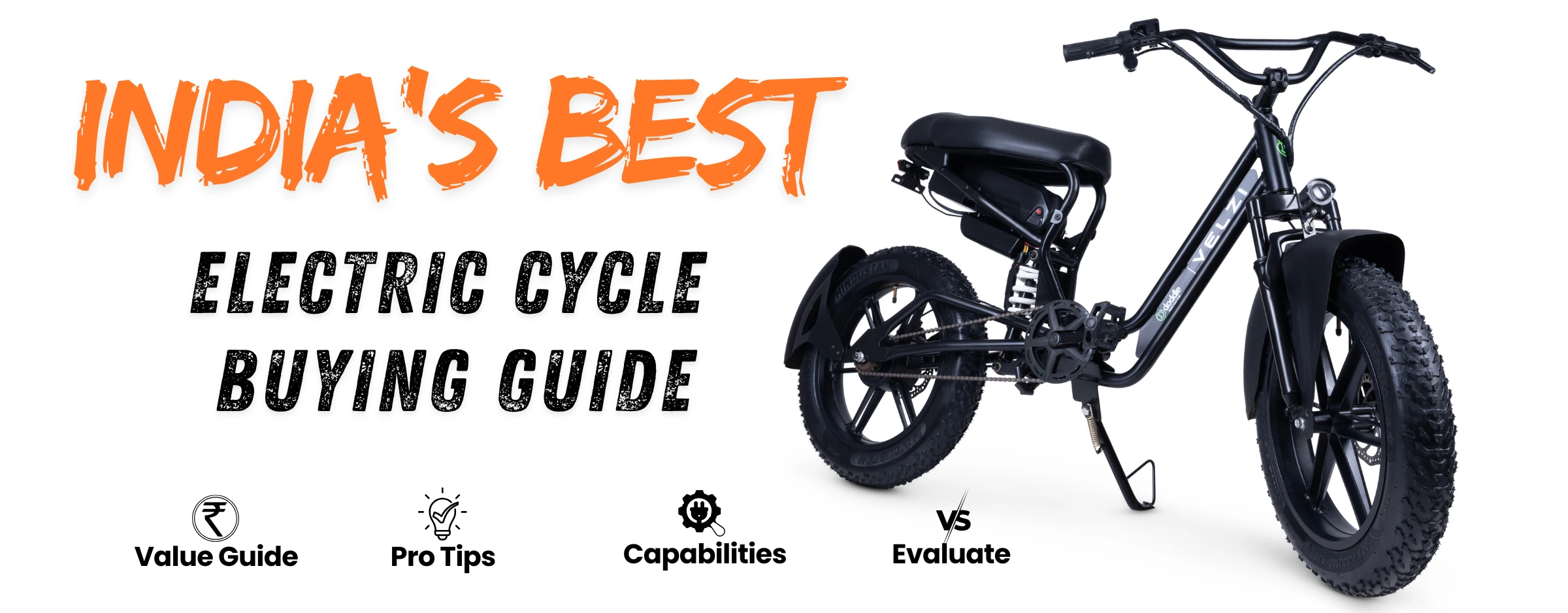
Finding the Best Electric Cycles in India Just Got Easier
Best electric cycles in India are no longer a small, hard-to-navigate category – they are a thriving, fast-evolving market with dozens of options across every budget, riding style, and use case. But with so many models flooding the market in 2026, how do you separate the genuinely great from the merely good?
Whether you’re a daily commuter tired of rising petrol prices, a student looking for an affordable and licence-free ride, a delivery professional wanting to slash fuel costs, or simply someone who wants to ride cleaner and smarter – this guide is built for you.
India’s electric two-wheeler sector crossed 1.5 million units in annual sales during 2025–26, with e-cycles accounting for a rapidly growing share of that figure. The combination of improving technology, expanding service networks, and real-world practicality has made 2026 the best year yet to buy an e-cycle.
Doddle’s lineup of high-performance electric cycles is among the most talked-about in the Indian market – engineered specifically for Indian roads, Indian budgets, and Indian riders. Read on to discover what makes a great e-cycle, and which options deserve a spot on your shortlist.
Why Are Electric Cycles the Smartest Buy in India in 2026?
Best electric cycles in India offer a value proposition that is genuinely hard to match in any other vehicle category. The economics are compelling, the practicality is proven, and the technology has finally caught up with the demands of everyday Indian commuting.
Here’s the core case at a glance:
- Running cost: As low as ₹0.10–₹0.15 per kilometre – versus ₹4–₹5 per km for a petrol bike
- Annual fuel savings: ₹25,000–₹35,000 for a 30 km/day commuter
- No licence required: Electric cycles under 250W and 25 km/h need no registration or driving licence under India’s Motor Vehicles Act
- Low maintenance: Annual servicing costs under ₹2,500, compared to ₹6,000–₹10,000 for petrol bikes
- Zero emissions: No exhaust fumes – a significant benefit in cities where air quality is a growing health concern
According to NITI Aayog’s 2025 mobility report, over 60% of daily urban trips in Indian cities are under 15 km – a distance that even the most affordable e-cycle covers with ease on a single charge.
What Should You Look for When Buying an Electric Cycle in India?
Best electric cycles in India are defined by more than just price. Before you commit to a purchase, here are the key factors every Indian buyer should evaluate carefully:
1. Battery Capacity and Real-World Range
Battery capacity is measured in ampere-hours (Ah) or watt-hours (Wh). In practical terms:
- 10Ah battery: 40–55 km real-world range
- 15Ah battery: 60–75 km real-world range
- 20Ah battery: 80–100+ km real-world range
Always check the real-world range, not just the claimed maximum. Real-world figures account for Indian road conditions, stop-and-go traffic, rider weight, and moderate hill gradients.
2. Motor Power and Type
Most Indian e-cycles use hub motors (mounted in the front or rear wheel). A 250W motor is sufficient for flat urban commuting; 350W–500W motors handle moderate inclines better and provide a more responsive ride.
3. Battery Type: Lithium-Ion vs LFP
Lithium-ion batteries are lighter and offer higher energy density. Lithium Iron Phosphate (LFP) batteries are heavier but more thermally stable – an important consideration for India’s hot summers. Premium e-cycles increasingly use LFP chemistry for longevity.
4. Removable vs Fixed Battery
A removable battery lets you carry the pack indoors to charge – eliminating the need to park near a power socket and reducing theft risk. This is a feature worth prioritising, especially for apartment dwellers and gig workers.
5. Build Quality and Frame Material
Look for high-tensile steel or aluminium alloy frames. Check suspension quality – front fork suspension is particularly valuable on Indian roads, which often feature potholes, speed bumps, and uneven surfaces.
6. After-Sales Service Network
An e-cycle is only as good as the support behind it. Prioritise brands with authorised service centres in your city or town, and check warranty terms – ideally 1–2 years on the frame and 1 year on the battery.
Which Are the Best Electric Cycles in India by Price Segment in 2026?
Best electric cycles in India span a wide price range, and the right choice depends entirely on your budget and use case. Here’s an honest breakdown of the 2026 market by segment:
Budget Segment: ₹14,000–₹22,000
Electric cycles in this range are ideal for short daily commutes of 20–40 km, student use, or first-time e-cycle buyers wanting to test the waters.
What you typically get:
- 250W hub motor
- 7.5Ah–10Ah fixed lithium-ion battery
- 35–50 km range per charge
- Basic LED lighting and analogue display
- Standard steel frame
Best for: Students, short-distance urban commuters, senior citizens.
Limitations: Fixed battery (charging requires parking near socket), limited suspension, fewer features.
Mid-Range Segment: ₹22,000–₹40,000
This is where the best value-for-money in the Indian e-cycle market sits in 2026. Mid-range models offer meaningfully better range, build quality, and features without crossing into premium territory.
What you typically get:
- 250W–350W hub motor
- 12Ah–15Ah removable lithium-ion battery
- 60–80 km range per charge
- Digital display, USB charging port, LED indicators
- Front suspension fork
- Alloy or reinforced steel frame
Best for: Daily office commuters, delivery riders, college students, Tier 2 city buyers.
At Doddle, we design the majority of our lineup to sit in this segment – because we believe this is where Indian riders get the best combination of performance, reliability, and price. Our mid-range models are built with Grade-A lithium cells, intelligent BMS protection, and suspension tuned for Indian road surfaces.
Premium Segment: ₹40,000–₹80,000
Best electric cycles in India at the premium end are designed for riders who want the best – more range, more power, smarter features, and higher build quality.
What you typically get:
- 350W–750W motor
- 15Ah–20Ah LFP or high-grade lithium-ion battery
- 90–120 km range per charge
- App connectivity (GPS tracking, ride stats, anti-theft alerts)
- Front and rear suspension
- Hydraulic disc brakes
- Cargo-capable variants available
Best for: Power commuters, long-distance daily riders, delivery fleet operators, performance enthusiasts.
How Does Doddle Compare to Other Electric Cycle Brands in India?
Best electric cycles in India come from a growing list of manufacturers, but not all brands are created equal when it comes to quality, after-sales service, and genuine suitability for Indian conditions.
Doddle’s advanced battery technology ensures each model undergoes rigorous quality testing – including thermal stress tests simulating Indian summer conditions (up to 45°C ambient temperature), monsoon-resistance checks, and road vibration endurance testing calibrated to Indian road quality data.
Here’s how Doddle’s positioning compares across key parameters:
| Parameter | Entry-Level Brands | Mid-Market Brands | Doddle |
| Battery Quality | Standard cells | Varied | Grade-A cells, BMS protected |
| Real-World Range | 30–45 km | 50–70 km | 60–100 km |
| After-Sales Network | Limited | Growing | Pan-India, with doorstep service |
| Warranty | 6 months | 1 year | 1–2 years (model-dependent) |
| Suspension | None/basic | Front fork | Both front and rear |
| Cargo Options | No | Limited | Yes (dedicated variants) |
What Is the True Cost of Owning an Electric Cycle in India Over 3 Years?
Best electric cycles in India deliver their full financial value over time – and a 3-year total cost of ownership (TCO) calculation makes this crystal clear.
3-Year TCO Comparison: Electric Cycle vs Petrol Bike (30 km/day commuter)
| Cost Item | Petrol Bike | Electric Cycle (Mid-Range) |
| Purchase price | ₹75,000–₹95,000 | ₹25,000–₹35,000 |
| 3-year fuel/charging cost | ₹75,000–₹90,000 | ₹3,500–₹5,000 |
| 3-year maintenance | ₹18,000–₹30,000 | ₹5,500–₹9,000 |
| Insurance (3 years) | ₹6,000–₹9,000 | ₹0 (not mandatory) |
| 3-Year Total | ₹1,74,000–₹2,24,000 | ₹34,000–₹49,000 |
The 3-year total cost of a petrol bike is typically 4–5 times higher than an equivalent electric cycle. Even accounting for a potential battery replacement at the 4–5 year mark (₹8,000–₹15,000 depending on capacity), the e-cycle remains dramatically more economical.
People Also Ask
Q: Which is the best electric cycle under ₹25,000 in India in 2026? A: In the sub-₹25,000 range, look for models with at least a 10Ah lithium-ion battery, 250W motor, and front LED lighting. Prioritise brands with a service network in your city and a minimum 1-year warranty on the battery.
Q: What is the average range of electric cycles in India per charge? A: Entry-level models offer 35–50 km per charge. Mid-range models offer 60–80 km. Premium models with larger battery packs can deliver 90–120 km on a single full charge under normal Indian riding conditions.
Q: Are electric cycles good for hilly areas in India? A: Mid-range and premium e-cycles with 350W–500W motors handle moderate inclines well. For consistently steep terrain – as in hill towns in Himachal Pradesh, Uttarakhand, or the Western Ghats – a 500W+ motor with torque sensor assistance is strongly recommended.
Q: How long does the battery of an electric cycle last in India? A: Quality lithium-ion batteries last 800–1,000 full charge cycles – approximately 3–5 years for a daily rider. Battery replacement costs range from ₹6,500 to ₹22,000 depending on capacity and chemistry.
Conclusion: Choose Smart, Ride Clean – The Best Electric Cycles Are Right Here
Best electric cycles in India in 2026 offer an unbeatable combination of low running costs, minimal maintenance, zero emissions, and genuine everyday practicality. Whether you’re shopping on a tight student budget or looking for a premium long-range commuter, the Indian market has a quality option waiting for you.
The key is knowing what to look for – battery quality, real-world range, build durability, and after-sales support – and choosing a brand that stands behind its products.
According to Doddle’s 2026 India EV Insights, riders who switch from petrol bikes to quality electric cycles report not just financial savings, but a measurably lower daily stress level – no more queuing at petrol stations, no more worrying about service due dates, and no more guilt about their environmental impact.
Ready to find your perfect ride? Browse the full range of best electric cycles by Doddle and discover why thousands of Indian riders are making the switch this year.
FAQ: Best Electric Cycles in India (2026)
Q1. What is the best electric cycle for daily office commuting in India?
A: For daily office commuting of 20–40 km, a mid-range e-cycle in the ₹25,000–₹38,000 range with a removable 13Ah–15Ah battery, front suspension, and a digital display offers the best balance of practicality and comfort. Doddle’s mid-range models are specifically engineered for this use case.
Q2. How much does an electric cycle cost in India in 2026?
A: Electric cycles in India range from approximately ₹14,000 for basic entry-level models to ₹80,000 for high-performance premium variants. The ₹22,000–₹40,000 mid-range segment offers the best value for most Indian buyers.
Q3. Do electric cycles require insurance in India?
A: No. Electric cycles classified as non-motorized vehicles (under 250W, under 25 km/h) do not require mandatory insurance under Indian law. However, voluntary coverage is available and advisable for higher-value models.
Q4. Can electric cycles be used in the rain and monsoon season?
A: Yes, most quality e-cycles have IP-rated water resistance for light rain and splash exposure. However, deep water crossings should be avoided as they can damage the motor and battery. Always check the IP rating of your specific model before the monsoon season.
Q5. What is the charging cost of an electric cycle in India?
A: A full charge consumes approximately 1.5–2.5 units of electricity, costing ₹10–₹20 based on India’s average residential electricity tariff of ₹6–₹8 per unit. This translates to a per-kilometer energy cost of just ₹0.10–₹0.15.
Q6. How do I choose between a hub motor and a mid-drive motor for Indian conditions?
A: Hub motors are more affordable, require less maintenance, and work well for flat urban commuting – making them the right choice for most Indian riders. Mid-drive motors offer better hill-climbing efficiency and a more natural riding feel, but come at a higher price point and are better suited for riders in hilly terrain or those seeking a performance-oriented ride.