
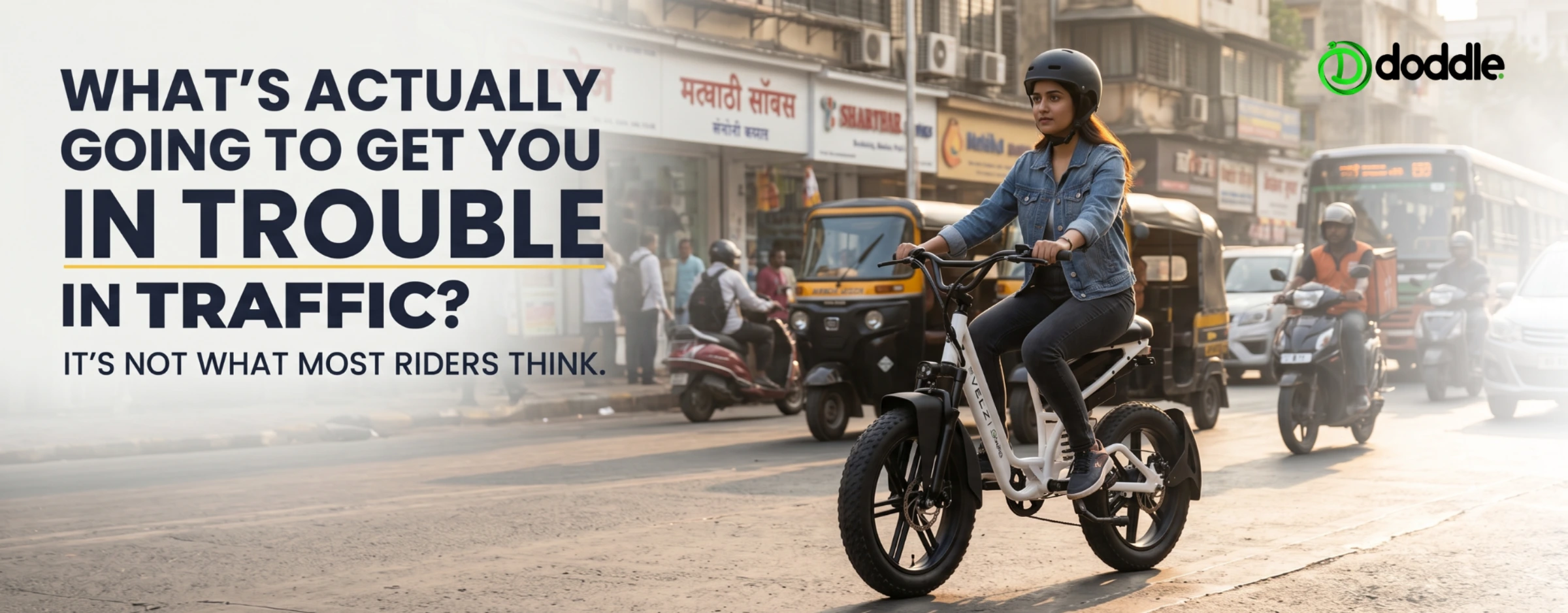
Why Electric Bicycle Safety in Indian Traffic Deserves More Attention in 2026
Electric bicycle adoption across India has surged at an extraordinary pace. By early 2026, more than 2.8 million e-cycles are estimated to be in daily use across Indian cities – from the gridlocked corridors of Mumbai’s Western suburbs to the rapidly expanding commuter networks of Tier 2 cities like Indore, Coimbatore, and Bhubaneswar. This growth brings immense opportunity – and an urgent need for rider education.
Electric bicycle riders occupy a unique and often misunderstood position in Indian traffic. Faster than conventional cycles, quieter than petrol two-wheelers, and more agile than cars, e-cycles move through urban traffic in ways that neither road infrastructure nor fellow commuters are always prepared for. Without the right safety habits, this agility can quickly become a liability.
India recorded over 4.61 lakh road accidents in 2023 – a figure that continues to rise as urban traffic density increases. Two-wheeler and cycle riders account for a disproportionate share of casualties, particularly in metro cities where speed differentials, distracted driving, and poor lane discipline combine into dangerous daily conditions.
Whether you are a daily office commuter in Bengaluru, a college student in Jaipur, or a delivery professional clocking 70 km per day in Pune, these 10 rules – developed from Doddle‘s deep understanding of Indian urban riding – will help you ride your electric bicycle with confidence, control, and safety every single day.
Why Does an Electric Bicycle Need Its Own Safety Rules Beyond a Regular Cycle?
Electric bicycle riders often assume that the safety instincts developed on a conventional pedal cycle transfer directly to an e-cycle. They do not – at least not completely. E-cycles introduce a set of dynamics that fundamentally change how a rider must think, react, and position themselves in traffic.
The key differences that make e-cycle-specific safety awareness essential:
• Higher baseline speed: E-cycles travel at 20–25 km/h without pedalling effort, closing gaps with vehicles faster than new riders anticipate
• Silent operation: Pedestrians and road users cannot hear an approaching electric bicycle, removing one of the most natural traffic safety cues
• Heavier build: A fully assembled e-cycle weighs 20–28 kg – significantly more than a conventional cycle – affecting braking distance and cornering feel
• Throttle sensitivity: Accidental throttle engagement at low speeds causes sudden forward movement, a common source of minor incidents for first-time riders
• Extended braking distance: At 25 km/h with a loaded e-cycle, the stopping distance is meaningfully longer than most new riders instinctively judge
According to Doddle‘s 2026 India EV insights, nearly 35% of minor e-cycle incidents among first-year urban riders involve underestimated braking distance or the bike’s silent approach catching other road users off guard. Deliberate habit-building from day one is the most effective safety investment any rider can make.
The 10 Essential Rules for Riding an Electric Bicycle Safely in Indian City Traffic
Rule 1: Always Wear a Helmet – Even for Short Rides
Electric bicycle safety begins before you mount the bike. Helmet adoption among urban e-cycle riders in India remains critically low – surveys suggest fewer than 15% wear one consistently in 2026. Yet most serious head injuries occur within 5 km of home, during familiar routes where alertness naturally drops. No commute is short enough to skip this single most important step.
An ISI-certified helmet costs between ₹800 and ₹2,500 and absorbs the energy of a typical urban fall or low-speed intersection collision – exactly the kind of incident most common in city riding. It is the highest-return safety investment available to any rider at any price point.
• Choose an ISI-marked full-face or half-face helmet with ventilation suited to Indian summers
• Ensure a snug, level fit – a loose helmet provides significantly reduced protection in a fall
• Replace every 3–5 years or immediately after any significant impact, even without visible damage
Rule 2: Make Yourself Visible – Especially at Dawn, Dusk, and During Monsoon
Electric bicycle riders are among the hardest road users to see in Indian urban traffic – smaller than cars, frequently in blind spots, and nearly invisible during the low-light conditions of early-morning commutes, overcast monsoon afternoons, and evening rush hours.
Visibility is active safety. Outfit yourself and your bike to be clearly seen from all directions at all times:
• Front white LED light (minimum 200 lumens) and rear red LED taillight – verify before every dawn or night ride
• Reflective ankle bands, vest, or jacket strips – visible from 150+ metres in vehicle headlights
• Avoid all-dark clothing during monsoon and evening rides
• Use your horn or bell proactively at pedestrian crossings, blind corners, and gaps between parked vehicles
Doddle‘s Velzi electric bicycle comes standard with front and rear LED lighting designed for Indian visibility conditions – built in, not bolted on as an afterthought.
Rule 3: Master Your Braking Distance Before Riding in Traffic
Electric bicycle braking dynamics differ meaningfully from both conventional cycles and petrol bikes. New e-cycle riders consistently underestimate how much road they need to stop safely at urban speeds – and this gap between expectation and reality is where many preventable incidents occur.
At 25 km/h on a dry road, a loaded e-cycle with rider requires approximately 5–8 metres to stop fully with quality disc brakes. On wet or gravelled roads – both common across Indian cities during and after monsoon – add 30–50% to that figure. That is the equivalent of three parked cars’ worth of empty road ahead before you engage the brakes.
• Practice emergency stops in a safe, open space before your first city commute
• Apply both brakes simultaneously – front provides stopping power, rear prevents rear-wheel skidding
• Increase following distance behind all vehicles during monsoon months and at speeds above 20 km/h
• Never grab brakes sharply – apply firm, progressive pressure, particularly on wet surfaces
Doddle‘s advanced dual disc brake system is calibrated specifically for Indian urban riding – delivering consistent, confident stopping power in both dry summer heat and wet monsoon conditions, giving riders the mechanical foundation to build safe braking habits.
Rule 4: Claim Your Lane – Ride Assertively, Not Along the Edge
Electric bicycle riders across India habitually hug the extreme left edge of the road, assuming it is the safest position. In reality, it is frequently the most hazardous. The leftmost strip of most Indian urban roads is a concentrated obstacle course: open drains, gravel, parked autos stopping without warning, sudden pedestrian entries, and delivery vehicles blocking access with zero indication.
Assertive lane positioning – approximately 1 to 1.5 metres from the left kerb in moving traffic – makes you visible to drivers around you, reduces exposure to roadside hazards, and signals clearly to other road users that you occupy your share of the road and expect appropriate space.
• Ride in a straight, consistent line – lateral weaving is one of the leading causes of rear-end incidents involving cyclists
• In slow-moving traffic, position yourself where car drivers can see you in their wing mirrors
• At intersections, never position alongside large vehicles – buses and trucks have substantial blind zones and wide turn radii
Rule 5: Never Enter a Truck or Bus’s Blind Spot
Electric bicycle riders must understand that buses, trucks, and heavy commercial vehicles have blind spots extending several metres to the left, right, and directly behind them. Within these zones, you are completely invisible to the driver – regardless of your visibility gear, your lights, or your horn.
Indian cities remain heavily reliant on large commercial vehicles, and most urban roads still lack dedicated cycling infrastructure. At busy intersections where heavy vehicles are turning, the inside of the turning arc is one of the highest-risk positions any e-cycle rider can occupy.
• Rule of thumb: if you cannot see the driver’s face in their mirror, they cannot see you
• At red lights, position clearly ahead of or behind large vehicles – never alongside
• Allow significantly more space than you think necessary when a bus or truck indicates a turn
Rule 6: Use Hand Signals Clearly and Early
Electric bicycle models in India typically do not carry built-in electronic indicators, making hand signals the primary communication tool between you and surrounding traffic. In India’s dense, unpredictable urban environment, clear and early signals dramatically reduce the risk of being struck during lane changes and turns.
• Signal 5–7 seconds before turning or changing lanes – not mid-manoeuvre as you begin to move
• Extend your arm fully and hold the signal until you actually begin the turn
• Where possible, make eye contact with the driver behind you before signalling
• In heavy traffic, combine hand signals with your horn or bell for maximum awareness
Rule 7: Manage Your Speed – Throttle Discipline Is a Skill
Electric bicycle throttle response is immediate and smooth – a large part of the riding appeal, but also a source of risk for riders who have not developed deliberate speed discipline. In congested urban traffic, modulating speed precisely – gentle acceleration through gaps, smooth coasting, controlled deceleration – is as important as any other riding technique.
Indian metro roads average 18–28 km/h during peak hours. Riding at your e-cycle’s 25 km/h top speed in stop-and-go conditions means constantly closing on vehicles ahead, increasing reaction time pressure and braking frequency. Matching traffic flow – not outrunning it – is both safer and significantly more battery efficient.
• Use pedal assist mode in dense traffic for finer speed control than full throttle allows
• Reserve full throttle for open stretches with clear sightlines ahead
• Slow to near-walking pace before entering crowded intersections, even when signals are in your favour
Rule 8: Scan Constantly for Indian Urban Road Hazards
Electric bicycle riders in India face a set of road hazards largely absent from riding guides written for other markets. Indian urban roads demand constant visual scanning, early identification, and adaptive response at all times.
• Unmarked or poorly lit speed breakers: approach at 90 degrees and reduce speed well in advance
• Open drains and manholes: especially dangerous at night and when submerged during monsoon
• Loose gravel near construction zones: reduce speed and avoid sudden braking or steering corrections
• Monsoon waterlogging: avoid riding through water deeper than 10 cm even with IP65-rated components
• Auto-rickshaws braking without warning: maintain a 2-car-length buffer in busy lanes
• Stray animals and cattle: slow down gradually, do not swerve – brake gently and pass wide
Rule 9: Ride Without Distractions – Phones, Earphones, and Fatigue Are Invisible Hazards
Electric bicycle riders face growing distraction pressures in 2026 – navigation apps, delivery platform notifications, music, and the constant stimulation of city life. Unlike car drivers enclosed in a protective body, e-cycle riders have no passive protection at any speed. A single distracted moment at 20 km/h can result in a serious injury.
Riding with both earphones is particularly hazardous. E-cycles are already near-silent – blocking ambient audio removes one of your most important safety inputs: approaching vehicles, emergency sirens, and warning horns. This concern is growing sharply across Indian metros as younger, digitally connected riders adopt e-cycles in large numbers.
• Mount your phone on the handlebar for navigation – configure your route before moving
• Use a maximum of one earbud at low volume – never block both ears in traffic
• Stop and rest if fatigued – impaired reaction time at 20 km/h is dangerous
• Set notifications to silent while riding – delivery pings can wait until you are stationary
Rule 10: Maintain Your Electric Bicycle Regularly – Safety Depends on Mechanical Reliability
Electric bicycle safety is inseparable from the mechanical condition of the bike. Worn brake pads extend stopping distance. Under-inflated tyres reduce grip on wet roads. An ageing battery delivers inconsistent power at critical moments. Regular maintenance is not optional – it is a fundamental safety practice.
Doddle‘s advanced battery technology ensures stable, consistent power delivery across all charge levels – but even the best engineering requires regular upkeep from the rider. A basic monthly check takes under 10 minutes and prevents the majority of mechanical safety failures.
• Check tyre pressure monthly – correct PSI is printed on the tyre sidewall (typically 40–65 PSI)
• Test both brakes before every ride – levers should engage firmly within half their travel range
• Inspect brake pads every 3 months – replace when worn below 2mm (₹300–₹600 per set)
• Confirm all lights function before dawn, dusk, or night rides
• Annual professional service: ₹1,500–₹3,000 at an authorised Doddle service centre
Your 60-Second Pre-Ride Safety Checklist
Run through this before every single ride – it takes less than a minute and prevents the majority of avoidable incidents:
• Helmet on and buckled securely
• Front and rear lights functioning (essential for dawn, dusk, and monsoon conditions)
• Both brakes tested and engaging firmly
• Tyre pressure within the recommended range
• Battery charge sufficient for planned route plus a 10–15% buffer
• Phone mounted on handlebar – navigation set before moving
• Reflective gear on if riding in low-light conditions
People Also Ask
Is it safe to ride an electric bicycle in heavy Indian city traffic?
Yes – with the right habits, an electric bicycle is safe in Indian city traffic. Essential practices include wearing a helmet, using front and rear lights, maintaining safe following distances, riding assertively in lane rather than on the extreme left edge, and staying clear of large vehicle blind spots. Speed discipline and regular bike maintenance are equally important to everyday safety.
Do I need special safety gear to ride an electric bicycle in India?
At minimum, every e-cycle rider needs an ISI-certified helmet (₹800–₹2,500), functioning front and rear LED lights for low-light riding, and reflective strips or a vest for visibility. Delivery professionals and long-distance commuters should also consider padded cycling gloves, knee guards, and a high-visibility jacket for daily use.
What is the safest speed for riding an electric bicycle in Indian city traffic?
In congested traffic, 15–20 km/h is the practical safe speed. On clear urban roads with good sightlines, 25 km/h – the legal ceiling for a 250W e-cycle – is appropriate. Always reduce to near-walking pace at busy intersections, school and market zones, monsoon-affected roads, and anywhere pedestrian density is high.
How should I ride an electric bicycle safely during monsoon in India?
Reduce speed by at least 30%, increase following distance significantly, avoid sudden braking on wet surfaces, and ride at walking pace through any waterlogged section. Doddle’s Velzi carries IP65-rated electrical protection that handles rain safely – but avoid water deeper than 10 cm. Always test brakes before riding after heavy overnight rain.
What are the most common electric bicycle accidents in Indian cities?
The most frequent e-cycle incidents involve: (1) intersection collisions with vehicles running late signals, (2) falls on waterlogged or gravelled surfaces, (3) dooring incidents near parked vehicles, and (4) low-speed rear contacts in stop-and-go traffic. Prevention focuses on predictable riding, early hazard scanning, consistent signalling, and reliable lighting.
Do I need a licence to ride an electric bicycle in India?
No. Electric bicycles with motor output up to 250W and a top speed of 25 km/h are classified as non-motorised vehicles under Indian law. No driving licence, vehicle registration, or road insurance is required. However, all general traffic rules – stopping at signals, yielding to pedestrians, not riding against traffic – apply fully to e-cycle riders.
Ride Smart, Ride Safe – Every Single Day
Electric bicycle riding in India’s urban landscape is one of the most practical, economical, and environmentally responsible commuting choices available in 2026. It reduces costs dramatically, navigates congested traffic more efficiently than most four-wheelers, eliminates fuel price anxiety, and contributes to cleaner air in cities that need it urgently. These benefits are fully realised only when riders approach every journey with consistent knowledge, preparation, and genuine safety discipline.
The 10 rules in this guide are not abstract precautions. They are the practical daily habits of experienced urban e-cycle riders who navigate Indian roads safely – across Hyderabad’s busy flyovers, the narrow lanes of Ahmedabad’s old city, the monsoon-soaked streets of Kolkata, and every road in between.
At Doddle, we believe that building a safer e-cycle culture across India is as important as building better e-cycles. Every bike we design incorporates features that directly support these safety habits – dual disc brakes calibrated for Indian road conditions, reliable LED lighting, IP65 electrical protection for monsoon riding, and stable frame geometry engineered for confident handling in slow, dense urban traffic.
Your safety is not an afterthought. It is the foundation of every great ride. Follow these rules, inspect your bike regularly, and approach Indian roads with the alertness and confidence they deserve.
Ready to ride with confidence? The Doddle Velzi – engineered for Indian roads and Indian riders – is available at doddle.in. Start your urban commuting journey on the safest, smartest terms possible.