
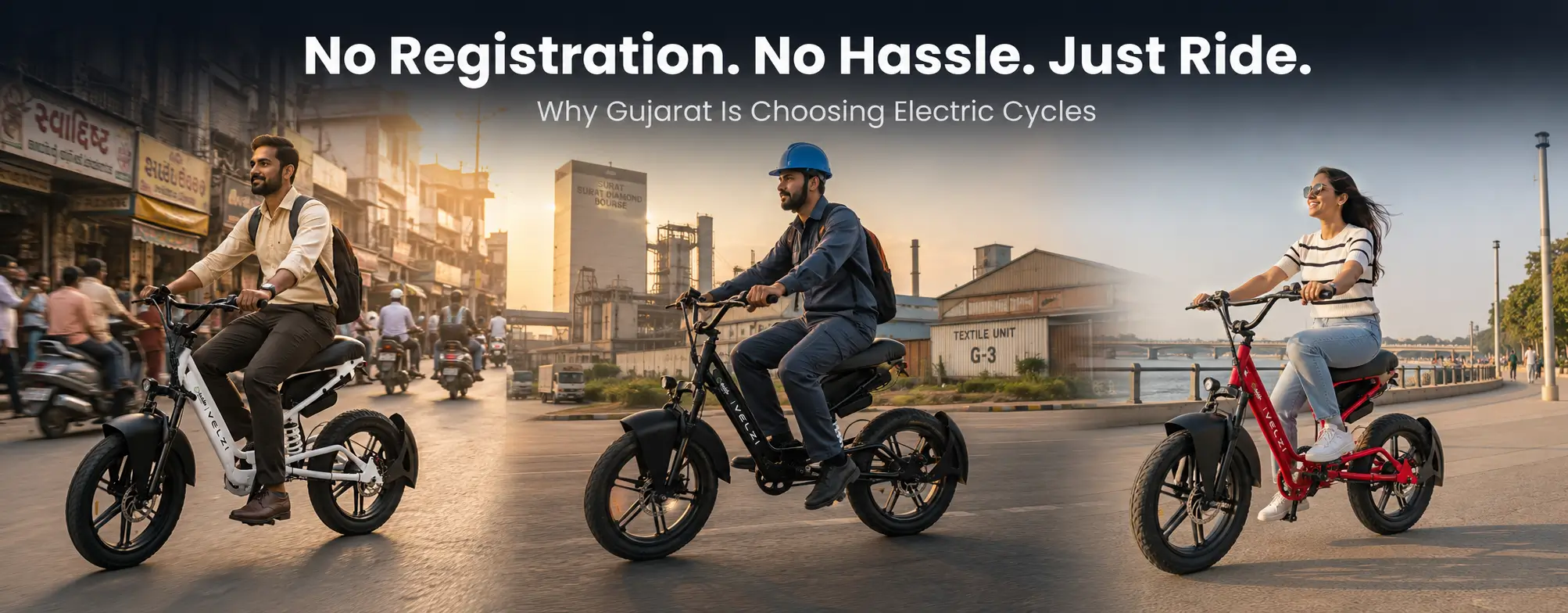
Gujarat has one of the highest adoption rates of battery-operated two-wheelers of any state in India, backed by an EV policy that’s been in place since 2021. But most articles covering “EV subsidies in Gujarat” lump electric scooters, electric motorcycles, and electric cycles together – which leads to a lot of confused buyers expecting a subsidy check that was never meant for their category. Here’s an accurate breakdown of what actually applies to an electric cycle in Gujarat, and why Ahmedabad and Surat are leading the state’s shift toward this kind of everyday commuting.
Quick answer: Gujarat’s direct EV purchase subsidies apply to registered electric two-wheelers (e-scooters and e-motorcycles) based on battery capacity in kWh. Low-speed electric cycles like Velzi – capped at 250W and 25 km/h – don’t need RTO registration in the first place, so they’re not part of the subsidy scheme, but they also skip registration fees, road tax, and licensing entirely, which is a more immediate day-one saving than a one-time subsidy.
What Gujarat’s EV Policy Actually Covers
The Gujarat EV Policy, first announced in 2021 and reinforced through the Gujarat Two Wheeler Scheme and the central government’s PM E-DRIVE scheme, offers demand-side incentives calculated per kWh of battery capacity for registered electric two-wheelers, three-wheelers, and four-wheelers. These are real, meaningful incentives – but they’re structured around vehicles that go through RTO registration, since the subsidy is disbursed against a registered purchase.
Why Electric Cycles Work Differently – and That’s a Good Thing
An electric cycle like Velzi, with a 250W motor and a top speed capped at 25 km/h, falls under India’s low-speed electric vehicle category. This means it doesn’t require RTO registration, a number plate, a driving licence, or mandatory insurance – not because it’s excluded from EV benefits, but because it was never part of the registration system those subsidies are built around.
In practical terms, this works out better for day-to-day ownership than chasing a subsidy application:
| What Registered EVs Get | What Electric Cycles Get Automatically |
| Subsidy per kWh (after application/approval) | No registration fee to pay in the first place |
| Road tax exemption (state-dependent) | No road tax applicable at all |
| Requires licence and RTO paperwork | No licence or RTO process needed |
| Insurance often recommended/required | Not mandatory |
For most riders, skipping the entire registration and licensing process on day one is a bigger practical win than waiting on a subsidy disbursement for a vehicle category that requires that paperwork to begin with.
Why Ahmedabad and Surat Are Leading Adoption
Gujarat’s overall EV two-wheeler adoption is among the highest in India, and Ahmedabad and Surat are the two cities driving most of that momentum – for different reasons. Ahmedabad’s dense mix of residential and commercial zones, older congested markets, and a growing IT and business commuter base make it a strong fit for short-to-medium daily commutes. We’ve covered Ahmedabad’s specific commute conditions in detail in our dedicated Ahmedabad guide.
Surat, meanwhile, is shaped by its diamond and textile industry workforce – large numbers of daily commuters travelling fixed routes between residential areas and industrial units, often across shift timings where a predictable, low running cost matters more than raw speed. Our dedicated Surat guide goes deeper into what that looks like on the ground.
Together, these two cities represent the two commuter profiles an electric cycle serves best in Gujarat: the urban daily commuter, and the industrial shift worker.
The Real Cost Advantage in Gujarat
With petrol prices in Gujarat regularly above ₹94–96 per litre or even ₹100+ , the ongoing running-cost gap between a petrol two-wheeler and an electric cycle adds up quickly regardless of any subsidy:
| Cost Factor | Petrol Two-Wheeler | Electric Cycle |
| Running cost per km | ₹3.5–5 | Under ₹0.50 |
| Monthly cost (12 km/day) | ₹2,500–3,500 | ₹120–250 (electricity only) |
| Registration & road tax | Applicable | Not applicable |
| Licence required | Yes | No |
Choosing an Electric Cycle Built for Gujarat’s Roads
Whether you’re commuting through Ahmedabad’s older city lanes, Surat’s industrial belt, or anywhere in between, Velzi’s 20×4 fat tyres and full suspension are built to handle uneven surfaces and daily wear without needing the registration and compliance overhead of a faster, registered EV. It’s a category built for exactly this kind of everyday, no-paperwork commuting.
Why Velzi Fits This Category for Gujarat
Velzi’s design is built for exactly the commuting patterns both Ahmedabad and Surat represent:
- 85 km real-world range on pedal-assist (enough for 2–3 days of commuting before needing to charge)
- Full suspension (front fork + rear mono shock) + 20×4 fat tyres for handling potholes and uneven surfaces
- Removable 48V 13Ah battery for safe, flexible charging at home or office
- 5 riding modes (pedal, pedal-assist, cruise, throttle, walk-assist) for different commute situations
- No registration, no road tax, no licence needed — day-one savings start immediately
For industrial shift workers or daily urban commuters, this means reliable, paperwork-free commuting at a fraction of petrol cost.
See how Velzi fits for Gujarat commute?
Explore Doddle’s Ahmedabad guide → | Explore Doddle’s Surat guide → | Book a free demo ride →
Frequently Asked Questions
Do electric cycles qualify for Gujarat’s EV subsidy?
No. Gujarat’s direct EV subsidies apply to registered electric two-wheelers and are calculated by battery capacity. Low-speed electric cycles, which don’t require RTO registration, fall outside this scheme – but they also skip registration fees, road tax, and licensing entirely.
Do I need a licence to ride an electric cycle in Gujarat?
No. Electric cycles with a motor under 250W and a top speed of 25 km/h are classified as low-speed EVs and don’t require a driving licence or RTO registration anywhere in India, including Gujarat.
Why is Gujarat considered a leading state for EV adoption?
Gujarat has one of the highest adoption rates of battery-operated two-wheelers in India, supported by a state EV policy in place since 2021 and strong central incentives like PM E-DRIVE for registered electric vehicles.
Which Gujarat cities are seeing the most electric cycle adoption?
Ahmedabad and Surat are currently leading, driven by Ahmedabad’s dense urban commute patterns and Surat’s large industrial and textile workforce commuting fixed daily routes.
Is an electric cycle cheaper to run than a petrol two-wheeler in Gujarat?
Yes. With petrol prices in Gujarat regularly above ₹94–96 per litre, an electric cycle’s running cost of under ₹0.50 per km is significantly lower than a petrol two-wheeler’s ₹3.5–5 per km.
#ElectricCycleIndia #GujaratEV #AhmedabadTech #SuratStartup #EVIncentives #FatTyreEBike #IndianYouth #UrbanMobility #ElectricVehicles #SustainableTransport #CycleLife #ElectricIndia