
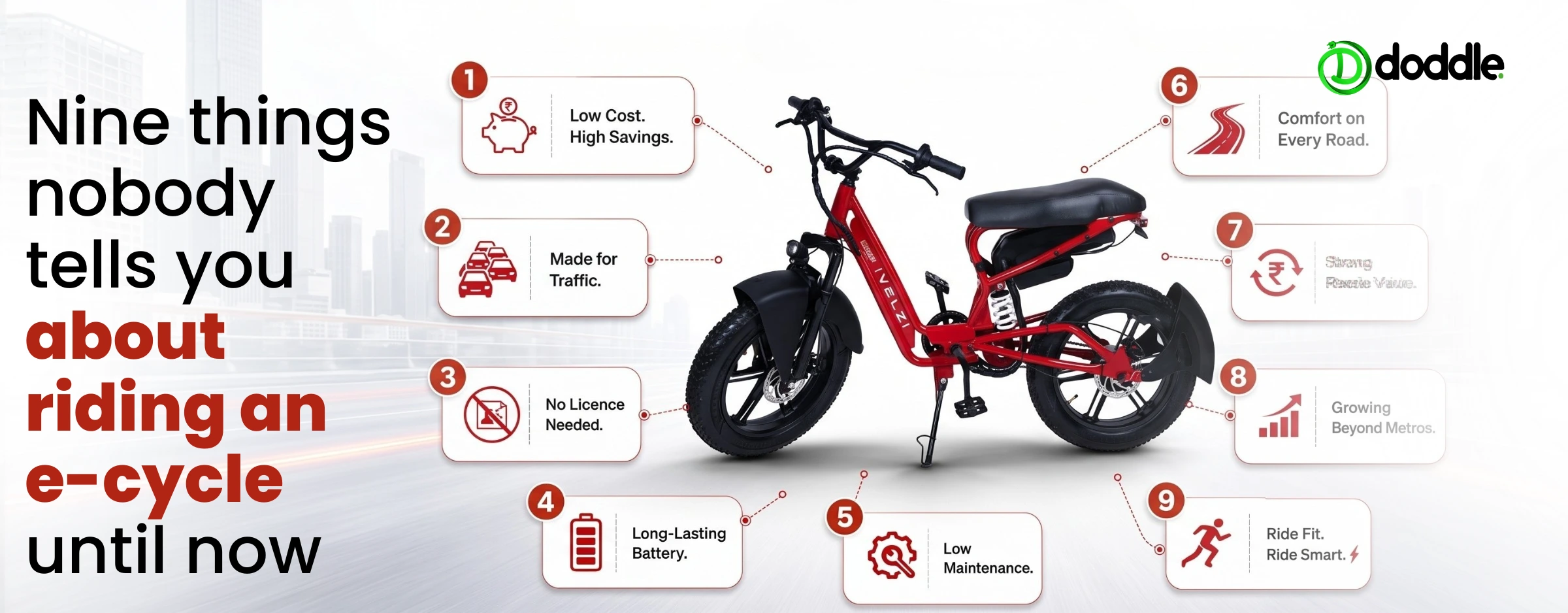
Electric cycles on city roads are no longer a novelty – they’re fast becoming the smartest commuting choice for millions of Indians. Whether you’re a student navigating campus traffic, a delivery professional racing against time, or simply someone tired of skyrocketing fuel bills and gridlocked streets, the electric cycle is quietly rewriting the rules of urban mobility.
But for every enthusiastic early adopter, there are dozens of riders who jumped in without knowing the full picture. At Doddle, we’ve spent years speaking with real urban commuters, and we keep hearing the same things: “I wish someone had told me this before I bought it.”
So here it is – nine honest, practical, and often-overlooked truths about riding an electric cycle on city roads in India, starting with the things most brands and reviews conveniently skip.
1. Your Real Running Cost Is Shockingly Lower Than You Think
Electric cycles on city roads cost a fraction of what most people expect to run. While a petrol two-wheeler can cost anywhere between ₹3,000–₹5,000 per month in fuel alone (based on 2026 fuel prices hovering around ₹110–₹115 per litre), a fully charged electric cycle averages just ₹10–₹20 per charge.
For a daily commute of 20–30 km, that translates to a monthly electricity bill of roughly ₹150–₹300 – sometimes less. Over a year, you’re looking at savings of ₹30,000–₹55,000 compared to petrol, not counting servicing costs.
According to a 2023 NITI Aayog perception survey, 75% of EV buyers in India cited fuel savings as their primary motivation – and in 2026, with fuel prices at an all-time high, that figure is likely even higher.
2. City Traffic Is Actually Where Electric Cycles Shine Brightest
Electric cycles on city roads aren’t just acceptable – they’re purpose-built for exactly this environment. Unlike highways where petrol vehicles have a clear range advantage, city riding involves constant stop-and-go, short bursts of speed, and frequent braking. This is where electric motors are most efficient.
Regenerative braking (available on several modern e-cycle models) converts braking energy back into battery charge, extending your range naturally. In dense urban grids like Mumbai’s western suburbs, Bengaluru’s HSR Layout, or Hyderabad’s Hitech City corridors, an electric cycle can comfortably handle 40–70 km on a single charge – more than enough for a typical day.
According to Doddle’s 2026 India EV insights, the average daily urban commute in Indian metro cities is between 18–25 km, meaning most riders return home each evening with battery to spare.
3. You Don’t Need a Licence or Registration for Many E-Cycles
This surprises almost everyone. Electric cycles on city roads that are classified as “low-speed” – under 25 km/h and with a motor output of 250W or less – are legally treated as bicycles under Indian motor vehicle law. That means no registration, no driving licence, and no insurance mandate.
This makes them especially attractive for:
- Students without a driving licence
- Delivery professionals who want lower regulatory hassle
- Senior citizens looking for assisted mobility
- First-time riders cautious about traffic rules
Higher-speed models (above 25 km/h) do require registration and a valid licence, similar to electric scooters. Always confirm your model’s classification at the time of purchase to understand your legal obligations clearly.
4. Battery Life Is Longer Than You’ve Been Led to Believe
Electric cycles on city roads often get unfairly dismissed because people assume battery replacement is an imminent, expensive headache. The reality in 2026 is considerably better.
Most modern lithium-ion batteries used in quality electric cycles are rated for 800–1,200 full charge cycles. If you charge your cycle once a day, that’s 2–3 years of daily use before you see any significant degradation. Even then, the battery typically retains 70–80% of its original capacity – still very usable for city commutes.
When replacement does become necessary, a standard lithium-ion battery pack for an electric cycle costs between ₹8,000–₹20,000 depending on capacity and brand.
Doddle’s advanced battery technology ensures thermal management and smart charging protection are built in, dramatically reducing premature degradation caused by heat – a crucial factor for Indian summers where temperatures regularly exceed 40°C.
5. Maintenance Costs Are Dramatically Lower (With One Caveat)
Electric cycles on city roads have far fewer moving parts than petrol two-wheelers. There’s no engine oil to change, no spark plugs, no carburettor, no complex gearbox. Routine servicing for an electric cycle typically costs between ₹300–₹800 per visit, compared to ₹800–₹2,000 for a petrol bike.
Typical annual maintenance expenses for an e-cycle in India (2026 estimates):
| Component | Average Annual Cost |
| Tyre replacement | ₹600–₹1,200 |
| Brake pad replacement | ₹300–₹600 |
| Chain/belt servicing | ₹200–₹500 |
| General checkup | ₹600–₹1,500 |
| Total | ₹1,700–₹3,800 |
Compare this to a petrol two-wheeler’s annual maintenance of ₹5,000–₹12,000+ and the savings are hard to ignore.
The caveat: Always buy from a brand with a reliable service network. At Doddle, we design our after-sales support to be accessible not just in metros but across Tier 2 and Tier 3 towns – because an EV is only as good as the support behind it.
6. Riding Comfort on Broken Indian Roads Is Better Than Expected
Electric cycles on city roads built for the Indian market are engineered differently from their European or Chinese counterparts. Indian urban infrastructure presents a unique challenge: speed bumps every 50 metres, waterlogged roads during monsoons, potholed by-lanes, and unpredictable traffic.
The best electric cycles for Indian city roads come equipped with:
- Front suspension forks to absorb shocks from bad roads
- Fat or semi-fat tyres (2.0–2.4 inches) for better grip and stability
- Low step-through frames for easy mounting, especially for women and seniors
- Ergonomic saddles designed for longer commutes
If you’re evaluating comfort before purchase, always test-ride on a route similar to your actual commute – including the worst stretch of road you encounter daily.
7. The Resale Market for Quality E-Cycles Is Growing Fast
Electric cycles on city roads from reputable brands are beginning to hold their value surprisingly well. India’s EV sector is expanding at a 49% CAGR between 2022 and 2030, according to NITI Aayog, and as demand grows, so does the secondary market.
A quality electric cycle bought today for ₹25,000–₹45,000 can typically be resold after two years for 50–65% of its original value – especially if the battery has been well-maintained and the frame shows minimal wear. Branded models with active service networks command a premium in resale because buyers trust the after-sales availability.
This makes an electric cycle a genuinely smart financial asset, not just a transportation expense.
8. Tier 2 and Tier 3 Cities Are the Real Growth Story
Most EV conversations in India focus on metro cities – Delhi, Mumbai, Bengaluru, Pune. But electric cycles on city roads are arguably making their biggest impact in smaller urban centres.
In cities like Nagpur, Coimbatore, Indore, Lucknow, Jaipur, and Surat, average commuting distances are shorter, incomes are growing, and the appetite for affordable, low-maintenance transport is enormous. India’s EV adoption is spreading rapidly beyond metros, signalling a broader social and economic shift that is reshaping how Bharat moves.
At Doddle, we specifically build our distribution and service network to reach beyond the top eight metros – because India’s next 200 million riders aren’t in Bandra or Koramangala. They’re in Nashik, Varanasi, Mysuru, and Rajkot, and they deserve the same quality of EV experience.
9. Riding an Electric Cycle Is a Fitness Choice Too – Not Just a Transport One
Electric cycles on city roads offer something petrol scooters simply cannot – the option to pedal. Pedal-assist (PAS) technology lets you choose how much effort you put in. Crank up the assist for a breezy commute, or dial it down and get a genuine low-impact workout during your daily ride.
This matters more than most people realise. Urban Indians are increasingly health-conscious, and cycling has been linked to improved cardiovascular fitness, reduced stress, and better mental well-being. The beauty of an e-cycle is that it removes the barrier of exhaustion – you don’t arrive at work drenched in sweat, but you still move your body.
For students, working professionals, and seniors alike, the pedal-assist model offers the perfect balance: exercise when you want it, electric assist when you need it.
The Bottom Line
Riding an electric cycle on city roads in India in 2026 is one of the most practical, cost-effective, and environmentally responsible decisions you can make as an urban commuter. The technology is mature, the savings over a petrol two-wheeler are substantial, and the riding experience has never been better engineered for Indian conditions.
The nine truths above aren’t reasons to hesitate – they’re the full picture that empowers you to make a confident, informed choice.
Ready to experience the difference for yourself? Explore the Doddle Velzi – engineered for Indian city roads, built for real Indian riders.
Frequently Asked Questions (FAQ)
What is the mileage of an electric cycle on a single charge?
Most quality electric cycles designed for Indian city roads offer a range of 40–70 km per charge, depending on battery capacity, rider weight, road conditions, and assist level. For average urban commutes of 18–25 km per day, one charge typically lasts 2–3 days.
How much does it cost to charge an electric cycle in India?
Charging an electric cycle costs approximately ₹10–₹20 per full charge at standard home electricity rates in India (2026). This makes the monthly running cost roughly ₹150–₹300 for daily commuters – significantly cheaper than petrol.
Do I need a licence to ride an electric cycle on Indian roads?
Electric cycles with a motor output of 250W or below and a top speed of 25 km/h or less are exempt from registration, insurance, and licence requirements under Indian law. Higher-powered models require a valid licence and registration.
How long does an electric cycle battery last before needing replacement?
A lithium-ion battery in a quality electric cycle is typically rated for 800–1,200 charge cycles, which translates to 2–3 years of daily use. Battery replacement in India currently costs between ₹8,000–₹20,000 depending on the brand and capacity.
Is an electric cycle suitable for Indian roads and weather conditions?
Yes. Electric cycles designed for the Indian market feature suspension forks, wider tyres, and weatherproofed electrical components to handle India’s diverse road conditions – including monsoon-season roads, speed bumps, and unpaved stretches common in Tier 2 and Tier 3 cities.
How does a Doddle electric cycle reduce commuting costs?
Doddle’s electric cycles run on just ₹10–₹20 worth of electricity per charge, replacing ₹3,000–₹5,000 in monthly petrol expenses. Combined with low annual maintenance costs of ₹1,700–₹3,800, riders typically save over ₹40,000 per year compared to owning a petrol two-wheeler.