
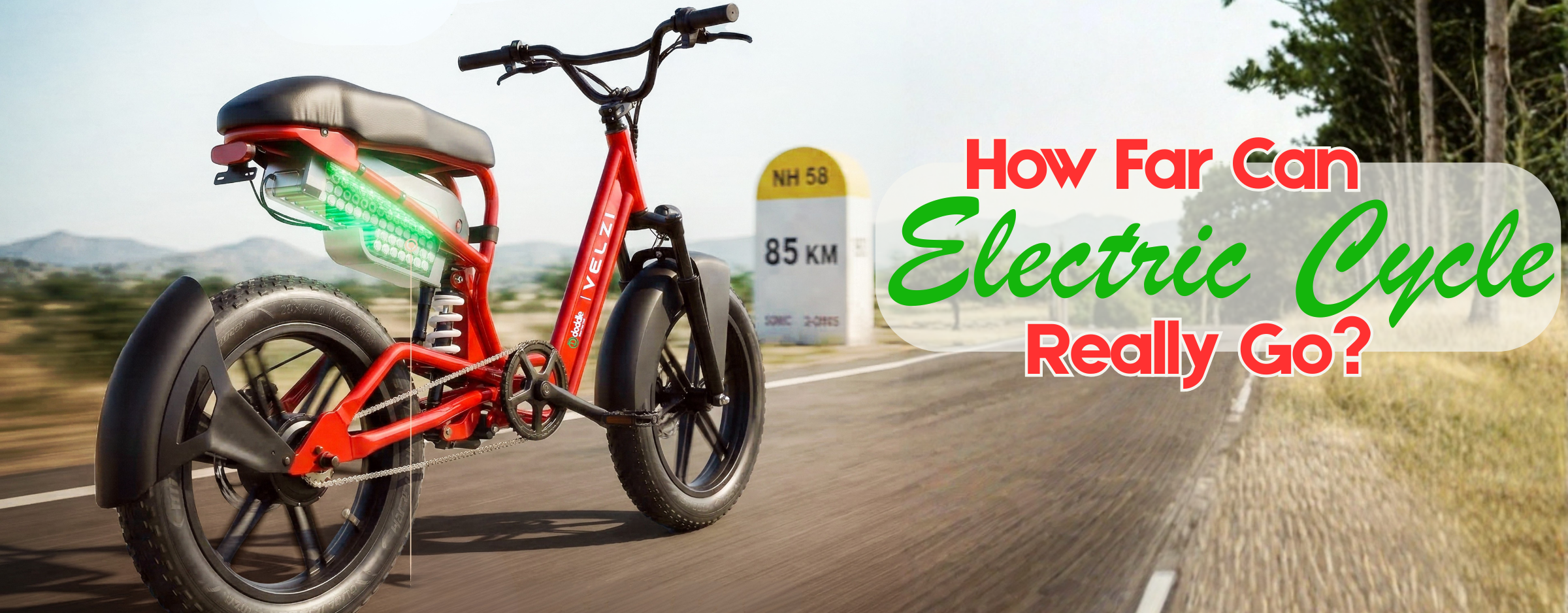
Electric cycle range is the number that sells bikes – and the number that confuses buyers the most. You see “80 km range” printed on a spec sheet and imagine riding from your home in Bhopal to a friend’s place 75 km away without a single stop. Then real life arrives: traffic in Indore’s Vijay Nagar, a climb through uneven lanes, a 40°C May afternoon, and suddenly the display is dropping faster than expected.
This guide cuts through the marketing fog. Whether you’re a daily commuter, a student, a delivery professional, or an eco-conscious rider exploring India’s shift to clean mobility – by the end of this article, you’ll know exactly what an 80 km range claim means in real-world Indian conditions, what actually drains your battery, and how to get the most out of every charge.
And if you’re looking for an electric cycle engineered honestly for Indian roads, take a look at the Doddle Velzi – a purpose-built EV cycle for Indian commuters.
Why Do Claimed and Real-World Electric Cycle Ranges Differ?
Electric cycle range as stated by manufacturers is measured under ideal, controlled laboratory conditions – not on the pothole-ridden, traffic-heavy, heat-soaked roads of everyday India.
Testing is typically conducted on flat surfaces, at optimal temperatures (around 20–25°C), at a constant moderate speed, and with a rider of standard weight. None of these conditions describe a typical Indian commute in 2026.
For an average Indian user, factoring in typical driving patterns on diverse roads, real-world range is generally 20–30% lower than officially stated figures. For electric cycles specifically, real-world range is typically 60–80% of claimed figures, depending on terrain, rider weight, and riding mode.
So when a manufacturer says 80 km, a grounded, honest expectation for most Indian riders is 50–65 km in mixed real-world conditions.
That’s still an excellent range for daily commuting – but understanding why the gap exists helps you plan better, ride smarter, and choose the right model.
What Is the Science Behind Electric Cycle Range?
Electric cycle range is determined by one fundamental formula:
Range (km) = Battery Energy (Wh) ÷ Energy Consumption (Wh/km)
Let’s break that down practically:
- Battery energy is calculated by multiplying voltage (V) × amp-hours (Ah). A 36V 10Ah battery holds 360 Wh of energy. A 48V 10Ah battery holds 480 Wh.
- Energy consumption varies widely. Typical e-bike consumption varies from 8 Wh/km (light rider, flat terrain, pedal assist) to 25 Wh/km (heavy rider, hilly terrain, throttle only). A reasonable average for Indian conditions is 15 Wh/km.
Using that average:
- A 36V 10Ah battery (360 Wh) ÷ 15 Wh/km = ~24 km on throttle alone, or 40–50 km with pedal assist
- A 48V 12Ah battery (576 Wh) ÷ 15 Wh/km = ~38 km on throttle, or 60–75 km with pedal assist
- A 48V 15Ah battery (720 Wh) ÷ 15 Wh/km = ~48 km on throttle, or 75–90 km with pedal assist
This is why higher-capacity batteries and consistent use of pedal-assist mode are the two biggest levers for maximising real-world electric cycle range in India.
What Factors Reduce Electric Cycle Range in Indian Conditions?
Electric cycle range in India is affected by a combination of factors that are far more extreme than what most global manufacturers account for in their testing:
1. Rider Weight and Load
Every additional kilogram requires more energy to move. A 90 kg rider on a delivery run with a 10 kg bag will consume noticeably more energy per kilometre than the 70 kg rider a manufacturer tests with. For delivery professionals in Mumbai or Hyderabad, carrying loaded bags consistently across 60–80 km daily runs will reduce effective range by 10–20%.
2. Terrain and Road Conditions
Uphill stretches, speed breakers, rough surfaces, and constant stop-and-go traffic in Indian cities all increase energy consumption significantly. Continuous uphill, muddy surfaces, and stop-and-go cycles cause dramatic range drops. Delhi’s flyover networks, Pune’s hills, and Mumbai’s traffic signals all affect battery drain differently.
3. Speed and Riding Mode
Using full throttle mode at maximum speed drains the battery far faster than riding in eco or pedal-assist mode at a moderate pace. The difference is dramatic – riding at 20 km/h in pedal-assist mode can deliver nearly double the range compared to throttle-only riding at 25 km/h.
4. Temperature – India’s Hidden Range Killer
Heat is one of the most underappreciated factors in Indian EV performance. Elevated temperatures can expedite chemical processes inside the battery, resulting in accelerated breakdown of internal components. For each 10°C increase in temperature, the battery’s useful life may be reduced significantly. In cities like Nagpur, Jaipur, and Hyderabad where summer temperatures routinely cross 42–45°C, battery performance and range can be noticeably affected compared to manufacturer test conditions.
5. Battery Age and State of Health
Battery State of Health (SoH) is a percentage indicating a battery’s current capacity versus its original factory capacity. A new battery starts at 100% SoH. As it ages through charging cycles and calendar aging, SoH gradually decreases. After 2–3 years of regular use, a battery at 85% SoH will deliver approximately 85% of its original range – meaning an 80 km claimed range becomes closer to 68 km even under ideal conditions.
6. Tyre Pressure
Under-inflated tyres increase rolling resistance and quietly drain your battery. This is especially relevant for fat tyre models where maintaining correct pressure is essential for efficiency.
How Does Riding Mode Affect Electric Cycle Range?
Electric cycle range varies dramatically based on which riding mode you use – and most Indian riders don’t fully utilise this to their advantage.
Here’s a practical range breakdown for a mid-range 48V 12Ah electric cycle (576 Wh battery) under Indian conditions:
| Riding Mode | Estimated Real-World Range |
| Full throttle only | 30–40 km |
| Pedal-assist Level 3 (high) | 45–55 km |
| Pedal-assist Level 2 (medium) | 55–70 km |
| Pedal-assist Level 1 (eco) | 65–80 km |
| Manual pedalling (motor off) | Unlimited |
The lesson is clear: using pedal-assist rather than throttle-only riding can nearly double your effective range. For Indian commuters covering 15–25 km each way, eco and medium assist modes make complete sense – you arrive at work with a gentle workout and plenty of battery remaining.
According to Doddle’s 2026 India EV insights, over 70% of our riders who switched from throttle-heavy riding to consistent pedal-assist mode reported a 30–40% improvement in their daily range – without changing their battery or any hardware.
What Does 80 km Range Actually Mean for an Indian Commuter?
Electric cycle range of 80 km claimed on a spec sheet translates to this in real Indian life:
For a metro city commuter (Delhi, Bengaluru, Mumbai): Dense traffic, frequent stops, summer heat, and mixed terrain mean you’ll realistically achieve 50–60 km in urban riding. For a 20 km daily commute, that’s 2–3 days of riding per charge – completely practical and requires charging just every 2–3 evenings.
For a Tier 2 city rider (Jaipur, Indore, Coimbatore, Vadodara): Roads are typically less congested and speeds more consistent. Pedal-assist efficiency is better used. Realistic range: 55–65 km per charge, covering a 25 km commute comfortably for 2 days on a single charge.
For a delivery professional (last-mile logistics): High daily mileage (60–100 km), loaded delivery bags, and city stop-start conditions. Realistic range: 45–55 km per charge, meaning one recharge mid-shift or at base. Fast-charging capability (if supported) becomes an important selection criterion.
For a student: Short campus or city commute of 8–15 km daily. An 80 km claimed range e-cycle may only need charging once or twice a week. Range anxiety is essentially non-existent.
At Doddle, we design our electric cycles with transparent range expectations built into our product communication – because a customer who understands what they’re buying will always be a happier, more confident rider.
How Can You Maximise Electric Cycle Range in India?
Electric cycle range can be actively managed and improved through smart riding habits and good battery care – no hardware changes needed.
Riding habits that extend range:
- Use pedal-assist over throttle-only wherever possible – the single biggest range extender available
- Maintain a steady speed rather than accelerating hard and braking repeatedly
- Anticipate stops – coast to traffic signals rather than braking hard at the last moment
- Ride in eco mode for regular commutes; reserve higher assist for hills and headwinds
- Check tyre pressure weekly – correct inflation reduces rolling resistance significantly
Battery care habits that protect long-term range:
- Lithium batteries last longest when kept between 20% and 80–90% charge. Charging to 100% every time accelerates cell degradation. Only charge to 100% when you need maximum range for a long ride.
- Always use the manufacturer-supplied charger or a certified equivalent
- Avoid leaving the battery fully discharged for extended periods
- Store at 40–60% charge if the cycle will be unused for weeks. Store in a cool, dry place at around 20°C.
- Avoid charging immediately after a long ride in peak summer heat – let the battery cool for 20–30 minutes first
Doddle’s advanced battery technology incorporates a smart Battery Management System (BMS) that handles cell balancing, thermal monitoring, and overcharge protection automatically – reducing battery degradation and preserving range over the long ownership period.
How Long Does an Electric Cycle Battery Last Before Replacement in India?
Electric cycle range degrades gradually over time as battery capacity diminishes through charge-discharge cycles. Here’s what Indian riders can realistically expect in 2026:
A typical lithium-ion e-bike battery lasts 500–1,000 full charge cycles or 3–5 years with average use. Premium models with advanced BMS reach 5–7 years or 1,000–2,000 cycles.
For an Indian commuter charging every 2–3 days, that translates to:
- Charging ~150–180 times per year
- Battery reaching 80% capacity retention after approximately 3–4 years of regular use
Battery replacement costs in India (2026 estimates):
| Battery Capacity | Replacement Cost (₹) |
| 36V 10Ah lithium-ion pack | ₹6,000 – ₹9,000 |
| 48V 10Ah lithium-ion pack | ₹9,000 – ₹13,000 |
| 48V 12Ah–15Ah pack | ₹12,000 – ₹18,000 |
These costs have decreased significantly as domestic lithium-ion manufacturing scales up in India, and are expected to continue falling through 2028 as battery supply chains mature further.
How Much Does It Cost to Charge an Electric Cycle in India?
Electric cycle range per charge is even more impressive when you calculate the cost of that charge:
A typical 48V 12Ah battery (576 Wh) draws approximately 0.6–0.7 units (kWh) of electricity per full charge from empty.
At India’s 2026 residential electricity rates of approximately ₹6–₹9 per unit (varying by state and consumption slab):
- Cost per full charge: ₹4 – ₹7
- Cost per km (at 55 km real-world range): ₹0.07 – ₹0.13
Compare this to petrol at ₹105–₹115 per litre, with a scooter delivering 40–50 km/litre:
- Cost per km on petrol: ₹2.10 – ₹2.88
Over a 25 km daily commute, that’s a monthly saving of approximately ₹1,500 – ₹2,200 in fuel costs alone – a compelling argument for any Indian household budget in 2026.
People Also Ask
Q: What is the real-world range of an electric cycle in India?
Real-world electric cycle range in India is typically 60–80% of the claimed figure. An e-cycle claiming 80 km will realistically deliver 50–65 km in Indian urban conditions, factoring in traffic, summer heat, terrain, and riding mode. Pedal-assist mode significantly improves real-world range compared to throttle-only riding.
Q: What battery capacity do I need for a 30 km daily commute in India?
For a 30 km daily commute, a 48V 10Ah battery (480 Wh) is sufficient for most Indian riders using pedal-assist mode. For heavier riders, delivery use, or hilly terrain, a 48V 12Ah–15Ah battery (576–720 Wh) provides a comfortable buffer and covers 2–3 days of riding per charge.
Q: Why does my electric cycle show less range than advertised?
Manufacturer range claims are measured in controlled lab conditions – flat terrain, optimal temperature, lighter test rider, constant speed. Indian real-world conditions including stop-start traffic, summer heat (35–45°C), variable terrain, rider weight, and cargo all reduce effective range. Switching from throttle-only to pedal-assist mode is the most effective way to recover lost range.
Q: How long does an electric cycle battery last in India before needing replacement?
A quality lithium-ion electric cycle battery lasts 500–1,000 charge cycles, or approximately 3–5 years of regular daily use for an Indian commuter charging every 2–3 days. Battery replacement costs ₹6,000–₹18,000 depending on capacity, and prices are declining as domestic manufacturing scales up.
Q: How much does it cost to charge an electric cycle in India per km?
Charging an electric cycle costs approximately ₹4–₹7 per full charge in India at 2026 electricity rates, delivering a per-km cost of ₹0.07–₹0.13. This compares to ₹2.10–₹2.88 per km for a petrol scooter at current fuel prices.
Q: Does heat affect electric cycle range in India?
Yes, significantly. High summer temperatures (40–45°C) common across North, Central, and coastal India can reduce battery efficiency and range compared to manufacturer test conditions performed at ~20–25°C. Parking your e-cycle in shade, avoiding charging immediately after long rides in peak heat, and choosing a model with thermal management in the BMS all help mitigate heat-related range loss.
Conclusion: The Range Number That Truly Matters
Electric cycle range printed on a brochure is a starting point, not a promise. The number that actually matters to you is your daily commute distance – and whether a single charge comfortably covers it, with real-world conditions factored in.
For most Indian commuters covering 15–30 km per day, a mid-range electric cycle with a 48V 10Ah–15Ah battery delivers 2–4 days of riding per charge, even after accounting for heat, traffic, and terrain. That makes daily charging unnecessary, range anxiety largely irrelevant, and the financial case for switching from petrol to electric undeniable.
The key is choosing a cycle with an honest battery specification, a quality BMS that protects your cells long-term, and a brand that tells you the truth about what your range will actually look like on Indian roads.
That’s exactly the commitment Doddle brings to every rider.
👉 Explore the Doddle Velzi electric cycle– built for real Indian roads, with a range that delivers where it matters most.