
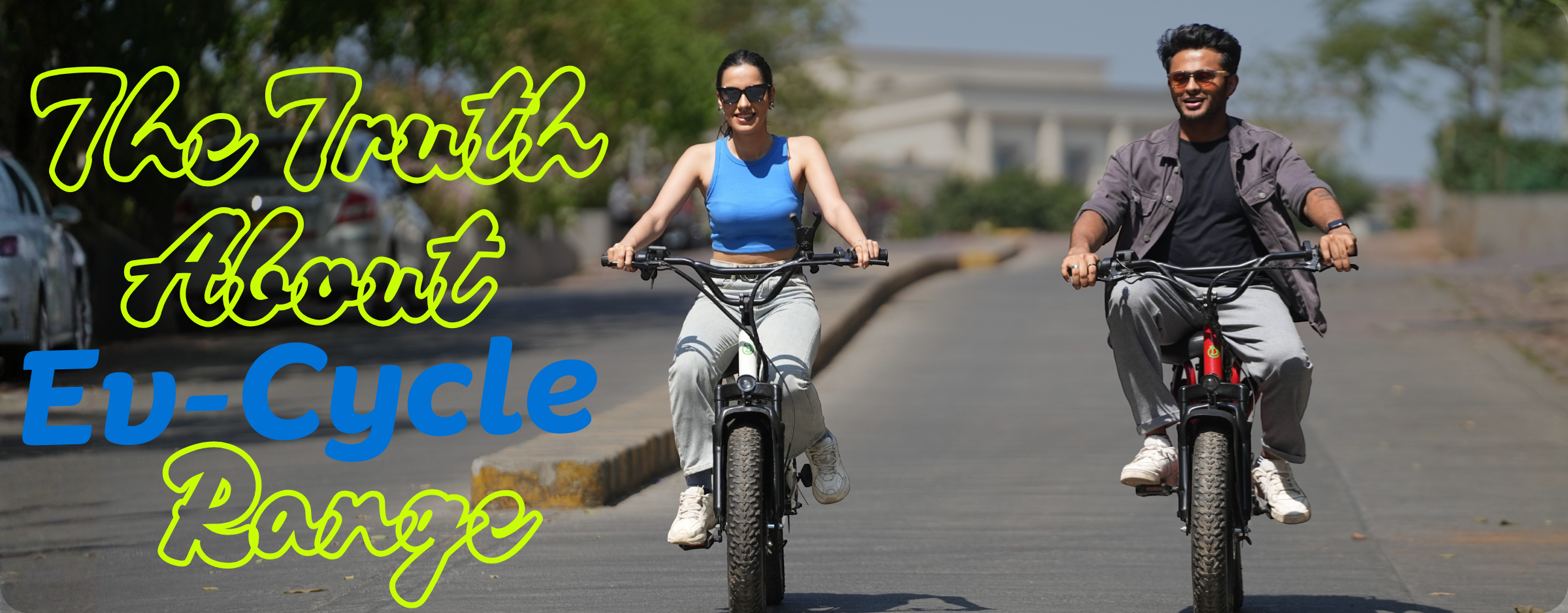
Electric cycles are no longer a novelty in India – they are the daily ride of choice for millions of urban commuters, college students, delivery riders, and eco-conscious professionals. One question, though, comes up every single time someone is thinking about making the switch: “How far can it actually go on one charge?”
It is a fair question. Range anxiety is real, especially when you are navigating Mumbai’s western suburbs, Bengaluru’s ORR, or the narrower but equally busy roads of Surat, Nashik, or Coimbatore. The answer depends on more factors than most people realise – and the real-world numbers in India are often very different from what you read on spec sheets.
This article breaks it all down honestly. We tested how Indian roads, weather, rider weight, riding modes, and traffic patterns affect the range of an electric cycle – and what you can realistically expect from your daily commute. For a deeper technical breakdown of how the Velzi handles these conditions, you can explore the Doddle Velzi knowledge hub, which covers battery management, riding modes, and maintenance in detail.
What Does “Range on a Single Charge” Actually Mean?
Electric cycle range refers to the total distance a fully charged battery can cover before it needs to be plugged in again. Most manufacturers quote a range figure – say, 80 km – but that number is usually calculated under ideal lab conditions: flat road, constant speed of around 25 km/h, no wind, a rider weighing 65–70 kg, and pedal assist mode switched on.
Real life in India looks nothing like that.
Your actual range depends on a mix of factors that are very specific to Indian roads and riding habits. Understanding these factors is the first step to getting the most out of your electric cycle every single day.
Why Do Real-World Range Numbers Differ from Manufacturer Claims?
Electric cycle range figures from manufacturers are a starting point, not a guarantee. Here is why the gap between claimed and real-world range exists in Indian conditions:
Road surface quality plays a massive role. Pothole-laden roads, speed bumps every 200 metres, and uneven tarmac force the motor to work harder, draining the battery faster. A smooth highway ride can extend range by 15–20% compared to a congested city road with frequent starts and stops.
Rider weight is another key variable. A 90 kg rider will see roughly 10–15% less range compared to a 65 kg rider on the same cycle, same battery, same route. This is not a flaw – it is basic physics.
Speed has a disproportionate impact on range. Riding consistently at 30–35 km/h uses significantly more battery per kilometre than cruising at 20–22 km/h with pedal assist. Most Indian commuters, especially in city traffic, naturally ride at lower speeds – which actually works in their favour for range.
Temperature and weather also matter in India more than most people expect. Lithium-ion batteries perform slightly below their best in extreme heat (above 42°C) or during cold northern winters (below 8°C). During peak Indian summer months, you may notice a 5–8% reduction in range. Parking your cycle in shade and avoiding charging immediately after a long sunny ride helps.
Pedal assist vs throttle-only mode is the biggest range variable. Using pedal assist – where you contribute leg power and the motor supplements it – can extend your range by 30–40% compared to riding purely on throttle. Most riders in India use a combination of both depending on the stretch of road.
How Far Does a Doddle Electric Cycle Actually Go on Indian Roads?
At Doddle, we design our electric cycles specifically for Indian road realities, not just benchmark lab conditions. The Velzi comes equipped with a 624Wh removable lithium-ion battery paired with a smooth 250W hub motor.
Here is what real-world range looks like across different Indian riding scenarios:
| Riding Condition | Estimated Real-World Range |
| Flat city road, pedal assist mode, 65 kg rider | 70–80 km |
| Mixed city traffic, stop-and-go, pedal assist | 55–65 km |
| Throttle-only mode, no pedalling, flat road | 40–50 km |
| Hilly terrain or heavy rider (90 kg+), throttle-only | 30–40 km |
| Highway stretch at constant 30 km/h, pedal assist | 75–85 km |
For the average Indian commuter covering 12–20 km per day (the typical one-way office or college distance in a metro or Tier 2 city), even the most conservative real-world range means you are charging the Velzi once every 2–3 days – not every single day.
That changes the economics and convenience calculation significantly.
Which Factors Give You the Best Range in Indian Conditions?
You do not need to be an engineer to get the most range from your electric cycle. A few simple habits make a measurable difference:
- Use pedal assist mode on flat stretches and save throttle for uphill climbs or when you are tired. This single habit can add 15–20 km to your daily range.
- Keep tyre pressure right. Fat tyres like the 20×4 tyres on the Velzi perform best at the recommended PSI. Under-inflated tyres increase rolling resistance and cut range noticeably.
- Charge to 80–90% for daily use. Unless you need the full range, avoid charging to 100% every single day. It is a well-established battery health practice that extends your battery’s lifespan significantly.
- Avoid full discharge. Letting the battery drop to near zero regularly degrades cells faster. Plug in when you hit around 20%.
- Ride at steady speeds. Aggressive acceleration followed by sudden braking wastes energy. Smooth, consistent riding – especially in pedal assist – is the most range-efficient style.
How Does Indian Terrain and City Traffic Affect Electric Cycle Range?
India’s geography and urban planning create a uniquely varied riding environment. Let us look at how range plays out across different Indian contexts:
Metro Cities (Mumbai, Delhi, Bengaluru, Hyderabad, Chennai)
Stop-and-go traffic is the dominant pattern. Frequent braking and re-acceleration are hard on range. However, slower average speeds (15–20 km/h in peak hours) actually reduce the aerodynamic drag that kills range at higher speeds. Most metro commuters using an electric cycle in throttle-plus-assist mode can comfortably expect 50–65 km per charge in real city conditions.
Tier 2 and Tier 3 Cities (Nashik, Surat, Indore, Jaipur, Coimbatore, Ludhiana)
These cities often offer a better range scenario than metros. Roads are less congested, average speeds are slightly higher (but not excessive), and rides are more linear. Real-world range in these cities typically reaches 65–75 km per charge, making an electric cycle an exceptionally practical daily vehicle.
Semi-Urban and Peri-Urban Commutes
Towns on the outskirts of larger cities – places like Thane, Gurugram, Noida fringe areas, Whitefield’s outer zones – often combine open roads with moderate traffic. These conditions are close to ideal for electric cycles, and riders regularly report range figures at or near the manufacturer’s claimed maximum.
What Is the Real Running Cost of an Electric Cycle in India?
Electric cycles are not just green – they are genuinely economical. Here is a realistic 2026 cost breakdown for Indian riders:
Charging cost per full cycle: The Velzi’s 624Wh battery costs approximately ₹5–₹7 per full charge at an average Indian electricity tariff of ₹8–₹9 per unit. That translates to a running cost of roughly ₹0.08–₹0.12 per kilometre – compared to ₹3.50–₹4.50 per km for a petrol two-wheeler.
Annual fuel savings: A commuter riding 20 km per day saves approximately ₹25,000–₹35,000 per year switching from petrol to an electric cycle.
Servicing costs: Electric cycles have far fewer moving parts than petrol vehicles. There is no engine oil, no spark plugs, no clutch cable. Annual maintenance for an electric cycle in India typically runs between ₹1,500–₹3,500, compared to ₹6,000–₹12,000 for a petrol two-wheeler.
Battery replacement: Lithium-ion batteries in quality electric cycles are designed to last 3–5 years or 500–800 charge cycles before significant capacity degradation. A replacement battery for the Velzi is estimated at ₹8,000–₹12,000 in 2026 – a one-time cost spread across years of use.
According to Doddle’s 2026 India EV insights, riders who switch from a petrol bike to a Doddle electric cycle typically recover the full purchase cost within 18–24 months purely through fuel and maintenance savings.
How Does Battery Technology Affect Electric Cycle Range in 2026?
Battery technology has moved faster than most people realise. The lithium-ion cells in 2026 electric cycles are substantially more energy-dense than those from just three years ago. This means more range from a lighter, more compact battery pack.
Doddle’s advanced battery technology ensures the Velzi’s 624Wh removable pack maintains consistent output across its charge cycle – you do not experience a dramatic drop in performance in the last 20% of charge, which is a common complaint with older or cheaper battery systems.
The removable battery design is also practically significant for Indian riders. You can charge the battery at your desk, in your college hostel room, or at a café – without needing a charging point near a parking spot. For apartment dwellers in Mumbai, Delhi, or Chennai where ground-floor parking is shared and socket access is limited, this is not a minor feature. It is the feature.
Is an Electric Cycle Practical for Delivery Professionals in India?
Delivery riders – one of the fastest-growing segments of India’s urban economy – have unique range requirements. A Swiggy, Zomato, Blinkit, or Dunzo delivery partner in a metro city typically covers 60–100 km per shift, often across congested inner-city zones.
An electric cycle with 55–70 km of real-world range comfortably handles a single shift. Delivery professionals who invest in a second battery pack (or work with employers who offer battery swapping) can extend their operational range across a full day without a mid-shift break.
The low running cost is transformative for gig economy workers. At ₹6–₹7 per charge versus ₹150–₹200 in daily petrol for a two-wheeler, an electric cycle saves a delivery rider approximately ₹3,500–₹4,500 per month – money that stays in their pocket.
What Do Riders Across India Say About Real-World Range?
Actual rider experiences from across India consistently tell the same story: the real-world range is good enough for daily life, and the savings are immediate and visible.
Rahul, an IT professional from Hissar, Haryana, covers a 14 km daily commute. He charges the Velzi every third day and describes the running cost as “almost invisible.” Vaibhav from Alibaug, Maharashtra, uses his Velzi for errands across a wider rural-urban stretch and consistently gets 60+ km per charge. Dharampal from Palwal, Haryana, credits the cycle with bringing back the joy of riding after years of fighting petrol costs.
These are not outliers. They reflect the lived experience of Indian riders using their electric cycles in conditions that spec sheets never account for.
People Also Ask
Q: How far can an electric cycle travel on one charge in India?
A: Most quality electric cycles in India travel between 50–80 km on a single charge under real-world conditions. The exact range depends on rider weight, road type, speed, temperature, and whether pedal assist is used. The Doddle Velzi, for example, delivers 55–80 km depending on riding conditions.
Q: How much does it cost to charge an electric cycle in India?
A: Charging a 624Wh electric cycle battery costs approximately ₹5–₹7 at standard Indian residential electricity tariffs. This works out to around ₹0.08–₹0.12 per kilometer – a fraction of the cost of petrol.
Q: How long does an electric cycle battery last before replacement?
A: A good-quality lithium-ion battery in an electric cycle lasts 3–5 years or 500–800 charge cycles. Battery replacement in India costs between ₹8,000–₹12,000 for a standard 600Wh pack.
Q: Does an electric cycle work well in Indian cities?
A: Yes. Electric cycles are particularly well-suited to Indian city conditions – low average speeds, short daily commutes, and crowded roads all work in favor of electric cycle efficiency and range. Most urban Indian commuters charge their electric cycle every 2–3 days.
Q: Does heat affect an electric cycle’s battery range in India?
A: Yes, extreme heat above 42°C can reduce battery range by 5–8%. Keeping the cycle parked in shade, avoiding charging immediately after a hot ride, and storing the battery away from direct sunlight helps maintain optimal performance year-round.
Q: Is an electric cycle good for delivery work in India?
A: Absolutely. With 55–70 km of real-world range per charge and a daily running cost of ₹6–₹7, electric cycles offer significant savings for delivery professionals. A gig worker switching from a petrol two-wheeler can save ₹3,500–₹4,500 per month.
The Bottom Line: Range Is More Than Enough for Real Indian Life
The real-world range of a quality electric cycle in India – 55–80 km depending on conditions – is not just adequate. For the vast majority of Indian commuters, students, and delivery professionals, it is more than enough.
The average Indian urban commute is under 20 km one-way. The average daily errand circuit in a Tier 2 city rarely crosses 40 km. When you match these real travel patterns against realistic electric cycle range, the result is clear: you are charging every few days, spending ₹5–₹7 per charge, and saving thousands of rupees every month compared to petrol.
At Doddle, we believe that a great electric cycle should fit your life without asking you to rethink your daily routine. The Velzi was built precisely with that philosophy – Indian roads, Indian commutes, Indian riders.
If you want to understand exactly how the Velzi’s battery, motor, and riding modes work together to deliver consistent real-world range, visit the Doddle Velzi knowledge hub for a complete technical and practical breakdown.
The switch to electric is not a compromise. In 2026 India, it is simply the smarter way to ride.